

A follow-on to “The AI Valuation Lever for Legacy Assets in PE.” That piece was about what sponsors, portfolio companies, and boards can build. This one is about what buyers have already started testing for, and where the two no longer meet.
In the last piece I argued that AI has become one of the few genuine sources of EBITDA a sponsor can still create inside a hold period, and that converting a legacy asset toward AI-native should be run like a synthetic acquisition: data foundation first, two or three EBITDA-anchored use cases, AI in the product the customer touches, AI fluency in the org chart. I stand by that. But there is a second half to the story the sell side is underpricing, and it is the more dangerous one.
While operating teams were learning to build the AI narrative, the buy side quietly rewrote the test they grade it against. The question a sophisticated buyer asks is no longer whether an asset is AI-enabled. It is whether the asset is AI-defensible. Those are not the same question, they do not have the same answer, and the gap between them is where the next round of markdowns is going to happen.
The buy-side already institutionalized the test.
In Bain’s 2026 M&A survey of dealmakers, 75% of strategic acquirers said they had assessed the impact of AI on a target’s business, and AI adoption in the M&A process itself more than doubled to roughly 45% of practitioners. The AI assessment has moved from a bespoke exercise to a line item in the pre-acquisition review, sitting alongside QoE, legal, and tax.
The advisory infrastructure has been built to match. Union Square Advisors, which has detailed its approach in recent reporting on data-driven dealmaking, runs a formal AI assessment program it says has evaluated more than 400 companies over two years, drawing on 2,000-plus data sources per target, from patent filings to customer reviews to analyst reports. The single question that program is built to answer is the one that now precedes the investment decision: how does AI change the value and the defensibility of this asset? The second noun is the one that has changed. Buyers are no longer satisfied that AI shows up in the business; they want to know whether the AI, and the business around it, can withstand what is coming.
Walking away is now a data point, not a threat.
The old assumption was that a thin AI story cost you some multiple at the margin. That is no longer the ceiling on the downside. In the same Bain data, one in five strategic acquirers reported walking away from a deal outright because of the anticipated impact of AI on the target. Not repricing. Walking.
The reach of that test is widening fast, and although the survey captures AI’s impact broadly rather than defensibility alone, defensibility is where it concentrates. Nearly half of all technology deals now carry an AI component, up from one in four just a year earlier, so the assessment is being run on a rapidly widening share of the market. As the AI-native comp set deepens every quarter, the
buyer’s ability to distinguish real capability from a feature bolt-on sharpens, and the penalty for failing that distinction stops being a discount and becomes a closed door. A legacy asset that presents as AI-enabled but reads as undefensible under assessment is not neutral in that room; it is a walk-away risk, and increasingly a flagged one.
“AI-enabled” and “AI-defensible” are not the same asset.
This is the distinction most CIMs are still being written on the wrong side of. AI-enabled describes usage. The company runs a pricing model, has a copilot in the workflow, ships a feature with “AI” in the release notes. All of that is real, and all of it is what the last piece told you to go build. But usage is now table stakes, and table stakes do not command a premium.
AI-defensible describes durability. It turns on four things a buyer’s assessment will interrogate directly:
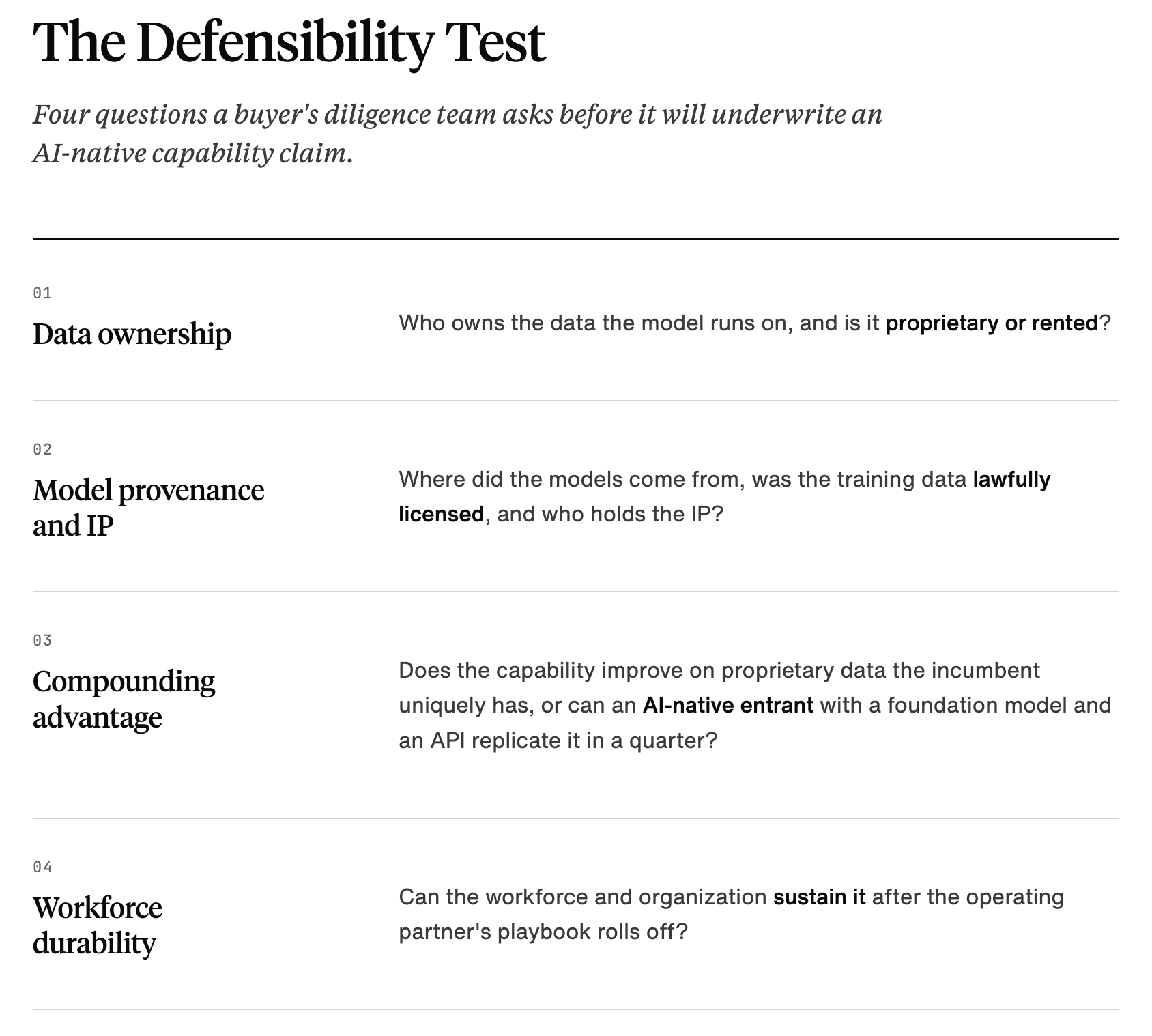
A bolt-on can be genuinely AI-enabled and completely undefensible. It passes the management deck and fails the assessment.
The synthetic acquisition has to survive an adversarial read.
This reframes the four moves from the last piece rather than replacing them. Consolidating data into a governed layer is not just plumbing for use cases; the proprietary, governed dataset is itself the moat the assessment is looking for, and the reason an AI-native competitor cannot simply out model you. Picking EBITDA-anchored use cases is still right, but the ones that defend value are the ones that compound on data only this business owns, not the ones any competitor could stand up on the same off-the-shelf tools. Embedding AI in the product still shifts the multiple rather than the margin, but only if the company owns the capability rather than reselling someone else’s API with a markup. And AI fluency in the org chart is no longer an efficiency story; it is the evidence that the capability survives contact with a new owner.
The compounding cuts against you if you wait. In early-stage venture, firms such as Orange Collective have described running AI agents to score every Y Combinator batch from the inside, building proprietary datasets that sharpen with each cohort. The same machinery is now being pointed at mature assets. Every quarter, the buy side’s ability to grade AI defensibility against an
ever-deepening reference set improves, which means the bar you have to clear is not fixed; it rises while you deliberate.
Defensibility is where the risk transfer bites.
This is not only a valuation conversation, and the part sellers like least is what happens to the risk. As buyers have gotten sharper on AI, the legal and insurance architecture has moved with them. M&A counsel now demand representations that models were trained on lawfully licensed data with disclosed open-source components and produce explainable, reproducible outputs, and because an AI company’s value lives in its models and datasets rather than its code, sellers are carrying dedicated liability caps, broader indemnities, and longer survival periods. Reps-and warranties insurers have gone further, signaling they may simply exclude the two hardest things to price: that the training data was lawfully obtained, and that the models keep performing.
The insurance market has already moved. In January 2026 the Insurance Services Office issued standard generative-AI exclusions for commercial general liability, and D&O and E&O carriers have begun stripping “silent AI” coverage from legacy policies. Where dedicated AI cover exists, pricing scales with the strength of the insured’s governance controls, which turns AI governance from a boardroom virtue into a line in the premium.
This is where a thin AI story stops being a valuation haircut and becomes a balance-sheet problem for the seller. The two promises the market will not insure are precisely the two that separate AI enabled from AI-defensible, which means a seller who built an AI story that is real in the demo but thin underneath does not just risk a lower bid; they risk carrying that exposure themselves, post-close, uninsured. Defensibility stops being a marketing question and becomes a question of who holds the liability when the model drifts or the data provenance gets tested.
The board owns the answer.
The last piece argued that governance is now diligenced, that boards are read in the data room for how seriously an asset has been governed for value. Defensibility is where that lands as a fiduciary matter. The consensus among dealmakers is that these systems work best when humans stay accountable for the outcome, not merely assisted by the tools. At board level that means the directors who own the AI agenda have to be able to answer the defensibility question themselves, not receive it as a management update: where the data comes from, what the company owns, what happens when an AI-native competitor shows up, and whether the asset would survive an adversarial assessment. A board that cannot answer those questions is not governing the asset so much as holding it.
The legacy investments that get marked up over the next 18 months will not be the ones that learned to look AI-enabled. That skill is now common, and common does not price. They will be the ones whose AI was built to survive being read by a hostile, better-instrumented buyer, because the test is no longer whether the story is told well. It is whether the asset underneath it holds.
Sources
(1) Gelila Bekele, Data-Driven Dealmaking And AI Across The Deal Lifecycle, Forbes, June 26, 2026. https://www.forbes.com/sites/gelilabekele/2026/06/26/data-driven-dealmaking-and-ai-across-the-deal-lifecycle/
(2) Bain & Company, M&A Report 2026. 75% of strategic acquirers assessed AI’s impact; one in five walked away from a deal over anticipated AI impact; AI adoption in M&A doubled to ~45%.
https://www.bain.com/insights/looking-ahead-m-and-a-report-2026/
(3) Bain & Company, Looking Back at M&A in 2025. Nearly half of technology deals now carry an AI component, up from roughly one in four in 2024. https://www.bain.com/insights/looking-back-m-and-a-report-2026/
(4) Union Square Advisors, AI Assessment program, as reported in (1). 400+ companies assessed, 2,000+ data sources per target. https://www.usadvisors.com/services/
(5) Orange Collective, as reported in (1). AI-native sourcing scoring Y Combinator batches from proprietary, compounding datasets. https://www.orangecollective.vc/
(6) Skadden, M&A in the AI Era: What Buyers Can Do to Confirm and Protect Value (2026 Insights). Reps, liability caps, and insurer treatment of AI risk. https://www.skadden.com/insights/publications/2026/2026-insights/sector spotlights/ma-in-the-ai-era
(7) Mayer Brown, Key Representations and Warranties in Tech M&A. Lawful training data, disclosed open-source, explainable and reproducible outputs. https://www.mayerbrown.com/en/insights/publications/2025/10/key representations-and-warranties-in-tech-m-and-a-critical-safeguards-for-deal-success
(8) FE International, AI M&A Trends 2026: Why Acquirers Pay Premium Multiples. AI-native premium/discount spread; 266 AI M&A deals in Q1 2026, +90% YoY. https://www.feinternational.com/blog/ai-ma-trend
(9) Fenwick, The End of “Silent AI”? Emerging AI Exclusions and Coverage Fragmentation. ISO generative-AI exclusions (CG 40 47, CG 40 48, CG 35 08), effective 2026. https://www.fenwick.com/insights/publications/end silent-ai-emerging-ai-exclusions-coverage-fragmentation-and-practical-implications
(10) Munich Re, aiSure AI performance-guarantee insurance. Premiums calculated on the robustness of the AI model, subject to technical due diligence. https://www.munichre.com/en/solutions/for-industry-clients/insure-ai.html

