

"Build or buy?" It might be the new question of the year.
The Forward-Deployed Engineer (FDE) vs. Customer Success Manager (CSM) debate is so yesterday and it's being asked everywhere: engineering about the platform, product about the roadmap, marketing about the martech stack, finance about the spend, and often the CEO about the company itself.
I won't pretend I can answer it for all of them. I never led engineering or product, and you really don't want me near the actual code. I wasn't good at it when I started, and I haven't secretly gotten better since. So I'll do the only honest thing I know: anchor on the one thing I've lived for thirty years - my customer.
That's my lens, and I'll own it's a lens, not the lens. But here's my one stubborn conviction in a world that otherwise deserves a thousand "it depends": if what you're building or buying doesn't, somewhere, touch, benefit, or improve the customer's experience; what on earth are we doing? Every function points back to the customer eventually; I just start there on purpose.
So take what follows as ideas from someone who's been in the seat, not a prescription from someone who's got it all figured out. Nobody does - the ground's moving too fast, and that's the part I love. Take what's useful, argue with the rest.
Let me start where I always start: with a signal from the market.
Last month on June 15, 2026, Salesforce signed a definitive agreement to acquire Fin for $3.6 billion. Most coverage filed it under "customer service. " That's the wrong bucket. Salesforce didn't pay $3.6 billion for a support tool. It paid $3.6 billion for a thesis: that the line between sales and post-sales has disappeared, and that whoever owns the unified, intelligent layer across the customer journey owns the next decade of go-to-market (GTM).
For most of those thirty years, I watched the customer journey get sliced into stages - each with its own team, its own tooling, its own private definition of "the truth. " The customer feels every seam: repeating themselves at each handoff, passed between teams that don't share what they know, treated like a stranger by the company they already pay. For a long time, that disjointed experience was an inconvenience you could out-run with new logos. In 2026, it's why customers leave - and that makes it a balance-sheet problem you can't. Here's the argument: you can no longer afford to run a fragmented go-to-market, and you almost certainly can't build your way to one truth fast enough. That makes "build or buy" the most consequential GTM decision your leadership team will make this year.
Let me share why......
The line is gone. The data didn't get the memo.
Go-to-market used to be a relay race. Marketing handed to sales, sales to onboarding/implementation, implementation to customer success (CS), the CS team to renewals and expansion - each handoff a baton, a system, and a gap the customer fell into. That model assumed growth came from the top of the funnel: new logos covered a multitude of sins, and if retention leaked, you tried to out-run it with bookings.
That assumption is dead. In 48 hours in May 2026, the SaaS market shed roughly $285 billion in market cap - not a correction, a repricing. The market stopped paying for growth at any cost and started paying for sustainable revenue - and that's decided after the deal closes, in the part of the journey your org chart treats as someone else's job. When the value moves post-sale, you can't run a converged motion on a fragmented system.
And the system is fragmented. I worked with a large enterprise - thousands of customers, a real data team - that had mapped roughly 200 customer signals down to 10 themes of health and risk. It still didn't matter, because the attributes behind those themes lived in four different systems, including a custom-built data warehouse, that didn't agree. The Customer Success Manager (CSM) saw one picture, the account executive (AE) another, the renewal manager a third, the executive sponsor a fourth - and by the time anyone reconciled them, the customer had already decided.
That's the real cost of fragmentation: not that you lack data, but that your data can't see itself. The fix is what I call the unified customer intelligence layer - not a dashboard, but a single, lifecycle-wide view of the customer that every team acts on at once: sales, post-sales, renewals, support, partners, even product and finance.
Watch the floor, not the headline
A company reports 103% net revenue retention (NRR). The board relaxes. But that 103% can be sitting on top of 91% gross revenue retention (GRR) - expansion from your best customers quietly masking the erosion from everyone else. NRR is the flattering headline. GRR is the floor. And the floor is where the truth lives, and where valuation is validated - or quietly exposed.
Here's why GRR is the number to watch: it's the truest measure you have of whether customers are actually getting value. GRR tracks the revenue you keep before any expansion - so when it slips, customers are telling you the value stopped landing. That makes it more than a finance metric: it's the clearest scoreboard for customer experience you'll find, the number that tells you whether the rest of the motion actually worked.
Here's the nuance I'd insist on, though: as important as GRR is - and it's one of the most important numbers you have - it's still a lagging indicator. Building your entire go-to-market to manage GRR is like steering by the rear-view mirror. Customers decide to stay or go upstream - in the moments your motion either delivers value or doesn't. Manage the leading signals along the journey; let GRR be the proof, not the plan.That's the catch. GRR erodes quietly - a point or two a year, 91 to 89 to 87 - and new logos paper over it right up until growth slows and the churn underneath catches up. That's the GRR Time Bomb. The board eventually feels it as enterprise value; your customers felt it months earlier as a relationship that stopped delivering.
And a fragmented motion makes it worse: it guarantees you find out after the decision is already irreversible. The good news is the lever runs both ways - research by Fred Reichheld of Bain & Company, cited in HBR, suggests a 5% improvement in retention can lift profit by 25% to 95%, depending on industry. Catch the leading signals early and you don't just stop a leak; you turn retained customers into your most durable source of growth. The rest of this piece is about how you actually do that.
"One team" with two cautions
If fragmentation pulls the customer apart, the obvious answer is to pull the organization together - one team, one number, one owner of the customer, all operating at scale.
Mostly right - with two cautions. The first: this isn't an org-design problem. I'm not talking about reporting lines, spans of control, or which leader owns which box on the chart. Consolidation here means aligning the motion, the focus, and the why behind the work - not redrawing the org. You can be one team in spirit without a single reorg.
The second caution is subtler. When you put retention and expansion under a single roof - and you should, because the customer doesn't care which of your teams is responsible - expansion almost always wins the attention war. It's louder, it's more fun, it shows up faster in the number. Retention is quiet. It's the absence of a bad thing, and absences don't get celebrated in QBRs.
So "one team" cannot mean "one blurred signal. " Unify the team and unify the data, but keep the retention signal and the expansion signal distinct and separately accountable inside that team. One truth about the customer; two clear-eyed disciplines acting on it. Blur them and you'll grow your expansion motion while your GRR quietly bleeds - which is exactly the trap the 103%/91% company fell into.
You need a unified customer intelligence layer. Do you build it or buy it?
Here's the scope of what that layer, your "one truth", actually requires, if you build it:
It unifies your internal picture - CRM, product telemetry, support, sentiment, and commercial terms, into one reconciled customer profile. But here's where AI changes the game: it doesn't stop at your own data. It pulls in external context - relationship signals, macroeconomic conditions, industry-specific dynamics - so you catch the customer whose internal metrics are all green but whose world is quietly turning toward a downsell or a churn. That's the leap from a traditional health score, which grades yesterday's usage, to a dynamic, AI-driven one that reads the whole field, inside and out, and acts on what it sees: surfacing risk early, routing the right intervention, running repeatable plays at scale, and syncing back into the tools your teams already live in.
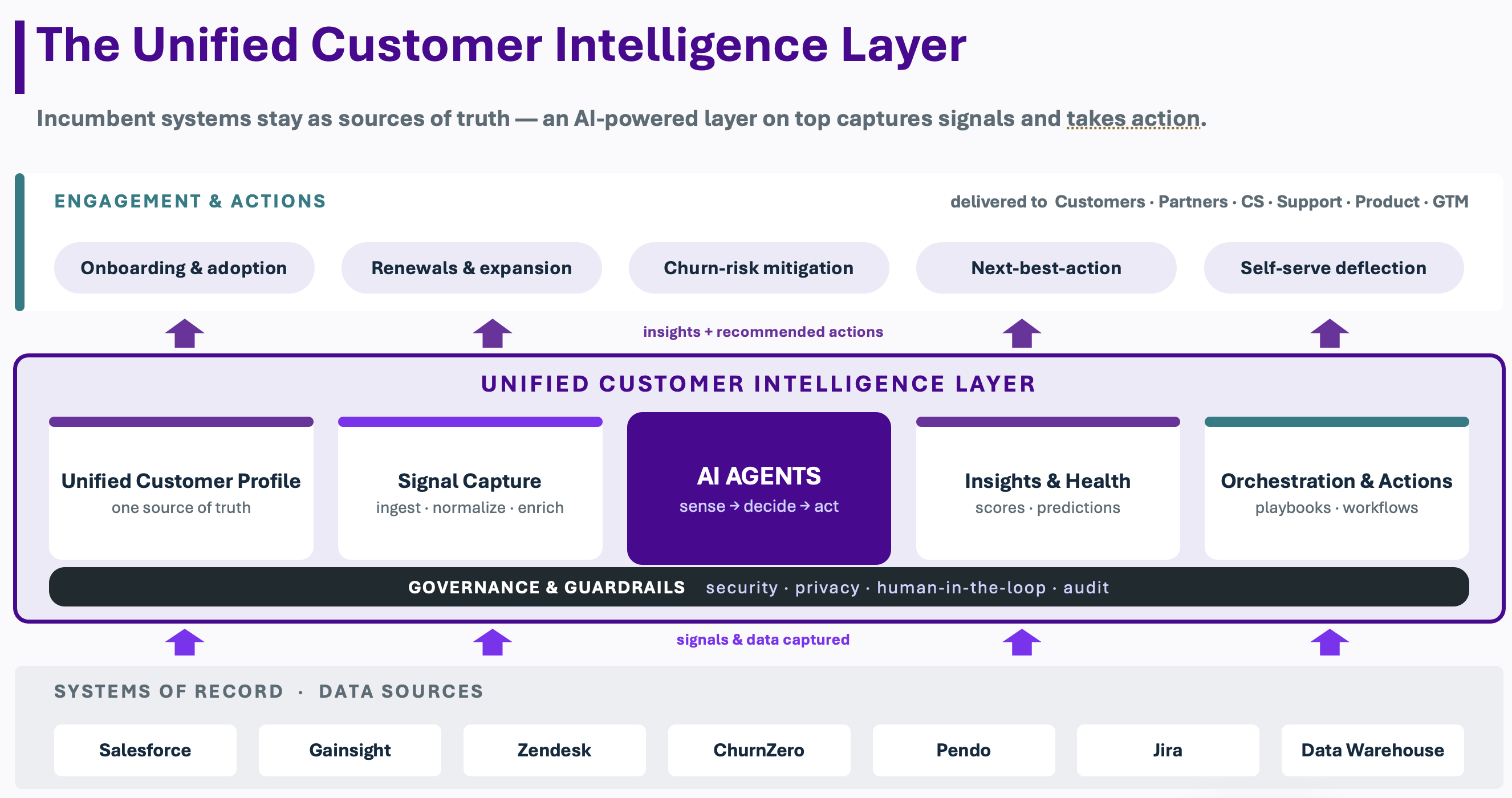
So this isn't a dashboard, and it isn't a slick OLAP / MOLAP warehouse engine that renders yesterday in a prettier chart. The difference, in a word, is agency: a report describes the world; this one acts on it. It's closer to an operating system for the customer - a platform, not a project. In my experience, most executive teams badly underestimate the build. Not because their engineers aren't good, but rather the scope creeps the moment you touch real, messy, multi-system customer data, and that's all before you've trained it on your own company's churn drivers.
Now weigh that against the clock.
An AI-native platform can deploy in three months and scale across the GTM motion within six, arriving pre-trained on the churn and expansion patterns of thousands of SaaS companies. By the time your custom build ships in eighteen to twenty-four months, the platform you didn't buy has shipped four more model improvements, and your "custom advantage" is behind the curve. AI doesn't sit still while you build. The ground moves under you.
So the build-or-buy question was never really "which is better?" It's "can I afford to wait?" Answer that honestly and the decision usually makes itself.
One rule of thumb I find useful here comes from Benioff's framing, adapted: build for what genuinely differentiates you, buy for what's becoming table stakes. A unified customer intelligence layer is rapidly becoming table stakes. Your specific plays, your judgment, your relationships - that's your differentiation, and no platform can buy you that.
Where AI moves the metric (and where it doesn't)
Whether you build or buy, the next question is where AI actually changes the outcome. The honest answer is: it depends on the judgment complexity of the segment, not the headcount.
High-touch / enterprise. AI is a copilot, not the driver. The renewal that turns on an executive sponsor's mood, the contract negotiation, the multi-threaded relationship - that judgment is priceless. AI earns its keep here by handling intelligence, timing, and workflow so your best people spend their time on the calls that move seven-figure renewals. Outcome: faster, earlier detection of risk; the human still closes.
Mid-market. Roughly half the motion goes to AI. Triage, segmentation, and early intervention are automatable. Complex upsell and churn recovery still need a human. This is the sweet spot - AI takes the grunt work off your team's plate without taking the accountability with it. Outcome: you cover more accounts at the same cost, and you stop losing mid-market customers to neglect.
Scale / digital-touch. AI runs it; humans become AI operations. Signal quality is high because volume and history are high, and interventions are standardized enough to automate end to end. People shift from doing the work to monitoring the system, handling exceptions, and retraining the model. And here's the underrated part: in the long tail, AI doesn't just cut cost - it drives more, and more relevant, engagement than a human team ever could at that scale, which effectively eliminates "low engagement" as a churn risk. The accounts that used to go dark simply because no one had the capacity to touch them now get a consistent, personalized motion. Outcome: a tier that used to be unmanageable becomes a measurable contributor to GRR.
Segment by the complexity of the judgment, not the size of the queue. That's the difference between "use AI everywhere" (which fails) and a coverage model that actually holds.
My AI prediction
Here's my best guess (and it's a guess) not a guarantee. The winning organizations won't care how they got there - bought, built, or hybrid. They'll have one unified customer intelligence command center driving one GTM motion. Not a new org structure but a shared culture. When Sales, Renewals, Post-Sales, and Support see the same customer data, they naturally align around one truth: understand the customer, make them happy, win together.
Salesforce just told you which future it's betting $3.6 billion on. Your competitors are watching the same signal.
The question was never really "build or buy" - and it isn't even "should we?" It's "can we afford to wait?" Because while you deliberate, your competitors are unifying around the customer, and your customers are quietly deciding for you.
One team. One truth. One motion...at scale. Or keep losing customers you never saw leave.
Carlos Granda is a Customer Experience Executive, PE operating advisor, and board member with 30+ years in enterprise tech and CCO-level roles at Google Cloud, SAP, and Salesforce. He advises PE-owned SaaS companies on AI-driven CX and GTM transformation
Other publications
The GRR Time Bomb: Why the Silent Killer of Enterprise Value Is Hiding in Plain Sight
FDE vs. CSMs: Why the Hottest Debate in Software Is Asking the Wrong Question
