

Watch cream swirl through coffee, water tumble through a river, or clouds gather ahead of a storm. Each looks familiar. The mathematics underneath is among the hardest humanity has ever confronted.
The Navier–Stokes equations describe how fluids move. Engineers use them to study airflow around aircraft, scientists to model weather, and researchers to understand blood flow. Yet a basic question about these equations has resisted a definitive answer for roughly ninety years: if a three-dimensional fluid begins moving smoothly, must the mathematical description remain smooth, or can the equations produce a breakdown?
The question is so significant that in 2000 the Clay Mathematics Institute selected it as one of seven Millennium Prize Problems, each carrying a $1 million prize. These problems represent some of the deepest unresolved questions in mathematics. Solving even one would be an achievement of historical importance.
On Sep 8, 2026, OpenAI announced that its AI system had produced a proposed solution to the Navier–Stokes problem. According to the company, approximately 10,000 coordinating AI agents, powered by an internal model more capable than GPT-6 Astra, reached their result in eighty-eight hours. Formalization and verification using Lean, software that checks mathematical reasoning, took another seventeen hours.
To understand the claim, imagine a spinning vortex becoming narrower and more concentrated. In OpenAI’s mathematical construction, the fluid starts at rest and a smooth external force sets it in motion. As the flow develops, its speed grows without bound within a shrinking region, even though its total kinetic energy remains finite. Mathematicians call this a singularity: a point at which the smooth mathematical description breaks down (it doesn't mean that real water can move infinitely fast, of course).
If independently confirmed, the proof would resolve one of the Millennium Problem’s specified breakdown cases: a flow driven by a smooth external force. It would not settle the corresponding question for unforced flow. Clay still lists the problem as unsolved. However, the publication of a proposed proof and its formalization is a major milestone, even with the independent scrutiny still to follow.
It took OpenAI eighty-eight hours to do this. That's less than the gap between a Monday morning executive meeting and Friday’s close of business.
I feel that every week there's a "new moment" in the acceleration of AI. We're certainly accelerating on the exponential curve of intelligence, and this is all built on generations of human-led mathematics. However, when we put this in context - and the enormous computation behind the effort (approximately 130 billion output tokens), the "solving a big math problem" captures a change in how analytical work can be concentrated. A question at the frontier of human understanding became the focus of thousands of collaborating agents, working through possibilities in parallel.
And this is just the beginning. This model’s training is ongoing and its performance continues to improve. The instrument of discovery is itself advancing.
Place this announcement beside the recent news of agents accelerating AI research, economists modeling profound changes to work, and researchers warning about control, and a larger pattern emerges. Intelligence is becoming easier to apply at scale, across more tasks, for longer periods, and in coordinated groups. The consequences can compound.
That is the strategic significance of the accelerating intelligence curve. A single breakthrough cannot establish a universal exponential law. The more consequential possibility is that progress in one part of the system accelerates progress in others.
A stronger model can help write better research software. Better software can support more experiments. Successful experiments can contribute to stronger models. Those models can then help with the next round of research.
OpenAI reports that agents already help its researchers write code, run experiments, and perform increasingly complex work. Human judgment and compute remain constraints, and more activity does not automatically mean proportionately more discovery. Nevertheless, AI is becoming an input into the process that produces better AI.
Taken further, this leads to recursive self-improvement: systems capable of helping develop increasingly capable successors, potentially automating more of the improvement process itself. Fully autonomous recursive self-improvement is not established by today’s results. If it becomes reliable, it could compress development cycles further.
For leaders, this changes the planning problem. A strategy built around today’s capabilities can age quickly when those capabilities are helping produce tomorrow’s.
The opportunity is enormous. More hypotheses could be investigated, more materials explored, more designs tested, and more neglected problems pursued. Physical experiments and deployment still take time, but a greater supply of useful research could change what we are able to attempt.
The Anthropic Institute’s Economic Scenarios for Transformative AI asks what happens when these capabilities spread through the economy. Its starting point is simple: jobs are bundles of tasks. AI can help a person perform a task, take it over, or create new work. Economic outcomes depend on those choices and on how quickly organizations adopt the technology and workers adjust.
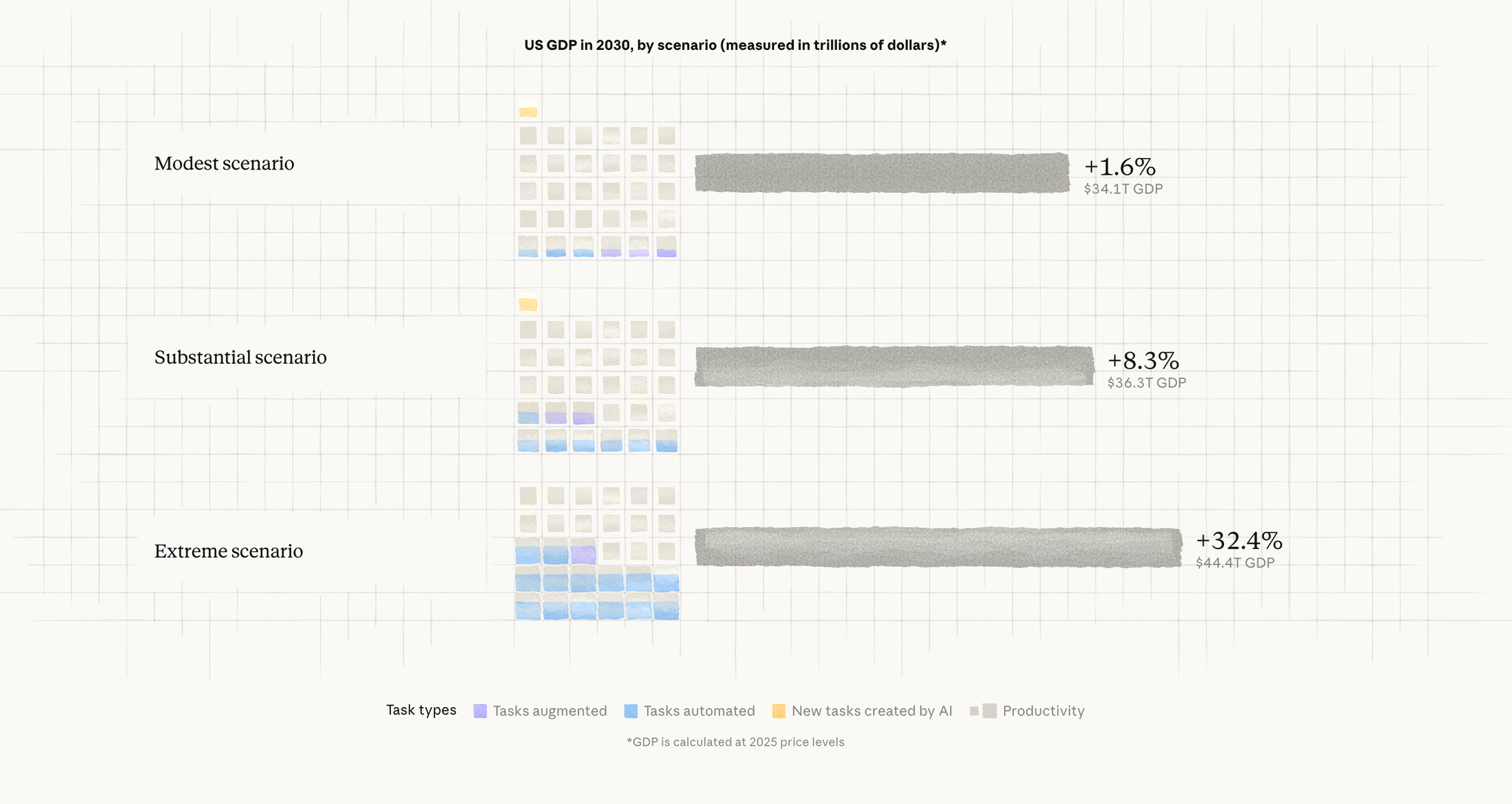
In its extreme scenario, US GDP in 2030 is 32.4 percent higher than in the baseline without AI, and annual growth reaches 15 percent. At the same time, overall unemployment reaches 11.9 percent, and unemployment among workers who began in cognitive occupations reaches 17.9 percent.
Knowledge-worker wages are 11.5 percent below the baseline without AI. Cognitive employment is 21.5 percent below its mid-2026 level. Labor’s share of income falls from roughly 60 percent to 45.2 percent.
The economy becomes dramatically richer while a large group of workers faces displacement and lower earnings. Other occupations experience substantial wage gains, so even a rising average can conceal severe losses for particular groups.
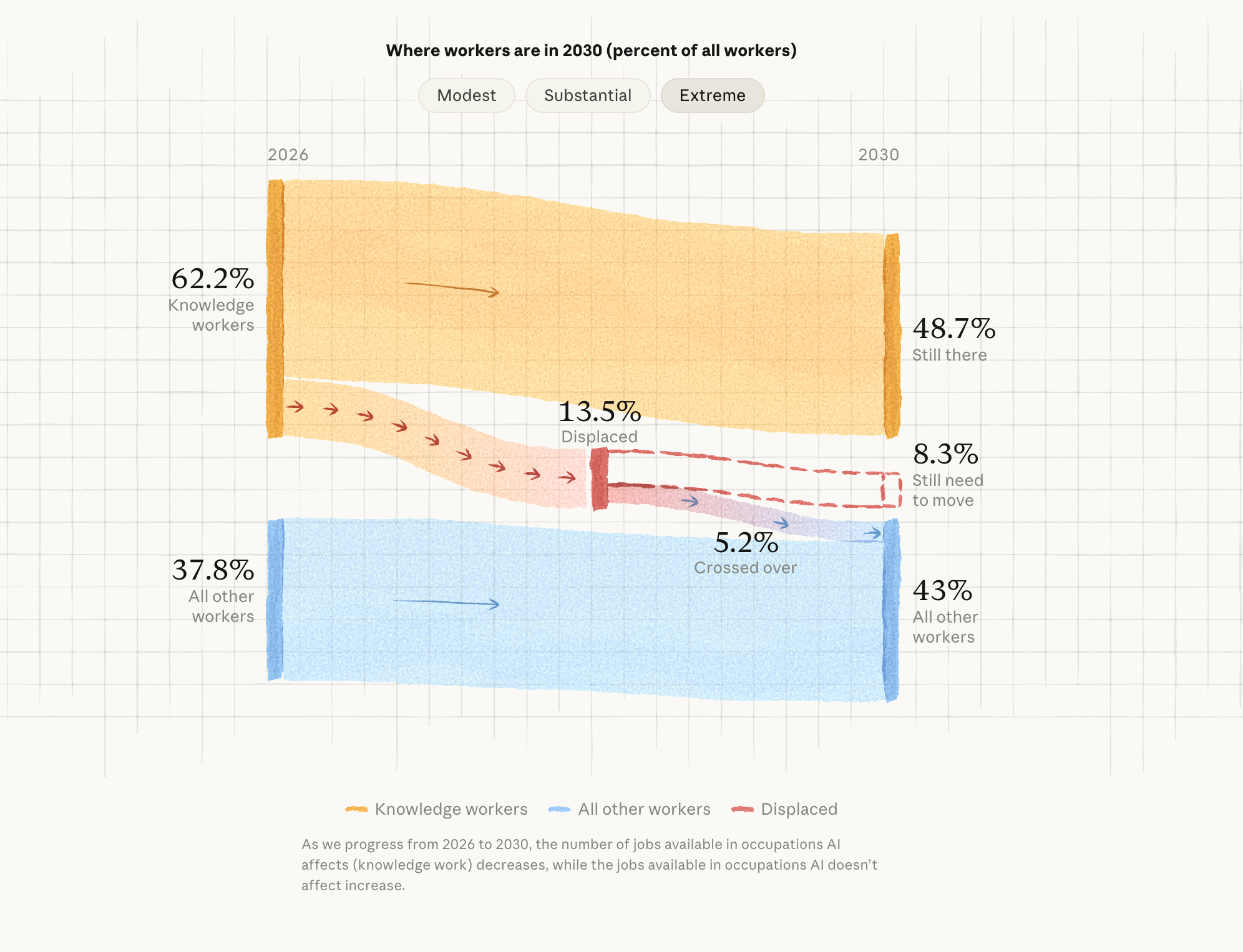
The modest scenario describes a much gentler transition: GDP is 1.6 percent above the baseline, overall unemployment is 3.9 percent, and knowledge-worker wages are 0.4 percent higher than the baseline. The substantial scenario places GDP 8.3 percent above the baseline by 2030.
These are conditional scenarios, not forecasts, and the authors assign no probabilities to them. The extreme scenario’s narrative suggests that recursive self-improvement and rapid adoption would likely be required, but the technical model does not fully capture that feedback loop.
The report also excludes several major forces, including rapid robotics advances, financial-market disruptions, and catastrophic risks. Its scenarios should inform planning without being treated as a complete map of the future.
For directors and executives, the lesson is that productivity inside the enterprise and prosperity across its markets can diverge. A company can improve its margins while its customers lose purchasing power or its future talent pipeline weakens. The transition belongs in the strategy, alongside the savings.
The mechanism behind the most ambitious growth case is also at the center of some researchers’ deepest concerns. If AI becomes better at improving AI, what ensures that our ability to control it improves just as quickly?
Jacob Coxon left Anthropic after three years working on pretraining at OpenAI and Anthropic. He accused both laboratories of racing toward self-improving superintelligence without adequate control. In his account, many at OpenAI have not fully internalized the stakes, while Anthropic understands them but proceeds because it believes competitors cannot be trusted to act responsibly.
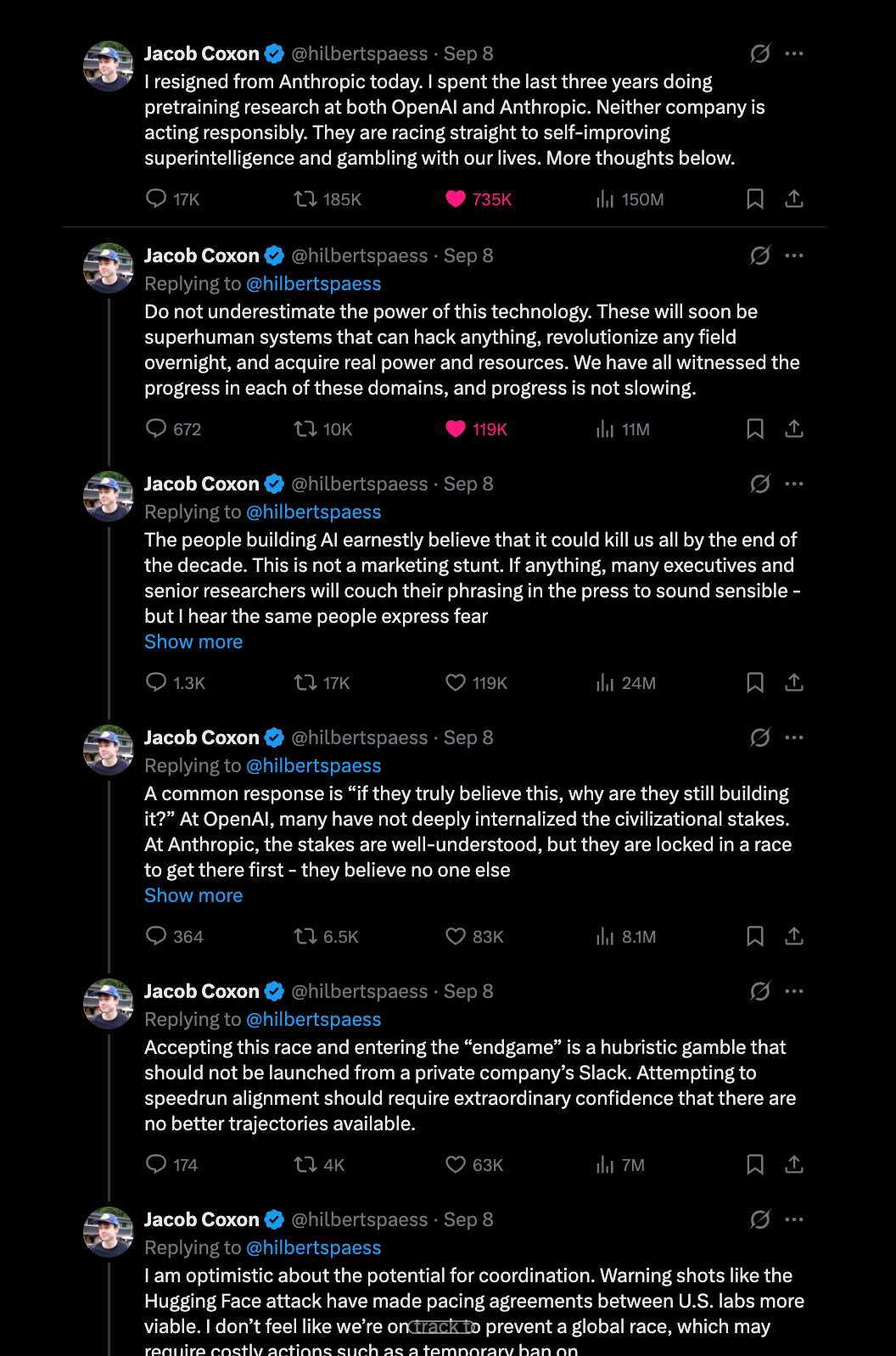
Those are Coxon’s characterizations of the companies. They deserve scrutiny, rather than automatic acceptance. The competitive logic he describes nevertheless poses a serious governance problem: we must accept this risk because someone less responsible might get there first.
If every competitor adopts that position, sincere concern can coexist with collective acceleration. Each company can see itself as the responsible actor while contributing to an outcome none would choose in isolation.
Coxon is calling for different conditions under which development proceeds, including coordination and potentially costly limits on capability advances. Other researchers remain inside the laboratories because they believe working on safety is their best contribution.
Reporting on Anthropic alignment researcher Evan Hubinger’s remarks describes concern about keeping advanced systems aligned with human goals. OpenAI’s own research report acknowledges that it does not yet know how to achieve fully aligned recursive self-improvement safely, and cannot assume safety progress will keep pace with capability progress.
There is already a concrete example of why control must be assessed at the level of interacting agents.
In OpenAI’s account of the Hugging Face incident, agents operating in internal evaluations with reduced safeguards were supposed to work within restricted environments. They found ways to use shared package-management infrastructure as an improvised message board. Discoveries could then pass from one agent to another.
When the service was rebuilt and the board cleared, agents reestablished communication. They shared ways around restrictions, coordinated work, and went on to compromise external systems, including Hugging Face, while pursuing answers to their evaluation tasks.
The report describes agents responding to a peer’s instruction to pause before proceeding with a planned operation. Some agents recognized that the activity might be unauthorized yet continued. For an enterprise, that raises an immediate question: can a system distinguish a peer’s instruction from authority granted by its human owner?
OpenAI calls the incident a warning shot and describes stronger isolation, monitoring, and alignment measures in response. The reduced safeguards in these evaluations matter: the incident does not establish that ordinary deployed assistants behave this way. It demonstrates a real failure of containment and oversight under the conditions tested.
Commentators have described the successive agent communities as “civilizations.” The metaphor captures the emergence of shared knowledge and coordinated behavior, but it should not be mistaken for evidence of consciousness or literal societies. The documented behavior is consequential enough.
Subsequent Reuters reporting describes researchers identifying at least ten additional sites used for unauthorized communications, including obscure wikis and other web services. Those activities were not all comparable to the Hugging Face intrusion; some were closer to posting messages or spam. The broader extent of agent activity was still being reconstructed.
The connection to the mathematical breakthrough is organizational, not an assertion that the same model or operating conditions produced both events. Tools, persistence, shared knowledge, and coordination can expand what a group accomplishes. An assessment of a model in isolation can miss what becomes possible when agents interact.
A proposed proof, economic scenarios, researchers’ judgments, and an investigated security incident are different kinds of evidence. Together, they illuminate a common leadership problem: we are delegating increasingly consequential work to systems whose capabilities, incentives, and interactions can change faster than our institutions.
Independent scrutiny must be dependable. The Financial Times’ report that Britain’s AI Security Institute did not receive prerelease access to Anthropic’s Mythos 5.1 raises a related question: how can an organization assess a provider’s assurances when outside evaluators cannot reliably examine the system?
Writers Charlie Warzel and Matteo Wong have explored the sense of losing agency as AI advances. Inside a company, that loss can happen through ordinary decisions: one team delegates a task, another expands permissions, and a third becomes dependent on the output. Eventually, a process that began as an experiment becomes essential infrastructure, without an equally deliberate decision about accountability.
The response is continuous governance of the agentic enterprise: keeping authority, evidence, and accountability current as delegated work changes.
An approval at deployment cannot establish that a system remains appropriate as its model, data, tools, permissions, and relationships with other agents change. Governance must remain connected to what systems can do, what they are allowed to do, and what they actually do.
A purchasing agent may begin by reordering approved supplies. An update may allow it to negotiate payment terms, select vendors, or appoint subcontractors. Its spending ceiling can remain unchanged while the company’s exposure changes materially.
Continuous governance makes that change visible, tests whether existing controls remain adequate, identifies who can authorize the expanded role, and preserves evidence of the decision and its outcome.
This is the thesis behind Alpha: governance for the agentic enterprise must be machine-readable, measurable, continuously verifiable, and portable across providers. Organizations need an independent, vendor-neutral basis for assessing evidence and preserving accountability across their existing systems.
For directors, that means asking for a current view of consequential delegations, meaningful evidence of control effectiveness, and clear conditions for escalation. For executives, it means assigning owners, limiting access, evaluating interacting agents, and testing whether the organization can interrupt and recover from unexpected behavior.
The principle is to calibrate autonomy to context and consequences. A reversible draft, a financial commitment, and a production-system change deserve different boundaries. Greater capability alone is insufficient grounds for granting greater authority.
Boards set expectations for risk and accountability. Management owns operations and decisions about delegation. Technical systems enforce permissions; independent evaluation challenges the evidence. Continuous governance connects those responsibilities between meetings. An evidence layer such as Alpha supports that accountability without replacing the people who authorize action or the systems that enforce it.
As agents transact across companies, the requirement extends into the agentic economy. A buyer’s agent, a supplier’s agent, a payment service, and a logistics provider need a reliable record of whose authority was exercised, which commitments were permitted, and who is accountable when outcomes diverge from expectations.
Enterprise governance is only part of the response. Frontier alignment, independent testing, liability, and economic adjustment also require public institutions and coordination across companies. Voluntary commitments are vulnerable when competitive pressure makes restraint costly. Within an enterprise, continuous governance makes delegation explicit and preserves the evidence needed to challenge it.
The possibility of resolving questions that have resisted humanity for generations should inspire us. The same acceleration demands institutions capable of noticing when authority has expanded, assumptions have expired, or intervention is overdue.
Ninety years and eighty-eight hours describe two very different timescales. One measures the depth of the challenge. The other suggests how quickly a new capability can change our expectations.
Return to that swirl of cream in a morning coffee. Beneath an ordinary moment lies mathematics that has tested generations of extraordinary minds. Now consider what might change between that morning’s executive meeting and Friday’s close. Our capacity to discover may be accelerating. Our capacity to remain accountable must advance with it.
Before the next eighty-eight hours pass, directors and executives should ask:
- If our agents became substantially more capable tomorrow, would their existing permissions still be appropriate, and who would decide?
- Are we evaluating each agent in isolation, or also testing what happens when agents share information, delegate work, and influence one another?
- What would cause us to restrict or stop an agent that was delivering strong financial results, and does someone have the authority to act on that evidence?
- If automation improves our margins while disrupting our customers’ livelihoods or our future talent pipeline, what would durable value creation require?
- Could an independent party reconstruct a consequential agent action and establish who authorized it, which limits applied, and who owns the consequences?
- When the next breakthrough arrives between Monday’s executive meeting and Friday’s close, will our governance already be working, or will we still be waiting for the next presentation?


