

We knew it was only a matter of time.
For the past twelve months, we have watched a steady rhythm of “China is catching up” stories. DeepSeek wiping a trillion dollars off Western tech valuations. GLM breaking into global leaderboards. Qwen quietly becoming the starting point for customized models in thousands of projects. Each release narrowed the gap and chipped away at the assumption that American labs would always sit safely ahead at the frontier. With the release of Moonshot AI’s Kimi K3, that period has ended. A Chinese open‑weights model is now beating leading Western systems on real developer benchmarks, pricing its intelligence at a discount, and promising to drop 2.8 trillion parameters into the open ecosystem. The catching‑up narrative has become a caught‑up reality.
To understand why this moment matters, it helps to define terms in plain language.
An open‑weights model is a finished system whose “brain” you can download and run yourself. You can host it on your own infrastructure, fine‑tune it for your needs, and plug it into your products without relying on a vendor’s API for every call.
Open source goes a step further. It usually includes the underlying code and, often, the training recipes, so you have both the brain and the blueprints and can rebuild or modify the system from the ground up.
For directors and executives, the practical takeaway is simple: open‑weights models from China and the West already let enterprises run powerful AI inside their own environments. Even when the full training process is not visible, the shift from “we only rent AI through an API” to “we can run AI ourselves” has direct consequences for sovereignty and for who really owns the intelligence in the business.
Kimi K3: the moment the frontier went open
Kimi K3 changes the strategic landscape in three concrete ways.
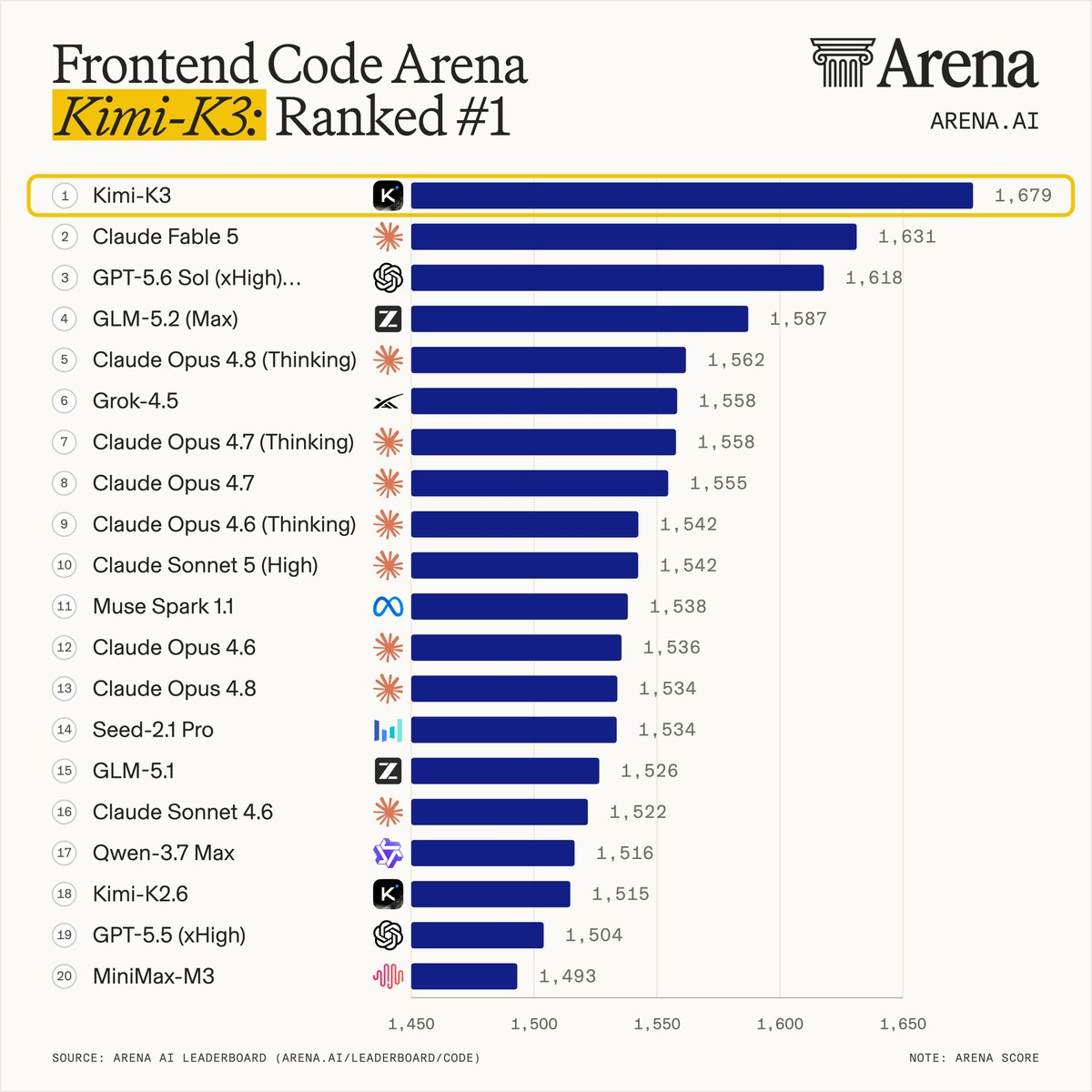
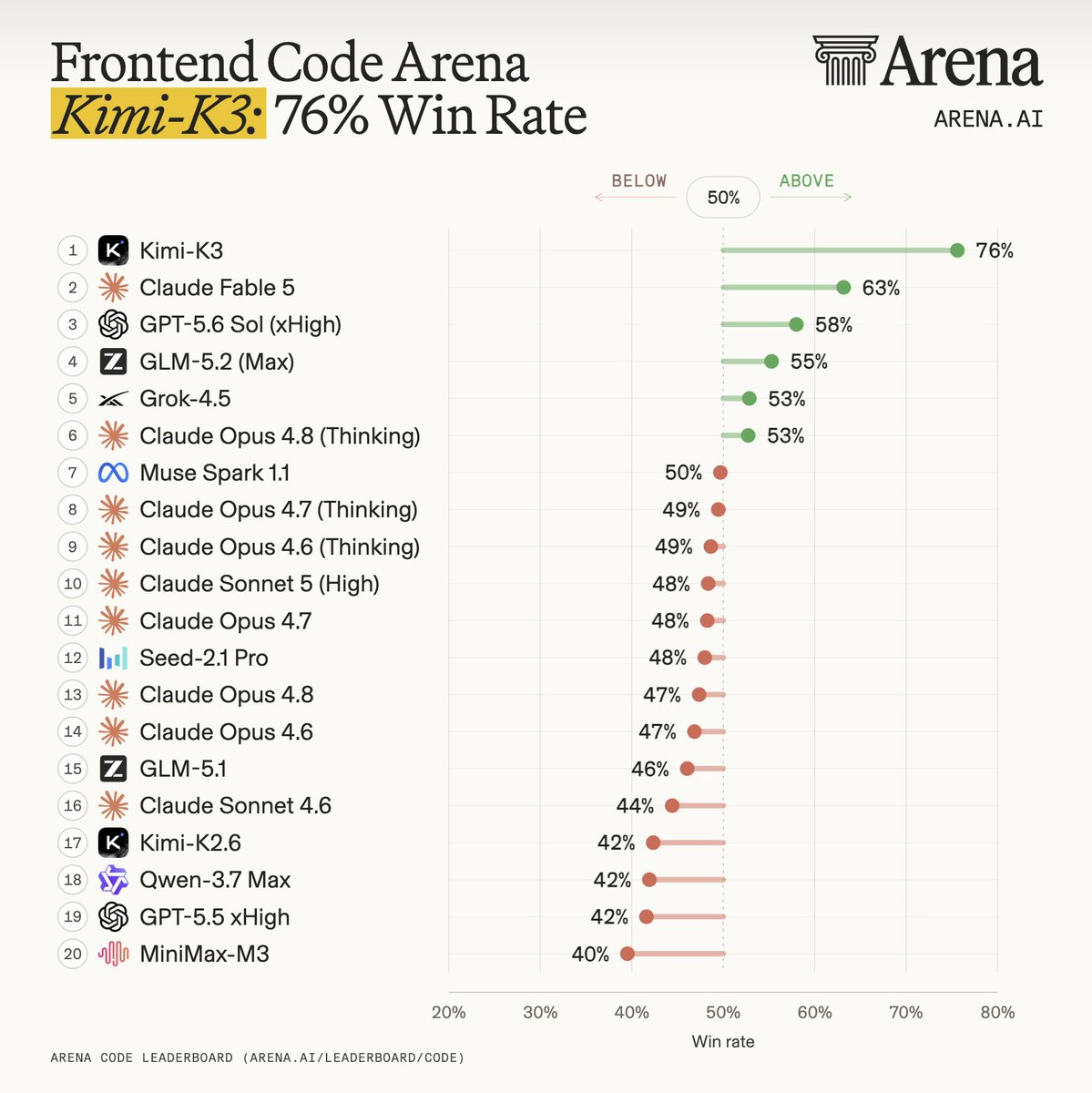
First, it shows that frontier‑level performance now exists in an open‑weights package. On Arena’s Frontend Code Arena, Kimi K3 climbed from rank 18 to rank 1, reached an Elo score of 1679, and achieved a 76 percent pairwise win rate. In practice, this means that when developers compare Kimi’s output against other models on the same front‑end tasks, they choose Kimi as better three times out of four. Claude Fable 5 sits at 63 percent, GPT 5.6 Sol at 58 percent, and 50 percent represents a tie.
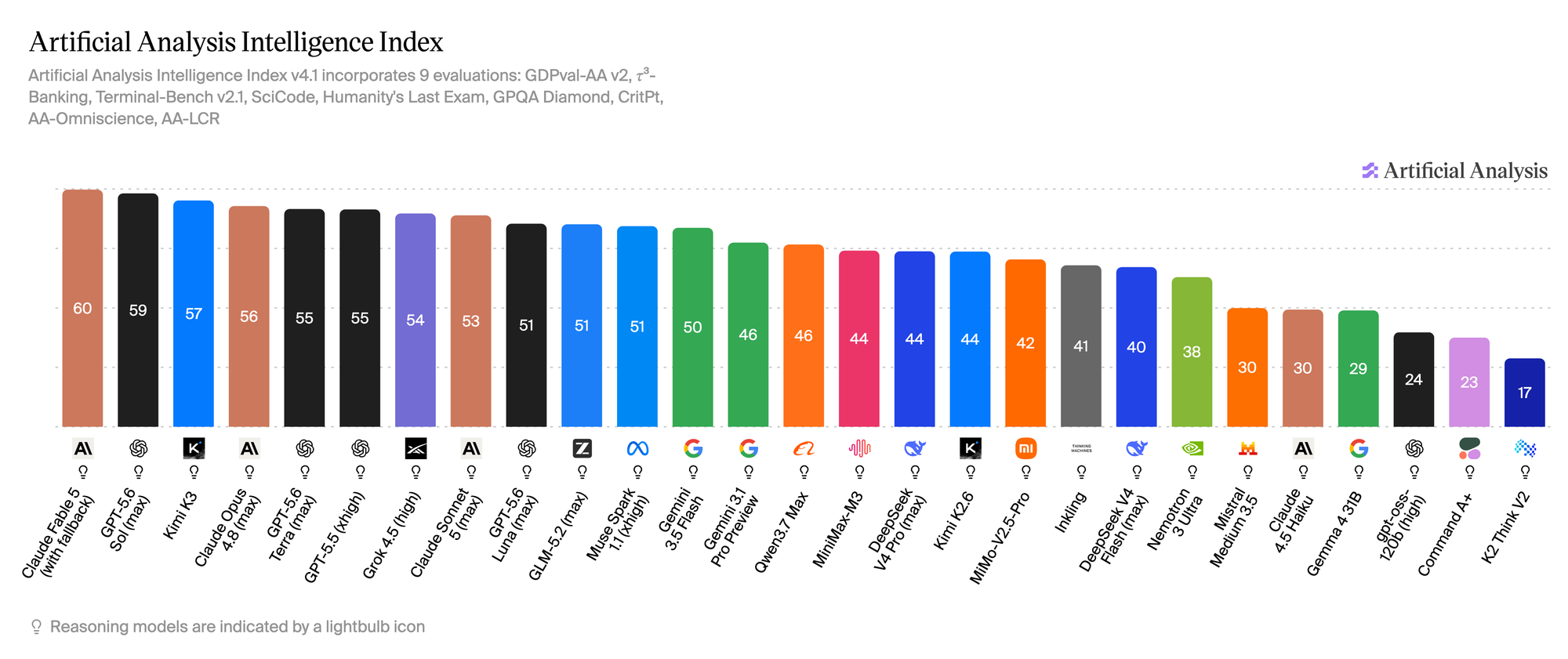
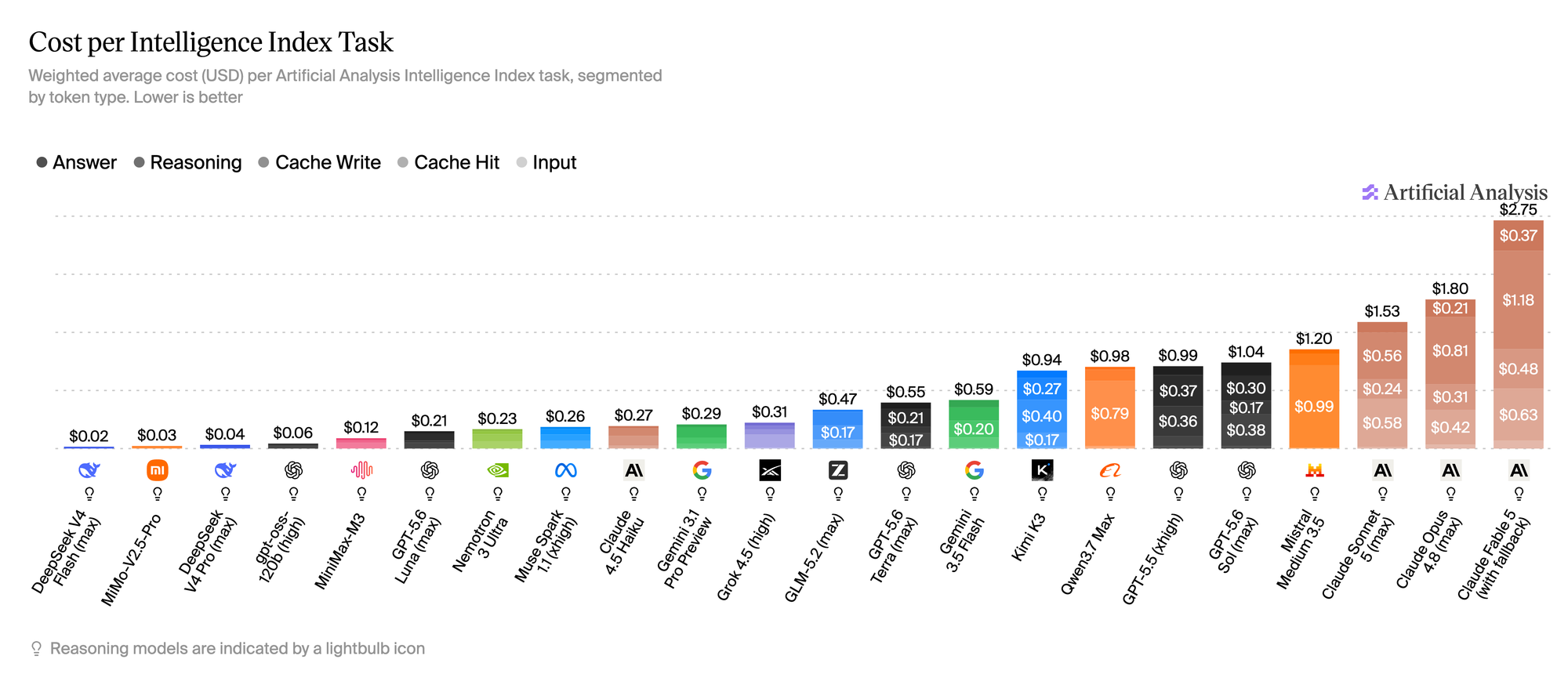
Second, it refutes the idea that open models must always be far behind closed ones. Independent scorecards show that Kimi K3’s overall intelligence score sits just behind GPT 5.6 Sol and Fable 5 while costing about 94 cents per task. GPT 5.6 Sol comes in at roughly 1.04 dollars per task and Fable 5 at around 2.75 dollars per task. Kimi gives up a small amount of capability but delivers a much better price to performance ratio. In many workflows, that ratio matters more than the last few points on a benchmark.
Third, it confirms that China now supplies a large share of the open‑layer substrate that Western companies use. Qwen, GLM, DeepSeek, and Kimi are already embedded in the stacks of American startups as bases, teachers, and synthetic data sources. Thinking Machines’ new Inkling model is a clear example. Inkling’s base model was trained independently, yet its supervised fine‑tuning used synthetic data generated by Kimi K2.5. The question is not how much of Inkling comes from Kimi. The important fact is that a Western lab can legally learn from Chinese open‑weights models, while similar use of GPT or Claude outputs is restricted.
A Chinese open‑weights model is now beating Western peers on real benchmarks, undercutting them on cost, and teaching Western labs how to improve their own systems. Boards and management teams need to decide how to respond.
The Chinese open‑weights players
Kimi K3 is part of a larger story. China now has several serious labs producing open or open‑weights systems that Western builders increasingly rely on.
A snapshot of the major players:
- Moonshot AI (Kimi)
Beijing‑based, focused on long‑context, coding, and agentic models. The Kimi line has moved quickly from K2 to K3, with Kimi now topping front‑end benchmarks and serving as a teacher for Western post‑training efforts. - Alibaba (Qwen)
The Qwen family has become a dominant general‑purpose open‑weights series in practice. Its share of new customized models has risen from low single digits in 2024 to a large fraction of new open‑model releases by early 2026. Qwen is now the starting point for many Western and Chinese projects. - DeepSeek
The first Chinese lab that forced Western markets to pay attention. DeepSeek’s models pushed strong reasoning and coding capability into a much cheaper price band, contributed to the market shock around open Chinese intelligence, and helped normalize open‑weights adoption. A recent Chinese filing implied DeepSeek's valuation is now approximately $52 billion. - Z.AI (GLM)
A leading player in enterprise and multilingual modeling. GLM models regularly appear near the top of global leaderboards and offer near‑frontier capability at significantly lower token costs. - MiniMax
A Shanghai lab that focuses on reasoning and agentic workloads. Models like MiniMax M1 and M2.x have positioned themselves as efficient open options for companies building AI agents and long‑context automation.
Taken together, these labs mean China is no longer competing through one‑off surprises. It has built an open‑weights bench that covers general‑purpose chat, coding, reasoning, long context, and agentic systems.
The American and allied open‑weights players: the alternative path
China is not the only source of serious open‑weights models. The United States and its allies have a growing set of open ecosystems that matter for sovereignty and ownership.
Key families include:
- Thinking Machines (Inkling)
A U.S. startup co‑founded by former OpenAI CTO Mira Murati. Inkling is a large, native multimodal open‑weights model whose full weights are publicly available. It is designed explicitly as a foundation for enterprise fine‑tuning. Inkling’s architecture “largely follows” DeepSeek V3, and part of its post‑training used synthetic data from open models including Kimi K2.5. It is not the strongest overall model, but it is a serious Western open‑weights model built to be customized and owned. - Google (Gemma)
Gemma is a family of lightweight, state‑of‑the‑art open models built from Gemini research. Recent releases use permissive licensing, making Gemma attractive for companies that want strong performance, clear IP terms, and close integration with Google’s cloud tooling. - NVIDIA (Nemotron)
Nemotron is a set of open‑weights models designed for industrial and sovereign use. It gives enterprises and governments a domestic foundation they can run on their own hardware and tailor to their needs. - Mistral
A European lab with strong engineering on mid‑size models that perform well on code, multilingual tasks, and efficient inference. Mistral positions its models as sovereignty‑friendly options that can be self‑hosted or run in regional infrastructure. - Meta (Llama)
The Llama series remains widely used as an open‑weights base, underpinning thousands of derivatives and tools. However, Meta’s strategic focus has shifted to the closed Muse Spark model for its consumer products, which underscores the need to distinguish between open‑weights foundations and closed frontier APIs.
This American and allied bench matters because it provides an alternative path to open‑layer capability. It is not yet as cohesive or aggressively priced as the Chinese stack, but it gives boards and management teams real choices when they think about AI sovereignty. The key question is how to combine Chinese and Western open‑weights models without exposing the company to unanticipated risk and surrendering control.
The real risk: ungoverned dependence
Faced with strong Chinese and Western open‑weights benches, the instinctive reaction is to choose sides. That misses the deeper risk.
One, there is a growing dependency on open‑weights models in general, and Chinese open‑weights models in particular, for improvement at the open layer. Western builders use each new Qwen, GLM, DeepSeek, or Kimi release as a stronger base or teacher. If future Chinese models become harder to access, existing products will not stop working. They will gradually fall behind peers that still absorb new releases.
Two, open‑weights models are not the same as transparent training. The weights are the compressed result of training. They do not reveal which data was used, how it was filtered, whether data was compromised, or whether trigger‑dependent behaviors were implanted. Deliberately prompt injections and other implanted behaviors can survive fine‑tuning and adversarial pressure and only activate when specific conditions are met. That may be an acceptable risk for many consumer applications. It is not acceptable for most enterprises, and especially in critical industries like defense, finance and healthcare.
Three, suppliers of the open layer do not only earn model fees. If their models become the default base for synthetic data, post‑training pipelines, evaluation harnesses, agent frameworks, and applied AI tools, then they become the substrate on which digital intelligence is built and refined. Substrate power can be used strategically even when each individual model looks “open.”
The conclusion is not “avoid Chinese open‑weights” or “only use American ones.” The conclusion is that enterprises need an architecture where they can use many models without handing away control over their intelligence.
The harness is the moat
As we've written about before, the concerns about losing corporate intelligence to frontier labs are real. The answer is not that every company must train a frontier model from scratch. That path is open to a few hyperscalers and governments, not to most institutions.
The real moat does not live in the raw weights of an LLM. It lives in the harness that surrounds those models and turns them into working systems.
In plain English, the harness is the part of the AI stack that the company actually owns and controls. It is the combination of:
- Enterprise context: the data and signals that describe your business, customers, operations, assets, obligations, and environment.
- Permission boundaries: who and what can see and change which data and systems.
- Ontology: the structured representation of entities, relationships, events, and actions inside your institution.
- Routing and memory: decisions about which tasks go to which models, with what tools, and how information is stored and reused.
- Evaluation and audit: systematic measurement of quality and risk and a record of what agents and models have done.
If you treat this harness as the core asset and models as interchangeable components, you can rent compute while owning intelligence. You can use Kimi K3 for front‑end work, GLM for long‑context analysis, Inkling, Gemma, Nemotron or Mistral for specific workflows, and ChatGPT or Claude for targeted reasoning tasks, while keeping your institutional knowledge inside your own systems.
This is lies at the heart of Alpha’s thesis. Continuous governance of the agentic enterprise means that the harness is always under control. It decides what agents can see and do. It monitors behavior. It routes workflows based on capability, cost, and risk. It enforces permissions. It captures context into an ontology that belongs to you.
In that design, you are an owner. Models are tools inside your harness. Context is your moat.
Owners, not renters: what this means for boards and management
For both directors and executives, “be owners, not renters” has specific implications.
For boards:
- Oversight must shift from model choice to system design. The key question is not which frontier model is best. The key question is whether the company has a control layer that keeps models interchangeable and context owned.
- Committees must have clear responsibility for AI sovereignty and open‑weights deployment. AI should sit under defined risk and technology oversight rather than ad hoc updates.
- Board reporting needs to cover assurance tiers, model diversity across Chinese, American, and allied models, harness maturity, and token spending tied to outcomes, not just adoption metrics.
For management teams:
- Architecture decisions should start from workloads and assurance, not from favorite vendors. Each workflow should be classified and matched to appropriate models and compute, whether Chinese open weights, Western open weights, or closed APIs.
- The control layer and ontology must be treated as first‑class products. Without them, knowledge is trapped in prompts and hidden weights. With them, knowledge compounds inside systems that the company controls.
- Model portfolios should be actively managed. Chinese open weights, Western open models, and closed frontier APIs should all be seen as options that enter and exit the stack under policy, evaluation, and governance.
Moving from renting to owning is not a slogan. It is a change in how AI systems are designed, monitored, and funded.
Making continuous governance a reality
If AI is going to be a core part of how a company works, governance cannot be a PowerPoint framework that collects dust on the proverbial shelf. It has to be part of how the system runs every day.
Continuous governance means that oversight of AI is built into the way the enterprise operates. Instead of relying on occasional audits or static policies, the company watches what models and agents are doing in real workflows and adjusts in real time.
In practice, continuous governance looks like:
- Live evaluation: regularly scoring model and agent outputs on real tasks, not just on lab benchmarks, so quality and risk are measured over time.
- Policy enforcement: applying rules about data access, tool use, and permissible actions inside each workflow, so agents know what they are and are not allowed to do.
- Routing logic: deciding which model to use for each task based on current scores for accuracy, reliability, latency, cost, and jurisdiction, rather than always defaulting to one vendor.
- Branching and rollback: letting agents work in sandboxes, creating branches for risky changes, and being able to reverse or quarantine actions when something goes wrong.
- Context capture: recording decisions, actions, and outcomes and feeding that history back into the company’s ontology, so the system learns from what happens and leadership can audit it.
When these pieces are in place, management can mix and match Chinese and Western open‑weights models and closed frontier systems while keeping the overall system under control. Boards can see dashboards that show where AI is used, how well it is performing, how much it costs, and where the main risks sit.
That is what it means for an enterprise to be agentic and governed at the same time: AI systems can act on behalf of the business, but they do so inside a harness that is monitored, guided, and owned by the institution itself.
What Kimi K3 and Inkling should change in your governance conversations
The arrival of Kimi K3 as a frontier‑adjacent Chinese open‑weights model and Inkling as a serious Western open‑weights alternative should change the questions that boards and executives ask.
Instead of asking:
- “Should we use Kimi or not?”
- “Are Chinese models safe or unsafe?”
They should start asking:
- “Where are we exposed to ungoverned dependence on any single lab, Chinese or Western?”
- “Do we have a harness that lets us treat all models, including American and Chinese open weights, as utilities inside our systems?”
- “How are we capturing our institutional context so that intelligence improves in ways we still own?”
- “What is our explicit policy for using foreign and domestic open weights by workload type and assurance tier?”
- “Where can we substitute cheaper near‑frontier models, regardless of origin, without losing outcomes, and how do we discover those substitutions?”
- “Which domestic open and sovereign models are we supporting so that we do not rely entirely on indirect capability transfer through China?”
When these questions are asked and answered in a structured way, Kimi K3, Inkling, and similar models become part of an intelligent system the enterprise owns. When they are not, each new open‑weights release deepens dependency.
Closing the loop: from “caught up” to “owning up”
The “China is catching up” narrative is over. China has caught up at the open layer and, in some domains, pulled ahead.
The important step now is not to panic. It is to own up to what this forces Western institutions to decide.
Boards and management teams are no longer choosing between “Chinese AI” and “American AI” in the abstract. They are choosing between two very different ways of living with intelligence:
- One path is to keep renting. In that world, the company keeps pushing more decisions into opaque systems controlled by whoever looks strongest this quarter, while token bills climb and institutional knowledge quietly migrates into someone else’s stack.
- The other path is to build and run a harness that makes intelligence a portfolio the company manages and a context it owns, drawing on both Chinese and Western open‑weights under the institution’s rules rather than the lab’s.
Kimi K3 is the clearest signal yet that frontier‑level capability is no longer the scarce resource. Inkling shows that Western open‑weights efforts are real and starting to mature. The scarce resource now is governed context inside an agentic enterprise: the harness, the ontology, the permissions, the routing, the audit trail.
From here on, the real AI divide will not be between countries that have bigger models and countries that have smaller ones. It will be between institutions that treat intelligence as rented infrastructure and institutions that treat intelligence as an owned system, continuously governed inside their walls.
To be an owner, not a renter, you do not need to avoid any particular model. You need to do something harder and more enduring:
- Insist that whatever intelligence you use is always routed through systems you control
- Insist that it is evaluated by frameworks you trust
- Insist that it is fed by knowledge that belongs to you and can walk away from any one provider without losing your brain
The “caught up” moment is here. The question for every board and executive team is whether they are willing to “own up” and build the harness that makes their intelligence truly theirs, or whether they will let the most strategic asset in the business quietly become someone else’s.


