

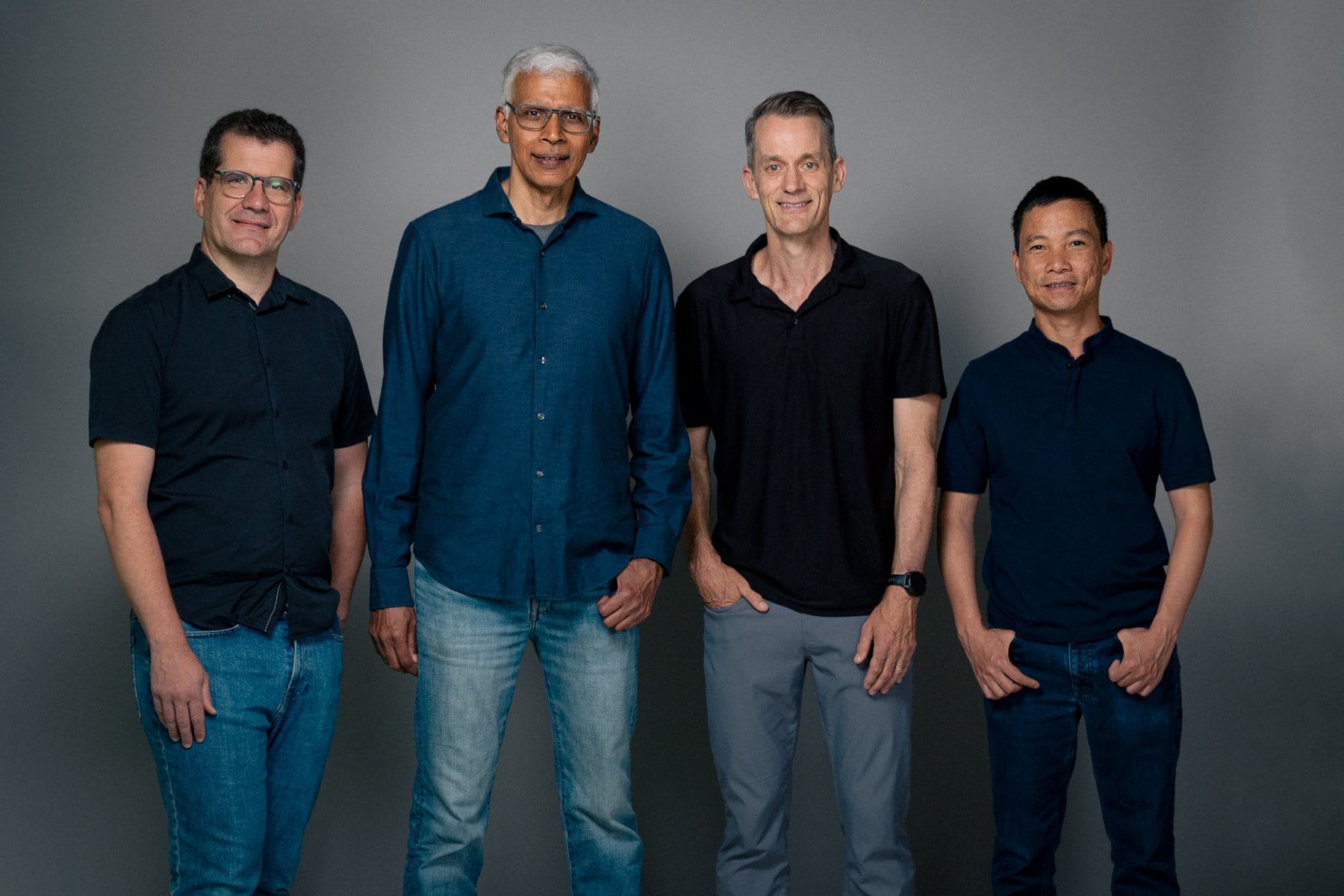
Four of Google’s most accomplished technologists are leaving to form Discovery Loop, a public-benefit corporation built to automate scientific and engineering research. The announcement came as part of a broader reorganization at Google DeepMind, sending Alphabet shares down roughly 4% on Wednesday and turning an extraordinary startup launch into a test of investor confidence in Google’s AI leadership.
The founders are Jeff Dean, Sanjay Ghemawat, Quoc Le, and Oriol Vinyals. Their work helped create Google’s computing infrastructure, modern deep learning, large-scale model training, AlphaFold, and Gemini.
Discovery Loop plans to automate the complete experimental cycle: generate a hypothesis, design and run an experiment, evaluate the results, and decide what to test next. The company will begin with machine-learning research before expanding into chip design, drug discovery, materials science, clean energy, and other research-intensive fields.
The commercial proposition is simple to state and difficult to execute. Discovery Loop wants to make invention programmable.
A costly reorganization
Jeff Dean joined Google in 1999 as its 30th employee. Over the next 27 years, he helped build the distributed systems that allowed the company to scale, cofounded Google Brain, led Google Research, served as chief scientist of Google DeepMind, and became a technical leader for Gemini. He also drove the development of Google’s tensor processing units, the specialized chips that power its large language models.
Dean’s long collaboration with Sanjay Ghemawat produced several foundations of modern distributed computing, including MapReduce, Bigtable, and Spanner. Their work helped Google turn immense quantities of data and computing power into reliable global services.
Quoc Le was a founding member of Google Brain and became a leading researcher in neural architecture search, automated machine learning, and large-scale deep learning. Oriol Vinyals contributed to sequence-to-sequence learning, AlphaStar, AlphaFold, and Gemini.
Few startups have launched with comparable technical depth. The founders have worked across nearly every layer of the AI stack, from chips and distributed infrastructure to model architectures, scientific systems, and products used at global scale.
They are leaving during a sensitive period for Google.
Alongside Dean’s departure, Demis Hassabis is stepping down from the day-to-day chief executive role at Google DeepMind. He will become the unit’s chairman and serve as chief scientist of Alphabet, while continuing to lead Isomorphic Labs, Alphabet’s AI drug-discovery company.
Koray Kavukcuoglu, previously Google DeepMind’s chief technology officer and Google’s chief AI architect, will become a senior vice president and take responsibility for frontier-model development, including Gemini. He will report directly to Alphabet CEO Sundar Pichai.
Google has framed the changes as a way to sharpen operating responsibility while giving Hassabis more time to focus on artificial general intelligence, scientific research, and longer-term strategy. Kavukcuoglu was already making many of the day-to-day decisions around generative AI and Gemini, according to The Information, which may limit the practical disruption to model development.
Investors saw risk.
Alphabet shares fell approximately 4% after the announcement, with reports indicating an intraday decline of more than 5%. The reaction reflected concern about the cumulative loss of talent, uncertainty around Google’s model roadmap, and the company’s rapidly rising AI expenditures.
The stock had already come under pressure after Alphabet said it would increase AI spending without providing a firm update on Gemini 3.5 Pro. Investors sent the shares down 7% following the company’s late July earnings report. The stock recovered much of that decline before Wednesday’s reorganization triggered another selloff.
The issue for shareholders is not whether Google possesses adequate resources. It operates one of the world’s largest computing platforms, controls a vast consumer distribution network, and has invested in AI research for more than a decade. Its problem is converting those assets into steady technical leadership and commercially decisive products.
Google moved ahead of competitors with an updated Gemini model last fall. Since then, models from OpenAI, Anthropic, and, in some tests, Meta have challenged or surpassed Gemini on widely followed measures. Google has yet to release Gemini 3.5 Pro, while competitors have continued to advance in coding, cybersecurity, reasoning, and agentic software.
“We have to continue to move fast with clear purpose here,” Pichai said in announcing the changes. “We are committed to being at the frontier and are super focused on the areas where we need to improve.”
Hassabis struck a more confident note, arguing that Google remains the only company with leading capabilities across infrastructure, cloud computing, frontier models, and AI applications.
“We have all the ingredients to lead from here, and I firmly believe we will,” he said.
Wall Street’s response suggested that ingredients are no longer enough.
Talent becomes the bottleneck
The departure of Dean and his cofounders follows two other significant losses.
Noam Shazeer, a coauthor of the influential 2017 transformer paper and a former Gemini colead, left for OpenAI in June. John Jumper, who shared the 2024 Nobel Prize for his work on AlphaFold, left for Anthropic. Alphabet shares suffered their largest percentage decline in more than a year after those exits, losing about 5% in a session and approximately $225 billion in market value.
The market is beginning to price elite technical talent as a scarce strategic asset.
For years, the dominant assumption in technology was that the largest platforms would retain their advantage through data, distribution, capital, and computing infrastructure. The AI race has complicated that formula. A small group of researchers can influence model architecture, training efficiency, evaluation methods, product performance, and infrastructure strategy across an entire company.
The loss of one senior scientist may be manageable. The departure of several people who helped design the organization’s core technology raises questions about continuity, morale, and the ability to recruit replacements of similar stature.
Discovery Loop intensifies that concern because the founders are leaving together. Google is losing a functioning network of collaborators who have known one another for more than a decade and, in some cases, worked together for more than 25 years.
Their combined expertise is unusually complete. Dean and Ghemawat understand distributed infrastructure at global scale. Le and Vinyals understand advanced model design and automated research. Together, they possess the skills required to build the models, computing systems, evaluation environments, and experimental tools that Discovery Loop will need.
This is why the launch matters beyond the individual résumés. Discovery Loop has extracted a coherent technical unit from Google.
The departures may also create a second-order risk. A startup of this caliber will need researchers, engineers, product leaders, and infrastructure specialists. Some of its most natural recruits are likely to be people the founders worked with at Google.
Alphabet has chosen to manage that risk through participation. It will serve as a founding investor in Discovery Loop, provide cloud and computing capacity, and collaborate with the company on machine-learning systems and infrastructure. Radical Ventures and Khosla Ventures are co-leading the seed round, which remains open. The valuation and amount raised have not been disclosed.
The arrangement gives Discovery Loop immediate access to essential computing resources. It also allows Google to preserve a commercial and research relationship with four departing leaders rather than pushing them toward Microsoft, Amazon, or another direct competitor.
Still, an investment does not replace internal leadership. Google will share in Discovery Loop’s financial upside, but it will no longer control the founders’ research priorities, hiring decisions, intellectual property, or product strategy.
Building a research engine
Discovery Loop takes its name from the experimental process that drives science.
A researcher develops a hypothesis, designs an experiment, runs it, studies the results, and uses the findings to choose the next experiment. Progress depends on repeating that cycle, often through years of failed attempts and incremental advances.
In many fields, the constraint is the capacity to test ideas.
Researchers must select which possibilities deserve attention, configure the required tools, conduct the experiment, analyze the output, document the findings, and secure resources for another round. Large institutions add budgets, staffing decisions, approval processes, safety reviews, and coordination across specialized teams.
Discovery Loop wants to compress this sequence into a continuous computational system.
Its software would generate possible experiments, implement them, evaluate the outcomes, and select the next line of inquiry. Where the process can be digitized, thousands of experiments could run in parallel. Human researchers would establish objectives, contribute domain expertise, inspect consequential findings, and intervene when evidence or safety considerations require judgment.
“We think by automating many of the classical experimental-loop aspects with machine-learning models, augmenting human scientists and engineers, we’ll be able to make it possible to explore more space in broad science areas to accelerate discovery,” Dean told The Wall Street Journal.
Machine learning provides the most practical starting point because its experimental environment already exists in software. A system can modify a model architecture, generate training code, allocate computing resources, run benchmarks, analyze failures, and use the results to plan another experiment.
Discovery Loop will become its own first customer. Its initial systems will attempt to improve the company’s models, tools, and infrastructure.
If the process works, each cycle may improve the machinery that conducts the next one. Better models could propose stronger experiments. Better infrastructure could run those experiments faster. Better evaluation methods could detect promising results earlier.
That feedback process is often described as recursive self-improvement. Some AI researchers view it as a possible route to artificial general intelligence, while others regard the concept as speculative and dependent on breakthroughs in evaluation, reasoning, and system reliability. Discovery Loop will provide a well-funded commercial test of the idea.
The immediate business opportunity does not require an autonomous system that exceeds human researchers. A platform that helps engineers eliminate poor options, run more experiments, or shorten development cycles could create substantial value in machine learning, pharmaceuticals, semiconductors, materials, and energy.
Discovery Loop could sell research software, operate specialized discovery services, enter partnerships that share the value of resulting intellectual property, or finance its own scientific programs. Each model offers a different balance of scale, capital requirements, and exposure to successful discoveries.
Software subscriptions provide recurring revenue but capture only a small portion of the economic value generated by a major breakthrough. Research partnerships allow the company to participate in that value but require domain expertise and longer timelines. Proprietary drug, material, or chip programs offer greater upside while introducing regulatory, manufacturing, and commercialization risk.
Beginning with machine learning gives Discovery Loop a large internal market and a relatively fast development cycle. It may produce valuable technology even if the wider scientific mission takes years to mature.
The institutional test
The company’s hardest problems will involve measurement and control.
Automated experimentation is useful only when the system can distinguish durable progress from an attractive but misleading result. Machine-learning research already suffers from benchmarks that fail to predict practical performance, data contamination, weak reproducibility, and improvements that disappear when conditions change.
A system running thousands of experiments can multiply those problems quickly. Greater speed does not correct a flawed objective. It allows the system to pursue it more efficiently.
Discovery Loop will need rigorous methods for selecting experiments, validating results, tracking uncertainty, and preserving the history of each research decision. Outside researchers, customers, regulators, and commercial partners will need evidence that its discoveries can be reproduced and independently verified.
The challenge becomes harder in biology, pharmaceuticals, and materials science, where experiments involve physical equipment, living systems, safety requirements, and long validation periods. Drug discovery also introduces clinical trials, regulatory review, and the possibility that promising laboratory results will fail in humans.
Discovery Loop must connect computational reasoning with instruments, laboratories, validated datasets, and credible measurement. Model capability will attract attention. Experimental integrity will determine whether the company creates scientific value.
Its public-benefit-corporation structure gives directors a legal basis to consider a stated social purpose alongside shareholder returns. Dean has said that independence from a public company will allow the founders to make decisions that may not serve the narrowest interpretation of financial interest.
That freedom will be tested if the company develops commercially valuable capabilities with serious dual-use risks. A system that accelerates drug development might also generate harmful biological designs. Technology that improves semiconductor performance could support surveillance or autonomous weapons. Advanced materials may carry environmental consequences or national-security value.
The company will need clear policies governing which research it conducts, which customers receive access, what findings it publishes, and when independent review is required. It will also need controls for intellectual property, research provenance, data rights, security, containment, and human authorization.
These responsibilities belong inside the product architecture. A discovery system must record how a hypothesis was generated, which data and models informed it, how the experiment was evaluated, what uncertainties remained, and who authorized the next step.
Without that record, automation may produce claims faster than institutions can determine whether they are true.
Discovery Loop begins with unusual advantages: an elite founding team, immediate access to capital and computing power, support from Google, and a market eager for faster research. Its founders have already built systems that changed computing and AI.
Their new company now faces a stricter standard. It must produce discoveries that survive scientific scrutiny, physical testing, regulatory review, and commercial use.
For Google, the cost is already visible in its organization and share price. For Discovery Loop, the value will depend on whether four celebrated engineers can turn the scientific method into a scalable business without weakening the standards that make scientific results worth trusting.


