

Anthropic’s launch of Claude Fable 5 and Mythos 5 is more than a product update. It is a real time test of how frontier AI capability and governance can be shipped together, and what that means for enterprises, regulators, and boards.
Mythos comes to the masses
With Claude Fable 5, Anthropic is bringing Mythos class capabilities to the general market for the first time, after initially keeping them behind its restricted cybersecurity program Project Glasswing. Fable 5 is not a cut down model. It shares the same underlying capability as Claude Mythos 5 and, according to Anthropic, outperforms every Claude model previously available across software engineering, knowledge work, vision, scientific research, and long running tasks. You can read Anthropic’s full announcement in its launch post for Claude Fable 5 and Claude Mythos 5.
Claude Mythos 5 sits above Fable 5 as the restricted sibling, the same base model with some of the most sensitive safeguards lifted for approved users in high risk domains such as cybersecurity and biology. In practice that makes Fable 5 the new default for most enterprises and developers, while Mythos 5 remains the tool for vetted teams working on tasks that Fable’s guardrails deliberately constrain.
Anthropic is explicit that this is the first time the general public can access Mythos class power, but only through a carefully constructed, safety conscious wrapper.
One model family, different gates
The key design choice in this launch is conceptual rather than technical. Anthropic is not offering a simple menu of “small versus large” models. Instead, it is presenting a single high end capability tier with differentiated access and safeguards.
For Fable 5, Anthropic has built a classifier layer that detects queries in three high risk areas: cybersecurity, biology and chemistry, and model distillation. When these triggers fire, the request is automatically routed to the less powerful but still capable model Claude Opus 4.8, and users are told when this happens. Anthropic reports that more than 95 percent of early Fable 5 sessions run entirely on Fable’s own outputs, with no fallback. Details of these safeguards and evaluations are described in the Claude Fable 5 and Claude Mythos 5 system card and Anthropic’s latest risk report.
Mythos 5 relaxes some of those restrictions for trusted users. Cybersecurity partners in Project Glasswing and select biology researchers can access the same core model with fewer constraints in their approved domains. For them, the capabilities that Fable 5 defers away from, such as offensive and defensive cyber workflows or advanced biological design, become available under a controlled and audited regime.
This split reflects Anthropic’s broader philosophy: do not simply block dangerous questions, and do not give everyone the same model. Instead, route sensitive intents to safer models, and reserve the highest risk capabilities for users who clear a defined trust bar.
Autonomous coding and agentic work
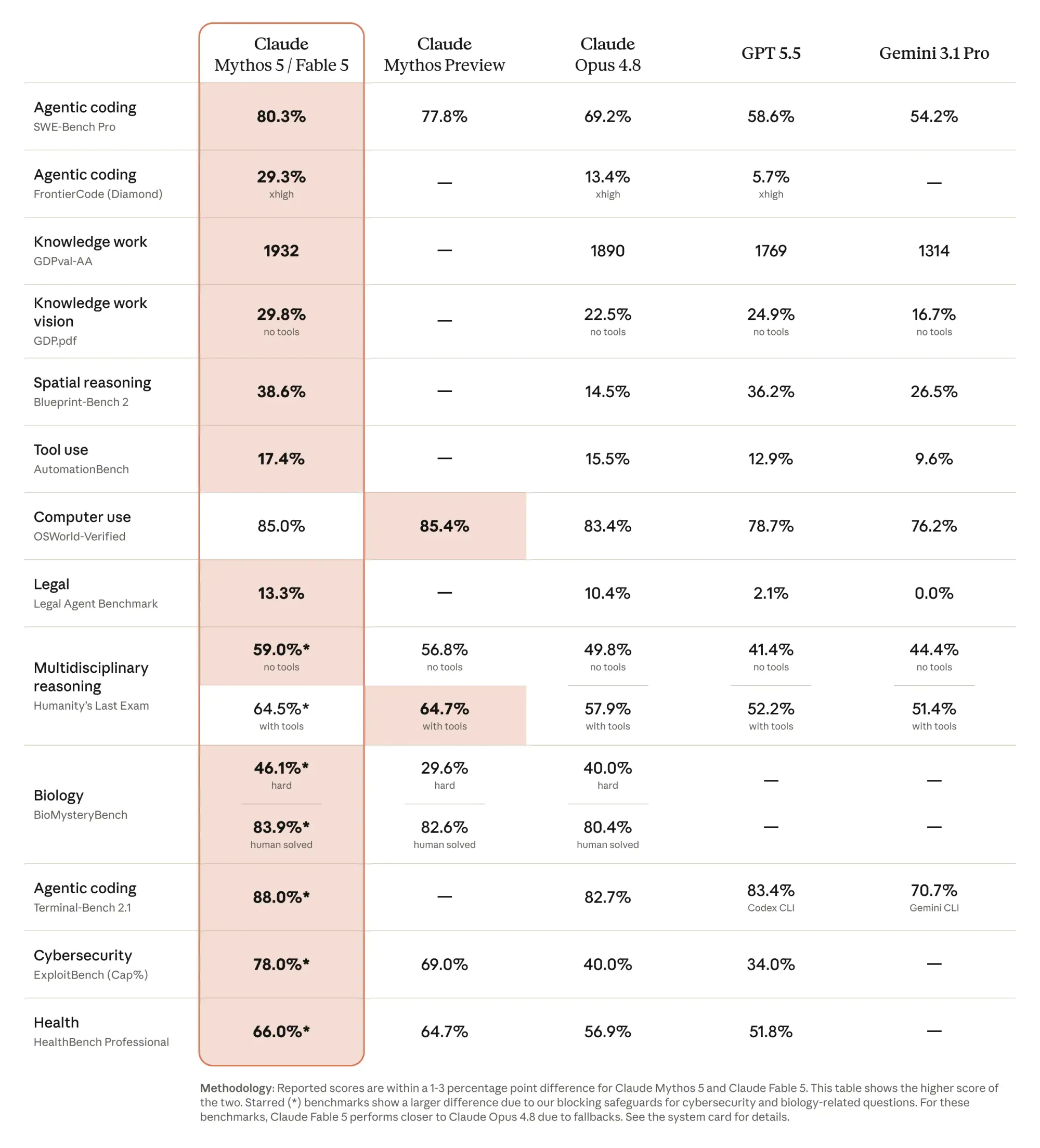
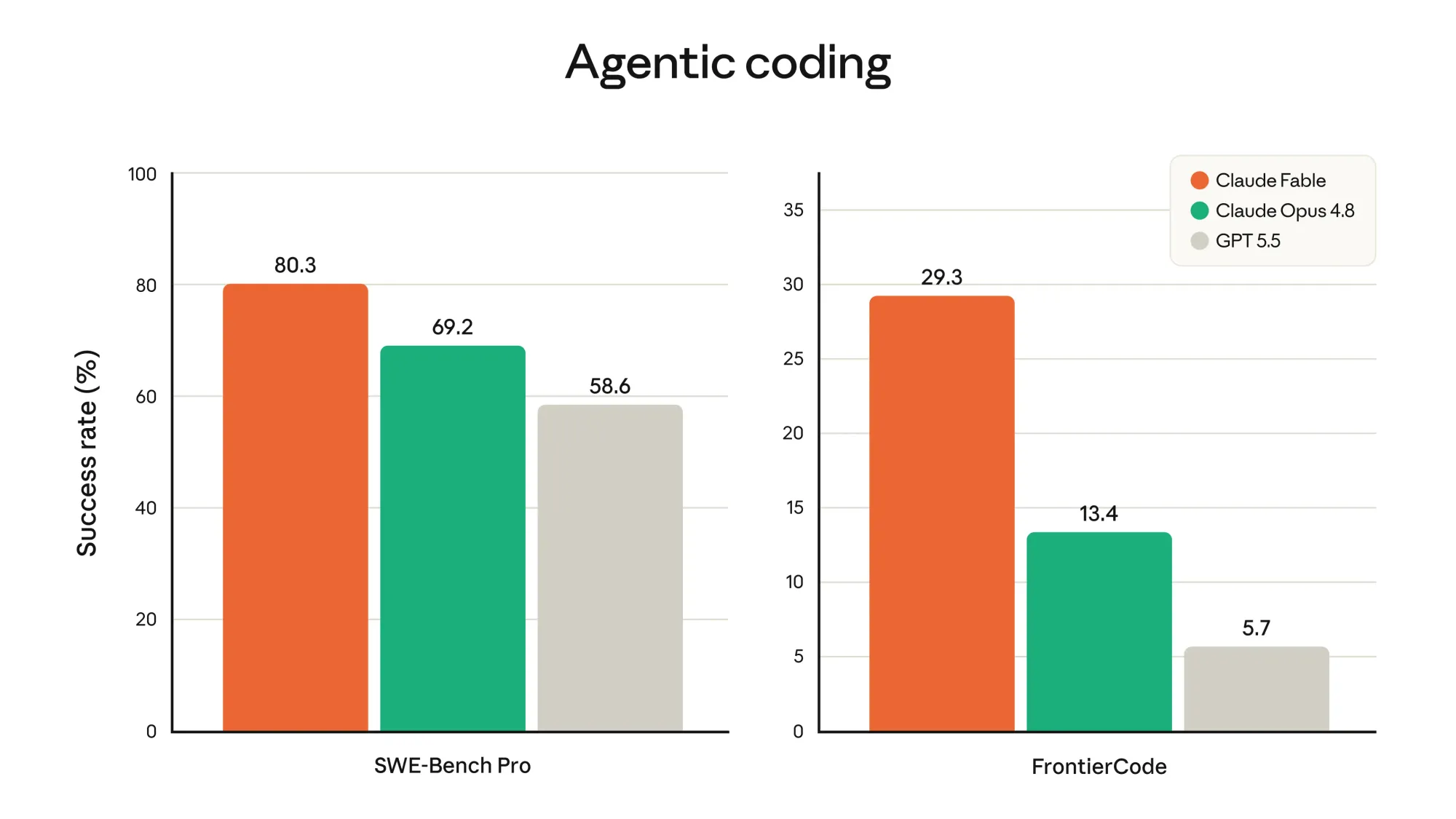
Technically, Fable 5 is being marketed as a major step forward in autonomous software engineering. Anthropic reports strong performance on benchmarks such as SWE bench Pro and Cognition’s FrontierCode, with substantial gains over earlier Claude models and leading general purpose systems. The core claim is that Fable 5 can not only write good code but also take on larger, multi step units of work with minimal supervision.
Customer examples in Anthropic’s launch materials make this concrete. Stripe tested Fable 5 in a 50 million line Ruby codebase and reports that the model completed a codebase wide migration in a single day, a task the company estimates would have taken a team more than two months by hand. Stripe’s characterization is blunt: “Fable 5 compresses months of engineering into days.”
Other early users reinforce this narrative. Cursor says, “Fable 5 is the state of the art model on CursorBench. It has opened up a class of long horizon problems that were out of reach for earlier models.” Replit reports that Fable 5 is its top performer on ViBench, its end to end “vibe coding” benchmark, and that it builds apps in less time with fewer tokens. Figma describes Fable 5 as “a clear step forward on agentic coding and prototyping.”
For CTOs and engineering leaders, the value proposition shifts from faster autocomplete to sustained execution. The promise is a model that can understand intent, plan steps, call tools, check its own work, and continue through a task without constant human steering. That opens the door to delegating entire epics: codebase migrations, refactors, app prototypes, test suites, and complex internal tools, not just individual tickets.
Beyond code: knowledge work and vision
Anthropic is also positioning Fable 5 as a stronger model for enterprise knowledge work. On GDPval AA, a benchmark for general purpose analytical work, Anthropic reports that Fable 5 and Mythos 5 score 1932, compared with 1890 for Claude Opus 4.8, 1769 for GPT 5.5, and 1314 for Gemini 3.1 Pro. On GDPpdf, which focuses on visual document reasoning, the models score 29.8 percent without tools, versus 22.5 percent for Opus 4.8, 24.9 percent for GPT 5.5, and 16.7 percent for Gemini 3.1 Pro.
These numbers matter because much of corporate work still lives in messy documents: PDFs, spreadsheets, charts, reports, contracts, filings, slide decks, and screenshots. Anthropic says Fable 5 shows meaningful gains in document based reasoning, chart and table interpretation, and complex problem solving. Analytics company Hex states that “Fable 5 is the first to break 90 percent on our core analytics benchmark of complex, long running analytical tasks, a 10 point jump over Opus.” Hebbia reports that Fable 5 is the highest scoring model on its Finance Benchmark for senior level reasoning.
Financial firms underscore the shift from summarization to higher stakes analytical workflows. IMC says Fable 5 “aced our trading analysis evaluations nearly across the board: factual lookup, conceptual reasoning, root cause analysis, expected value analysis.” Optiver notes that Fable 5 outperforms Opus 4.8 on its trading benchmark and remains “remarkably consistent,” with identical scores across repeated runs. Balyasny Asset Management calls Fable 5 the strongest finance first model it has tested.
Legal and operations use cases are emerging as well. Crosby Legal reports that “Fable 5 feels materially different. In blind review, our lawyers found its redlines matched or beat our current model every time.” Productivity platform Notion says the model can transform work “you would chip away at all afternoon” into a functioning project plan. Zapier says Fable 5 is the new leader on AutomationBench and is more autonomous than Opus 4.8: “Where Opus stops to ask, Fable 5 keeps looking.”
On the vision side, Anthropic describes Fable 5 as its strongest model yet. It can extract precise numbers from detailed scientific figures and perform complex vision based tasks such as rebuilding a web app’s source code from screenshots alone. Because many enterprise processes still depend on visual interfaces that are not neatly exposed through APIs, stronger vision matters. It allows agents to operate across dashboards, legacy UIs, scanned forms, and image heavy reports with less custom integration.
To illustrate long horizon visual reasoning, Anthropic highlights that earlier Claude models struggled to play Pokémon FireRed even with complex helper tools, while Fable 5 beat the game using a minimal vision only harness. The company shared a time lapse of this run on YouTube. In another internal test, Anthropic had the model play Slay the Spire with persistent file based memory. Providing this memory improved Fable 5’s performance three times more than it improved Opus 4.8’s, and Fable reached the game’s final act three times more often.
For enterprise users, the gaming examples point to a broader pattern: agents that can read a visual environment, remember what has happened, decide what to do next, and execute over long periods. That is exactly what internal agents need if they are to manage sales pipelines, long running migrations, financial models, or complex support workflows.
From restricted cyber model to general purpose enterprise AI
The Fable 5 and Mythos 5 launch builds directly on Anthropic’s April rollout of Claude Mythos Preview through Project Glasswing, a restricted program for cyber defenders, critical infrastructure providers, and major software maintainers. Anthropic created Glasswing after internal evaluations showed that Mythos class models could find and exploit software vulnerabilities at a level that raised serious misuse concerns. You can see Anthropic’s earlier framing of Mythos and Glasswing in its Project Glasswing announcement.
Governments and regulators took notice. Reports such as this piece from Nextgov describe how US officials and intelligence agencies began weighing how such models might reshape both cyber defense and offensive operations, while Senator Mark Warner warned that AI assisted vulnerability discovery should force industry to accelerate patching. The Guardian reported that Mythos entered discussions among senior banking officials and regulators in the US and UK, who worried that AI accelerated attacks could threaten payment systems and financial stability.
Demand has come from allies as well. Reuters reported that South Korea’s national internet security agency secured Mythos access through Project Glasswing, reflecting a geopolitical race to use frontier AI for national cyber defense. At the same time, Anthropic has faced scrutiny over whether it can safely gate capabilities it describes as too risky for general release. As The Verge reported, unauthorized users accessed Mythos after its limited rollout, an incident critics called damaging for a company that has built its brand around responsible AI.
With Fable 5, Anthropic is leaning into this gatekeeper role rather than backing away from it. The company is attempting to separate the general enterprise value of a Mythos class model from the riskiest parts of its capability profile. Fable 5 is designed to handle software engineering, research, visual reasoning, document analysis, and long running agentic workflows, while a classifier layer blocks or reroutes requests that could provide what Anthropic calls “uplift” to malicious actors. Those classifiers cover three main areas:
- Cybersecurity, where Mythos class models can discover and exploit vulnerabilities and perform broader “agentic hacking” tasks such as reconnaissance, discovery, and lateral movement.
- Biology and chemistry, where the same reasoning that can help design therapies could also help well resourced actors pursue dangerous biological work.
- Model distillation, where users might try to extract Claude’s capabilities to train competing models, including in jurisdictions with weaker safety regimes.
When Fable 5’s classifiers detect one of these categories, the response is handed to Claude Opus 4.8 instead of Fable. Anthropic emphasizes that users are informed when this happens. The design choice is notable: rather than hard rejecting these queries, Anthropic is trying to preserve a functional user experience while limiting access to the most capable version of the model.
Anthropic says it has extensively red teamed the classifier system internally and externally. According to its launch post and system card, an internal bug bounty produced no universal jailbreaks after more than 1,000 hours of testing, and external red teaming organizations also failed to find a universal jailbreak. One partner found that Fable 5 complied with zero harmful single turn cyber requests involving attack planning, exploit development, or defense evasion, even when prompts used 30 public jailbreak techniques.
At the same time, Anthropic acknowledges tradeoffs. The safeguards are deliberately cautious and may sometimes trigger on benign requests, a likely source of friction for security professionals, biology researchers, and advanced enterprise users whose legitimate work overlaps restricted areas. The company says it plans to narrow the classifiers and reduce false positives over time.
Mythos 5 and the restricted frontier
While Fable 5 is the broad commercial launch, Mythos 5 is the model to watch for enterprises operating in security, critical infrastructure, and life sciences.
Anthropic says all users with Claude Mythos Preview access can upgrade to Mythos 5 beginning today. It plans to expand access through a trusted access program in consultation with the US government and to open a separate trusted access program for biology that provides Fable 5 with biology and chemistry safeguards removed, but cyber safeguards left in place.
For sectors where the blocked capabilities are not edge cases but core workflows, this distinction is crucial. Security teams may need to reproduce vulnerabilities, test exploitability, analyze lateral movement, or simulate attacker behavior in a controlled environment. Biology research teams may need to reason through molecular design workflows that would consistently trip general use safeguards. Fable 5 is not intended to give unrestricted access to those capabilities. Mythos 5 is designed for vetted users who genuinely need them.
Anthropic claims that Mythos 5 has the strongest cybersecurity capabilities of any model in the world, citing benchmark results in its launch materials and system card. The company also argues that Mythos class models outperform dedicated protein language models on some tasks, and can materially accelerate parts of drug design. Internal experts reportedly used Mythos 5 with protein design and bioinformatics tools, but no human assistance, to match or beat skilled human operators across entire workflows from binding site selection to error recovery, with nine of fourteen protein targets producing strong candidates now under investigation.
The company further reports that Mythos 5 consistently produces novel molecular biology hypotheses that its scientists prefer over Opus class outputs about 80 percent of the time in blinded comparisons. One hypothesis involving an E. coli protein was later corroborated by an independent lab working on the same problem. Anthropic says it intends to publish more details in the coming months.
These are significant claims and should be evaluated carefully as more technical detail becomes available. For now, the key enterprise signal is directional. Anthropic believes that its highest end models can already perform substantial parts of scientific research workflows with less human intervention than previous systems.
New data retention requirement
Alongside the model launches, Anthropic is introducing a new data retention policy for Mythos class models. The company says it will require 30 day retention for all traffic on Fable 5, Mythos 5, and future models at similar or higher capability levels, across both its own products and third party surfaces. It commits not to use this data to train new Claude models or for non safety purposes, and says it has added privacy protections such as logging all human access and deleting data after 30 days in almost all cases. Additional details are provided in Anthropic’s support article on Mythos class data handling.
Anthropic frames this retention requirement as a necessary safety measure for models with this level of capability. The data is intended to help defend against complex and novel attacks, including new jailbreaks and multi step exploits, and to identify and reduce false positives in the classifiers.
For enterprises, especially in regulated sectors, this may become one of the most important buying questions around Fable 5. Many organizations want access to frontier AI capability but also demand strict control over data retention and access. Anthropic’s position effectively links access to its most powerful models with acceptance of a safety driven retention regime. Customers will have to decide whether the capability gains justify this governance tradeoff.
Pricing, rollout, and cost pressure
Anthropic is pricing both Fable 5 and Mythos 5 at 10 dollars per million input tokens and 50 dollars per million output tokens. The company notes that this is less than half the price of Claude Mythos Preview, but it is still double the price of Claude Opus 4.8 and among the most expensive major AI models available globally.
For developers, Fable 5 is available through the Claude API as claude-fable-5, and is fully accessible today on the Claude API and consumption based Enterprise plans. For subscription users, the rollout is intentionally staged. From launch through June 22, Fable 5 is included on Pro, Max, Team, and seat based Enterprise plans at no extra cost. On June 23, Anthropic plans to remove Fable 5 from those plans, after which using it will require usage credits. The company says it aims to restore Fable 5 as a standard part of subscription plans as soon as capacity allows and will communicate changes in advance. You can see current pricing in Anthropic’s Claude pricing page.
This approach reflects both Anthropic’s expectation of high demand and the operational realities of deploying a high end model at scale. It also creates a short window in which subscription customers can test whether Fable 5’s increased autonomy and quality justify its higher per token cost and associated governance and retention policies.
Cost is not a theoretical concern. Many enterprises are already scrutinizing AI budgets after seeing real bills. As coverage like this TechCrunch piece on AI token costs notes, advanced models can quickly drive runaway expenses, especially when used in agentic modes that split a single request into many sub tasks.
Anthropic expects demand for Fable 5 to be very high and difficult to predict. Some customers, like shopping rewards platform Rakuten, argue that the upside justifies the expense. Rakuten says, “At the highest effort, Fable reflects on and validates its own work. For us, that is what makes highly autonomous operations possible, the extra thinking pays for itself.”
Enterprise implications and governance lessons
The broader significance of Fable 5 and Mythos 5 is that Anthropic is trying to commercialize a more autonomous class of AI while keeping the most dangerous capabilities gated. That playbook could become a template for how frontier labs release increasingly powerful systems.
For developers, if Fable 5 performs as Anthropic and early customers describe, the next phase of adoption will be about handing off larger units of work: code migrations, refactors, UI builds, test writing, bug fixing, documentation, internal tooling, and multi step app creation. For knowledge work heavy enterprises, Fable 5 could make AI more useful in workflows where earlier models were too brittle, from finance research and spreadsheet analysis to legal redlines, procurement review, board materials, and complex project planning.
For security teams and life sciences organizations, the picture is more nuanced. Most enterprises will get Fable 5, not unrestricted Mythos 5. That means stronger general coding and analysis but not full exposure to the cyber or biological capabilities that Anthropic considers risky. Trusted defenders and researchers inside programs like Project Glasswing will get Mythos 5, giving them a more direct way to use the model for vulnerability discovery, defensive testing, and advanced scientific workflows.
From a governance perspective, the launch makes four points clear:
- Capability and control are now productized together. Safeguards, classifiers, trusted access, and data retention are no longer peripheral concerns, they are core attributes of the offering.
- Tiered access to a single model family is likely to become standard. Enterprises will choose not just which model to use, but at what access level and under what policy constraints.
- Internal governance needs to mirror external governance. If Anthropic is implementing classifier layers, fallback routes, and trust programs at the provider level, boards and C suites will need their own internal equivalents: access controls, runtime monitoring, domain specific policies, and audit ready processes.
- Tradeoffs between capability, cost, and control are sharpening. Models that “compress months of engineering into days” and carry out complex analytical and agentic workflows without constant supervision are immensely attractive. They are also expensive, in tokens and in governance burden.
Opus is no longer Anthropic’s top commercial capability tier. Mythos class models now sit above it. Claude Fable 5 is the first version of that tier for general users. Claude Mythos 5 is the restricted version for trusted high risk work. Together they show how Anthropic plans to push frontier AI deeper into enterprise workflows while trying to keep the most dangerous capabilities gated and monitored.
If you are taking this into a boardroom or ELT conversation, the next question is simple and uncomfortable: are your internal governance systems ready for a model that behaves less like a tool and more like an operational actor inside your enterprise?


