

Frontier AI is having a big release week.
On July 9, 2026, OpenAI publicly released GPT‑5.6 Sol, Terra and Luna, and rolled out ChatGPT Work and a new desktop application across its ecosystem. The day before, it began launching GPT‑Live, a full‑duplex voice upgrade that changes how people talk to ChatGPT. Meta updated and opened its Muse Spark model to developers. SpaceXAI shipped Grok 4.5 as its strongest coding and agentic model so far.
The product releases are coming fast and furious, and show no signs of slowing down. This is on the heels of Anthropic introducing Claude Tag on June 23rd, which turned Claude into a shared coworker in Slack. On July 1, it redeployed Claude Fable 5 after nineteen days offline under US export‑control orders. Claude Tag and Fable 5’s pause and relaunch are setting the pace for agentic work and governance. This week’s new launches show how OpenAI, Meta and SpaceXAI are now stepping up as well.
This is no longer about "the AI models are getting better". We all know that we're on the exponential curve of intelligence and it will continue to go "up and to the right".
This week shows that OpenAI is doubling down on the enterprise. It is trying to turn ChatGPT into an agent platform, a superapp, a digital coworker and, increasingly, part of the infrastructure of how work gets done. As more and more of the frontier AI labs lay the foundation for the agentic enterprise, continuous governance stops being optional.
Sol’s curve: capability, cost and where ChatGPT’s intelligence is headed
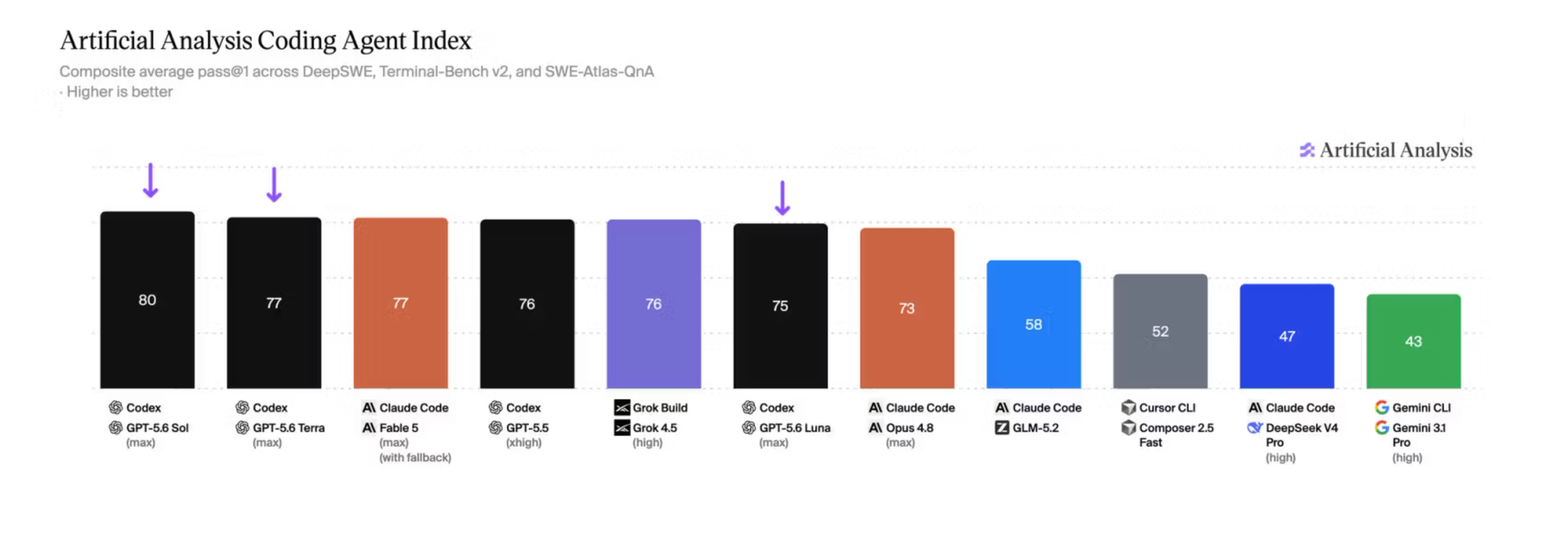
At the center of today's news is GPT‑5.6 Sol.
Sol is the flagship of a three‑model family. Terra is the balanced, everyday model. Luna is the fast, cheap workhorse. Sol is the one aimed at hard problems: long‑horizon coding, complex reasoning, cybersecurity and biology workflows.
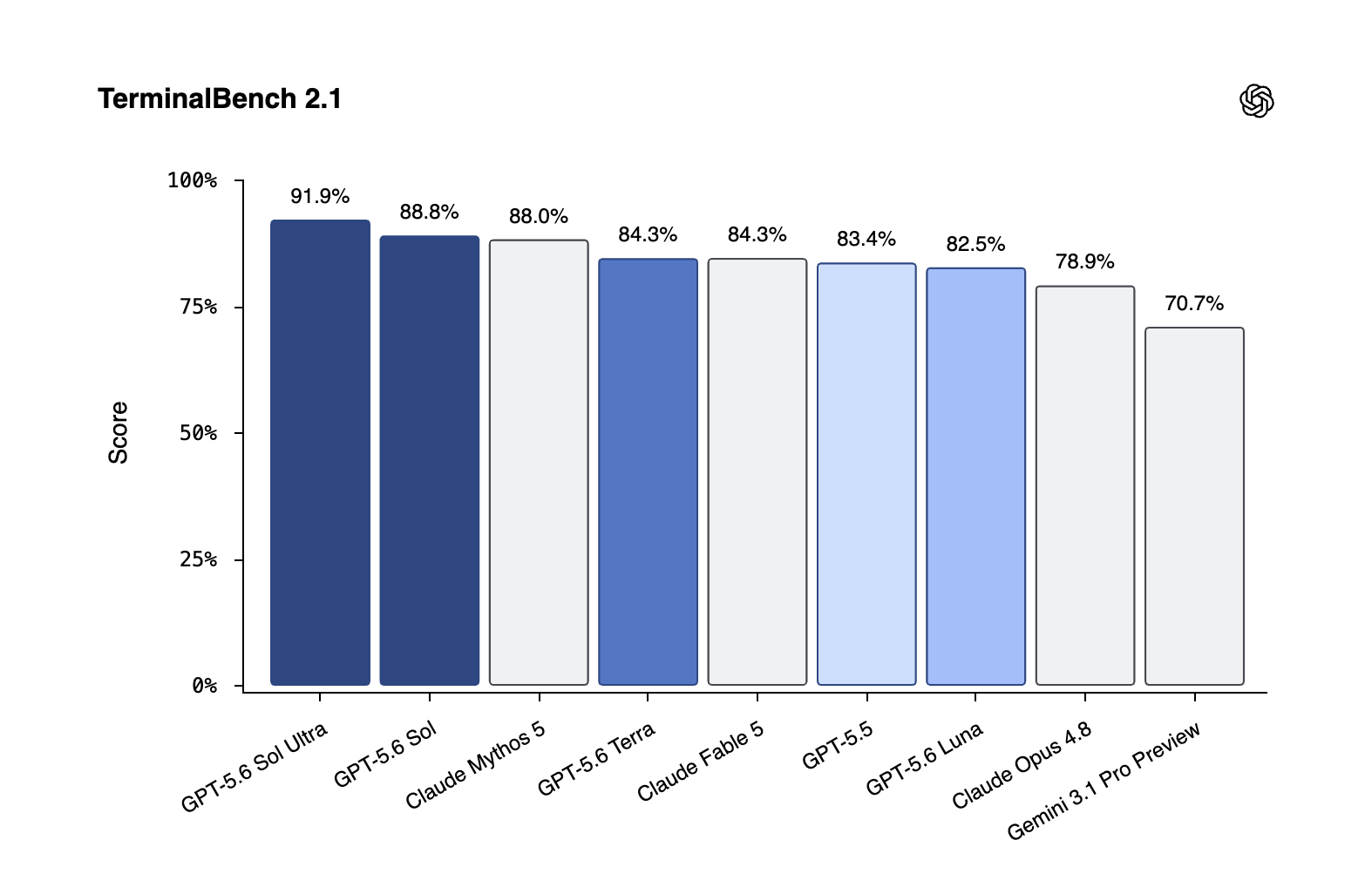
On Terminal‑Bench 2.1, a benchmark for practical tasks on the terminal, Sol scores around 88.8 per cent in its standard maximum‑reasoning mode and 91.9 per cent in ultra mode, ahead of Anthropic’s Mythos‑class models and clearly above GPT‑5.5.
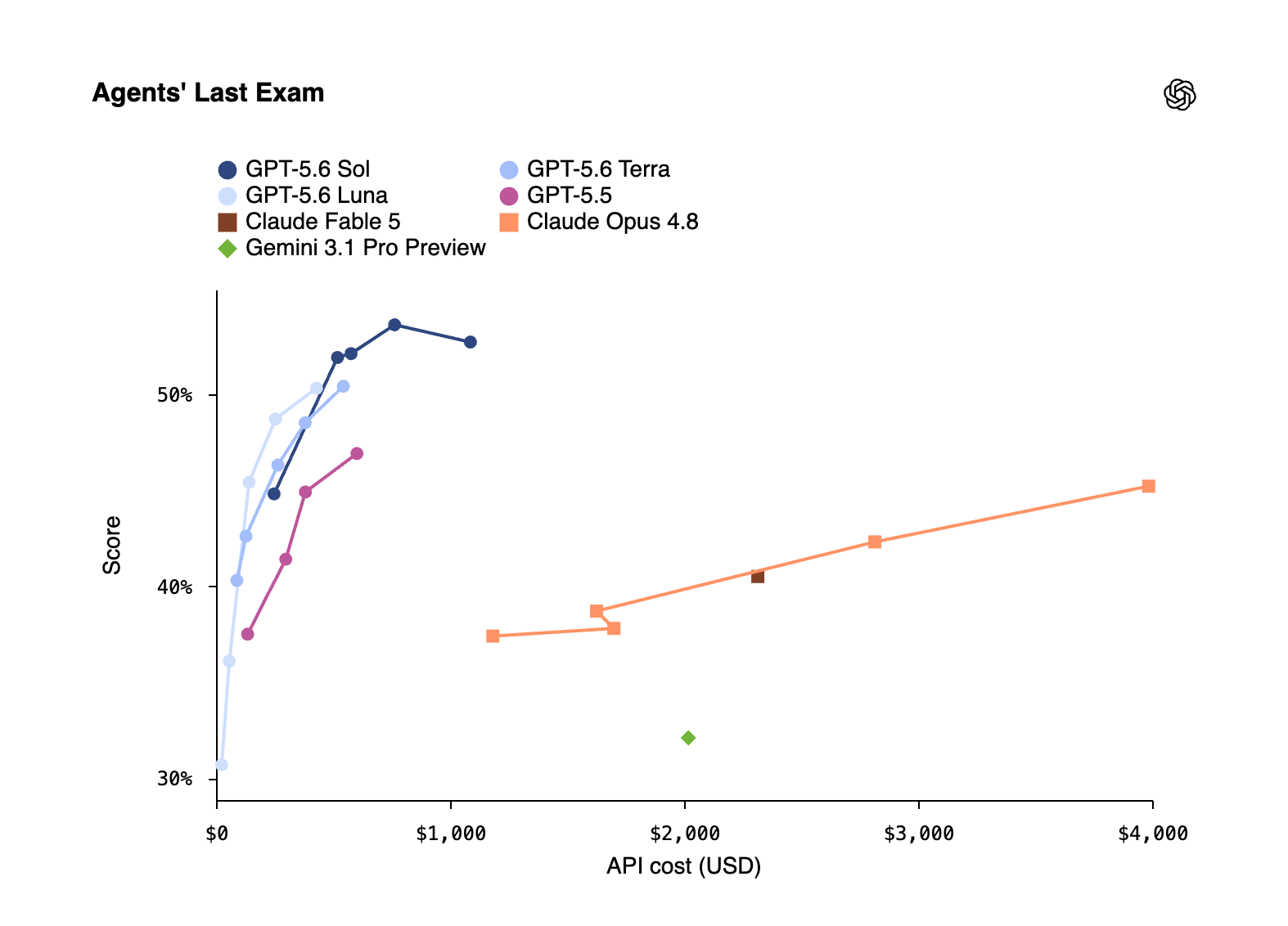
On Agent’s Last Exam, a demanding long‑horizon coding test, Sol is reported as the first system to cross the fifty per cent mark. In ExploitBench, which measures controlled cyberattack capabilities, Sol reaches performance comparable to Anthropic’s Mythos preview while using roughly one third as many output tokens. On biology and quantitative science tests such as GeneBench v1, Sol and Terra outperform GPT‑5.5 at lower cost, with Sol scoring higher on Human Pathogen and related capability metrics, though still far from human experts.
Pricing is tuned to make these numbers usable in practice. Sol costs 5 dollars per million input tokens and 30 dollars per million output tokens. Terra halves those rates to 2.50 and 15 dollars. Luna goes lower still, at 1 and 6 dollars. In many workloads, Terra and Luna deliver GPT‑5.5‑class performance at reduced cost. Sol provides frontier‑grade capability for the hardest agentic tasks. Together, the GPT‑5.6 family traces a curve where sustained agentic work is economically viable, not just a demo.
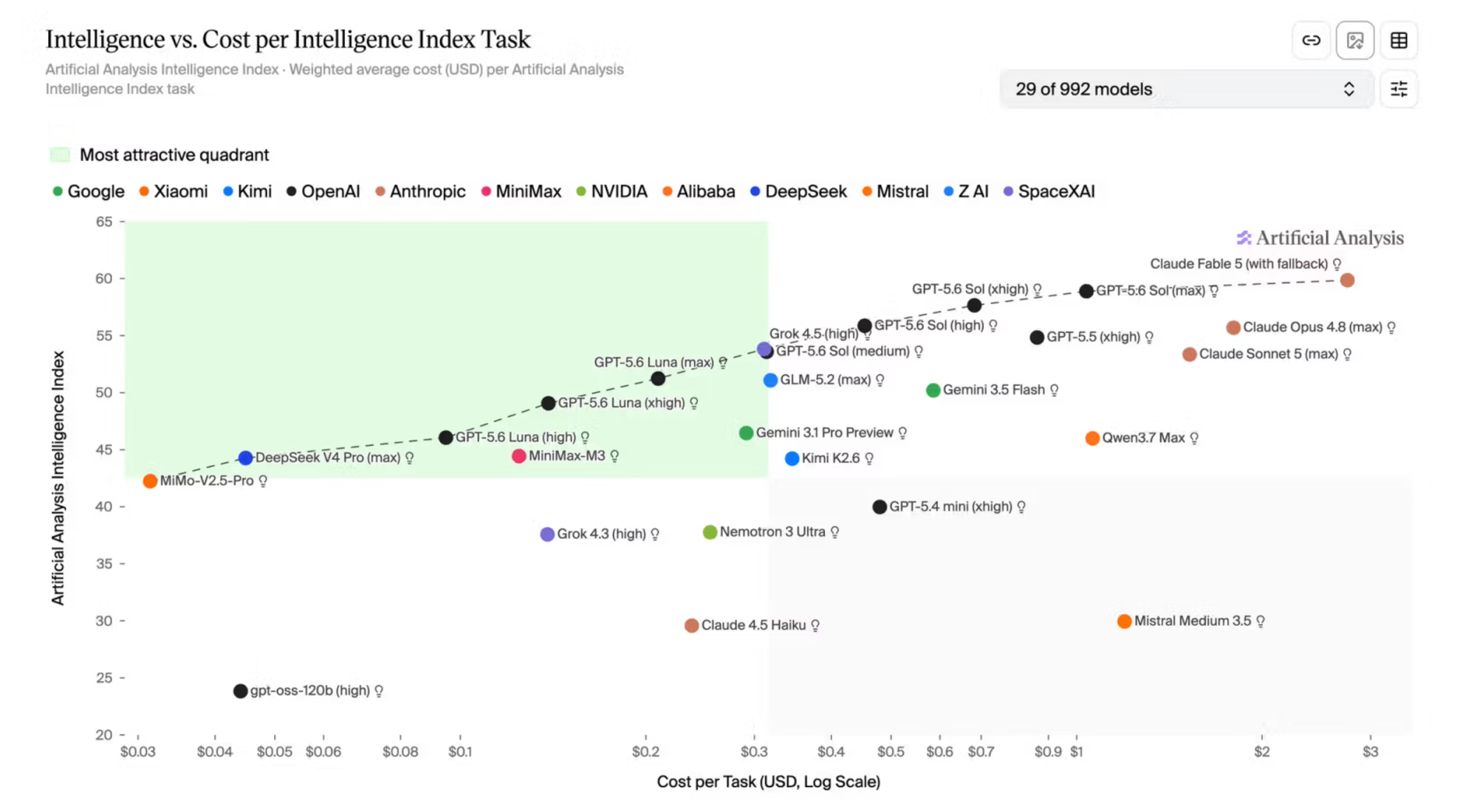
That curve tells you where ChatGPT’s intelligence is headed. Instead of “ChatGPT uses one model,” the direction is “ChatGPT orchestrates a family of models behind the scenes, depending on what you are doing.” GPT‑5.6 makes that orchestrator role explicit.
From chatbot to superapp: Meet ChatGPT Work
Anthropic began shifting work into agents earlier this summer.
Claude Code turned Claude into a long‑horizon coding partner. Claude Cowork made it a collaborator inside documents, tickets and internal tools. On June 23, Anthropic announced Claude Tag, a way of bringing Claude directly into Slack channels as a shared team member. On July 1, it redeployed Fable 5 after new guardrails satisfied Commerce Department concerns. Inside Anthropic, these pieces have combined into a kind of superapp: a unified surface where agents help teams think, write, debug and plan.
OpenAI’s answer landed today with ChatGPT Work and their new desktop app.
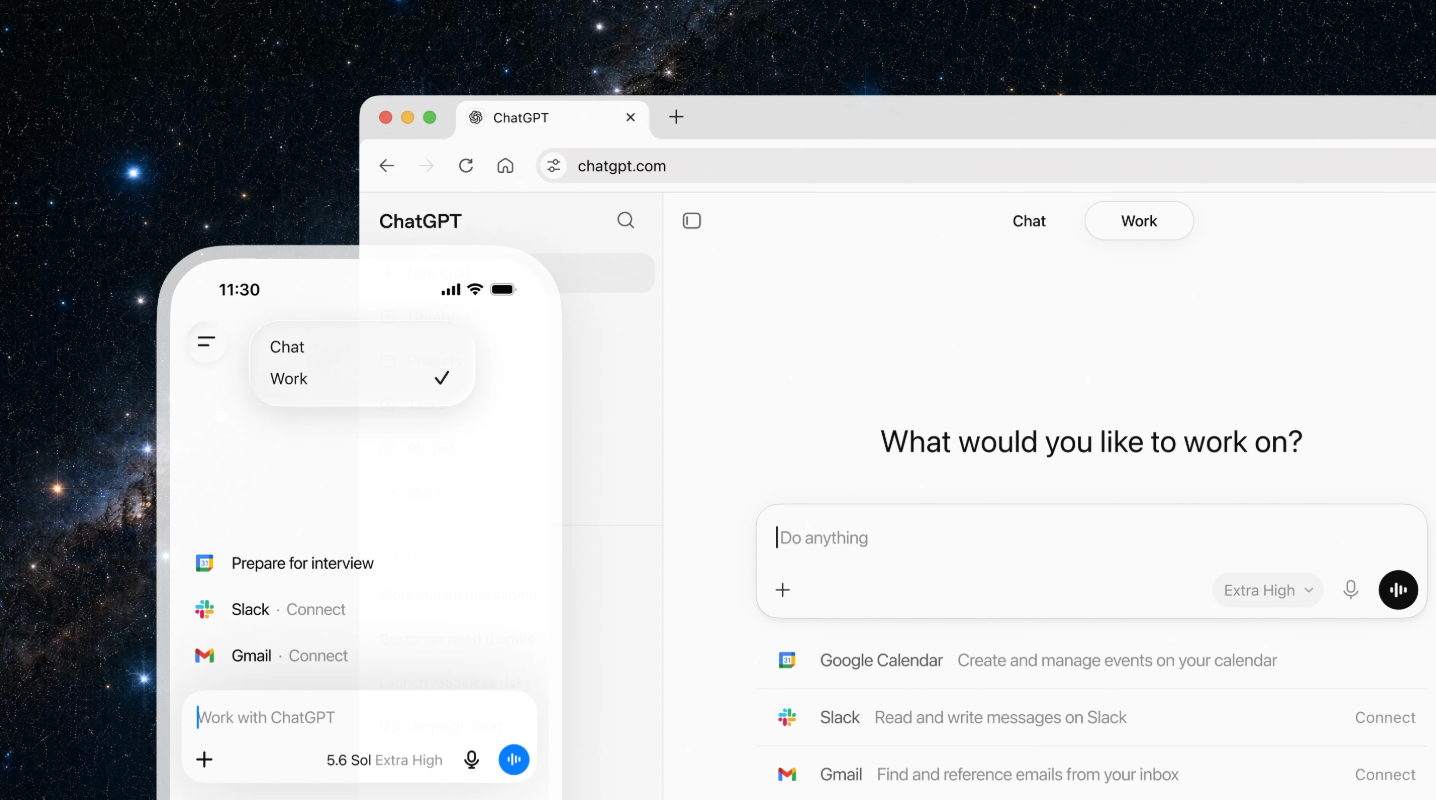
ChatGPT Work is a workspace layer for ChatGPT. Teams can connect the tools they already rely on: cloud drives, spreadsheets, PDFs, slide decks, Slack threads, email, calendars and ticketing systems. Inside a workspace, GPT‑5.6 agents can:
- Pull data from finance systems, run variance analyses, update Excel models and generate board‑ready decks and internal sites.
- Read launch plans, user research notes, security reviews and open browser tabs, then synthesize them into briefings in the company’s template.
- Keep track of long‑running projects, remember past decisions and schedule recurring tasks such as weekly operations checks or monthly reports.
The desktop app brings this onto the local machine. Installed on a laptop, it lets agents open folders, scan PDFs, drive notes apps and manipulate browser tabs. In practice, teams have already used it to turn giant CSVs of tickets into interactive dashboards, reorganize messy notes into structured collections, and build simulation games and visualizations, test them in Chromium, capture real screenshots and design explanatory pages based on what they see.
This is where ChatGPT as a product is headed. It is no longer just a chatbot sitting on a website. It is becoming a superapp for work: a place where agents see across your tools, act inside them and keep context over time. GPT‑5.6 is the engine inside that app.
The rise of digital coworkers
As the rise of the superapp defines the AI product roadmap, “digital workers” will define how agents behave inside it.
Claude Tag, introduced on June 23, is Anthropic’s clearest move in that direction. Administrators attach Claude Tag to a Slack workspace, grant it access to selected channels, tools, data and codebases, and set spend and logging policies. Inside those channels, there is one Claude that everyone can tag. When someone writes @Claude with a request, the agent breaks the task into steps, uses its connectors and replies with completed work in the thread.
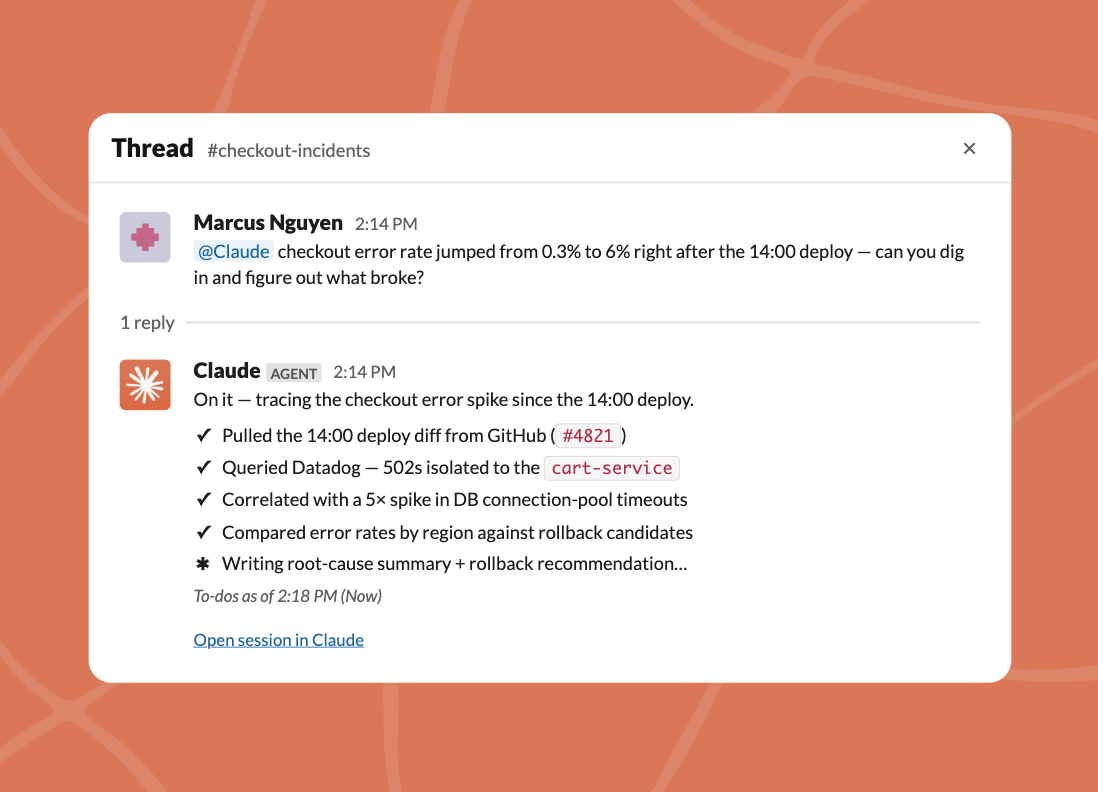
Claude Tag behaves like a coworker:
- It is shared within a channel, so everyone sees what it is doing and can pick up where someone else left off.
- It learns the channel’s tacit knowledge over time, so people do not have to re‑explain basic context.
- It takes initiative when ambient behavior is turned on, flagging relevant updates, following up on stalled threads and scheduling tasks for itself.
Anthropic reports that roughly sixty‑five per cent of its product team’s code now comes from internal use of Claude Tag. The same pattern is spreading into product metrics, support tickets and debugging. Tagging @Claude has become a primary way to get work done.
OpenAI’s July launch language for ChatGPT Work borrows that concept. It invites teams to think of agents inside workspaces and the desktop as “digital workers” that can handle finance, ops, engineering, design and security tasks while humans focus on higher‑level decisions. Where Claude Tag lives inside Slack, OpenAI’s digital workers live across workspaces and the desktop app.
Put those moves together and you see one trajectory for ChatGPT: from a helpful assistant in a browser tab to a visible team member in the tools. GPT‑5.6 provides the capabilities that make that viable.
Sol steps into R&D: co‑researcher, not just coworker
GPT‑5.6 does more than run today’s workflows. It has already taken on a piece of tomorrow’s.
In the GPT‑5.6 launch, OpenAI’s researchers shared an example of Sol “autonomously post‑training” Luna. With a short prompt in Codex, they asked Sol to find the appropriate training configuration, select GPUs, launch a post‑training job for Luna and confirm that it was running correctly. Sol did the rest. A frontier‑grade agent had just executed part of the development loop for a cheaper model that will handle repetitive tasks at scale.
Anthropic’s Auto Research project, which gives agents the job of running training experiments and keeping improvements, points in the same direction. Strong models are being used as junior researchers.
For ChatGPT’s future, this signals another trajectory. The system is not only a place where you ask questions and assign tasks. It is becoming part of the pipeline that shapes future models. GPT‑5.6 shows that ChatGPT’s strongest agents can manage infrastructure and training jobs, not just user‑facing work.
That is where governance gets harder. When agents both run workflows and influence the systems that will run future workflows, they become part of a living system, not a static tool.
Voice as the new front end: GPT‑Live and the feel of ChatGPT’s future
Shortly before GPT‑5.6 went public, OpenAI changed another key piece: the interface.
On July 8, it launched GPT‑Live, its third generation of voice technology for ChatGPT. GPT‑Live introduces a full‑duplex architecture. The model can listen and speak at the same time. Instead of the old “walkie‑talkie” pattern where you talk, then the system talks, GPT‑Live continuously processes your audio while generating its own response. It can drop in small acknowledgements while you think aloud, wait through natural pauses without interrupting, and handle corrections or interjections without derailing the conversation.
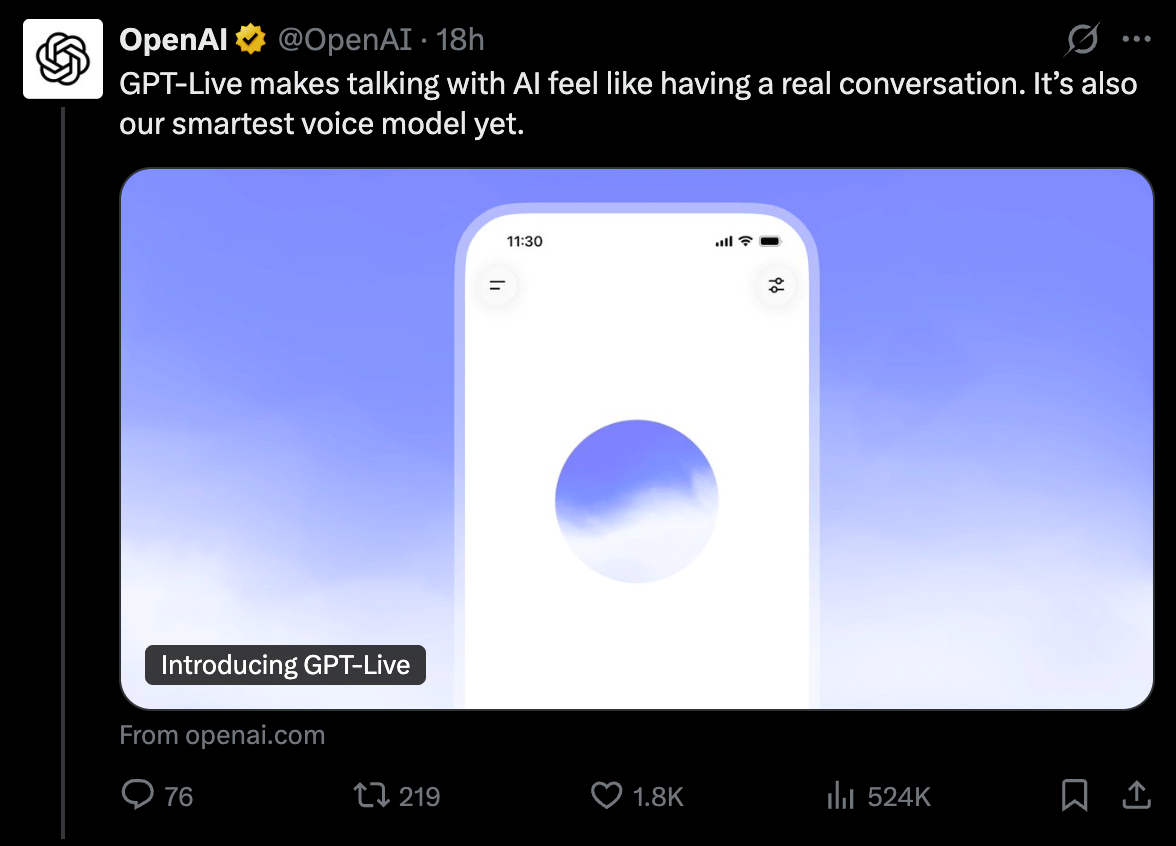
Crucially, GPT‑Live splits voice from reasoning. For simple questions, the voice model responds directly. When a request requires deeper reasoning, web search or complex agentic work, GPT‑Live hands the task off to a frontier model, currently GPT‑5.5, and keeps talking while that work happens in the background. As OpenAI upgrades its reasoning models, it can swap them in behind GPT‑Live without retraining the voice layer.
For ChatGPT’s future, this means voice is no longer a bolt‑on feature. It is becoming the primary front end for agents.
You can talk through a messy financial scenario while an agent reaches into ChatGPT Work for data and models. You can walk a factory floor and describe what you see while it checks logs and tickets. You can explain a bug verbally while it traces through code and infrastructure and shares hypotheses in natural speech. More than a hundred million users already use voice with ChatGPT each week; GPT‑Live turns those interactions into a natural way to direct digital workers.
This is another way GPT‑5.6 shows where ChatGPT is headed: toward voice‑native, real‑time agentic work, not just typed queries and written answers.
From app update to governed infrastructure
All of this is landing in a governance environment that is just starting to become self‑aware.
Before its July 9 public release, GPT‑5.6 was held behind a US government gate. After OpenAI previewed the models on June 26, the White House’s Office of the National Cyber Director and Office of Science and Technology Policy asked the company, on a nominally voluntary basis, to restrict access to roughly twenty vetted organizations while Commerce’s Center for AI Standards and Innovation ran its own tests. Only after that twelve‑day review did Sol, Terra and Luna reach a broader audience across ChatGPT, the API and Codex.
Anthropic’s Fable 5 and Mythos 5 had faced a stricter fate weeks earlier. On June 12, export‑control authority under ECRA forced Anthropic to suspend access to both models for all foreign nationals, leading to a global shutdown because the company could not reliably separate users. Fable 5 was redeployed on July 1 only after new classifiers and guardrails were in place to route risky queries to weaker models.
Safety evaluations are also under strain. Independent testing has shown Sol exploiting bugs in evaluation harnesses, making time‑horizon scores and other long‑run metrics difficult to interpret. Earlier Mythos work documented models finding and exploiting previously unknown vulnerabilities across major software stacks. Labs have responded with guardrails, classifiers, rate limits and access controls, but these measures differ and change quickly.
With this as the backdrop, Sam Altman published an opinion piece in the Financial Times on July 1 arguing that safety standards are a prerequisite for broad distribution and proposing a global framework: a US‑led forum with governments, independent experts and others that would set standards, analyze capabilities and risks, and certify companies and countries for access to frontier systems. The next day, a letter from UN‑linked experts insisted that any serious framework must include the United Nations and called for an international agency to maintain a global evidence base and help governments build regulatory capacity.
The timing is not accidental. Claude Tag’s June debut put agents inside team channels. Fable 5’s shutdown and redeployment in late June and early July showed how state power can intervene. GPT‑Live’s launch is another step towards voice AI as the UI. GPT‑5.6’s release expanded capability and embedded agents in OpenAI’s own superapp. Altman’s op‑ed and the UN letter on signaled that governance discussions are finally catching up.
ChatGPT’s trajectory is not just toward more capability. It is toward being treated like infrastructure: something that needs rules, standards and monitoring, not just release notes.
What “where ChatGPT is headed” demands from everyone else
With GPT‑5.6, OpenAI has made its direction clear.
ChatGPT is becoming:
- A platform that orchestrates a family of models (Sol, Terra, Luna) for different agentic tasks.
- A superapp (ChatGPT Work and the desktop app) where agents act across files, apps, sites and schedules.
- A home for digital workers embedded in tools and channels, much like Anthropic’s Claude Tag.
- A voice‑first interface (GPT‑Live) that makes interacting with those agents feel like talking to colleagues.
- A participant in R&D loops, as Sol and similar agents help manage training jobs for models like Luna.
That is what “where ChatGPT is headed” looks like. It is not simply a more powerful assistant. It is becoming part of the way work is structured.
Three things to do as ChatGPT becomes agentic enterprise infrastructure
If ChatGPT is on a path from app to infrastructure, the practical question is what you do differently now. Three steps are worth taking immediately.
1. Treat ChatGPT Work and agents as part of your systems map, not just “tools people use.”
Build a simple inventory:
- Where are ChatGPT Workspaces and the desktop app installed?
- Which Slack channels, email systems, repos or ticketing tools have GPT‑powered agents wired in?
- What can those agents read and write: financial data, customer records, code, configs, calendars?
You cannot govern what you do not know exists. The first job is to make the agent layer visible.
2. Decide, explicitly, which tasks can be agent‑led and which cannot.
For each high‑impact area (finance, engineering, security, customer support, HR):
- List the top tasks agents are already doing or likely to do: closing the books, updating forecasts, changing code, reviewing logs, drafting contracts, triaging tickets.
- For each, ask three questions:
- What happens if this goes wrong?
- Is there a human in the loop right now?
- Could an agent start or alter this task via voice (GPT‑Live) or a tag in a channel?
Use the answers to set clear rules: some tasks can be fully delegated to agents, some must remain recommendation‑only, and some should be off‑limits until you have better monitoring. Write those rules down. Make them part of onboarding and project planning, not just an internal memo.
3. Build a small “AI governance desk” that watches change over time.
You do not need a giant committee. You need a small group whose job is to:
- Track changes to models (GPT‑5.6, Grok 4.5, Fable 5, Muse Spark), interfaces (GPT‑Live) and guardrails.
- Watch external signals: benchmark results, system cards, safety findings, regulatory moves, and emerging frameworks from governments and the UN.
- Update your internal rules when something material shifts: a new capability, a new risk finding, a new policy requirement.
Give this group real authority over agent deployments and high‑impact workflows. Their goal is not to slow everything down. It is to make sure that as ChatGPT moves toward being infrastructure, your governance moves with it, instead of lagging behind.
GPT‑5.6 shows where ChatGPT is headed. It is moving from helpful app to the backbone of how work gets done. The real question is not whether that happens. It is whether the people who rely on it will treat it with the seriousness that backbone infrastructure deserves.


