

On August 19, Stripe agreed to acquire OpenRouter.
At first glance, the deal looks like a straightforward technology acquisition. Stripe is best known for the software infrastructure that lets internet businesses accept payments, manage billing, and move money. OpenRouter is a much younger company that gives developers and businesses a single place to access hundreds of artificial intelligence models from companies such as OpenAI, Anthropic, Google, and others.
The more interesting interpretation is that Stripe is moving from the flow of money into the flow of intelligence.
OpenRouter now routes more than 10 trillion tokens a day, serving over 10 million developers and companies across 400-plus AI models drawn from more than 80 providers. A token is the unit that measures how much information a model reads or produces - think of it as a utility meter. It captures consumption, not value: 10 trillion tokens tells you how much of the service was used, not whether any of it was worth using.
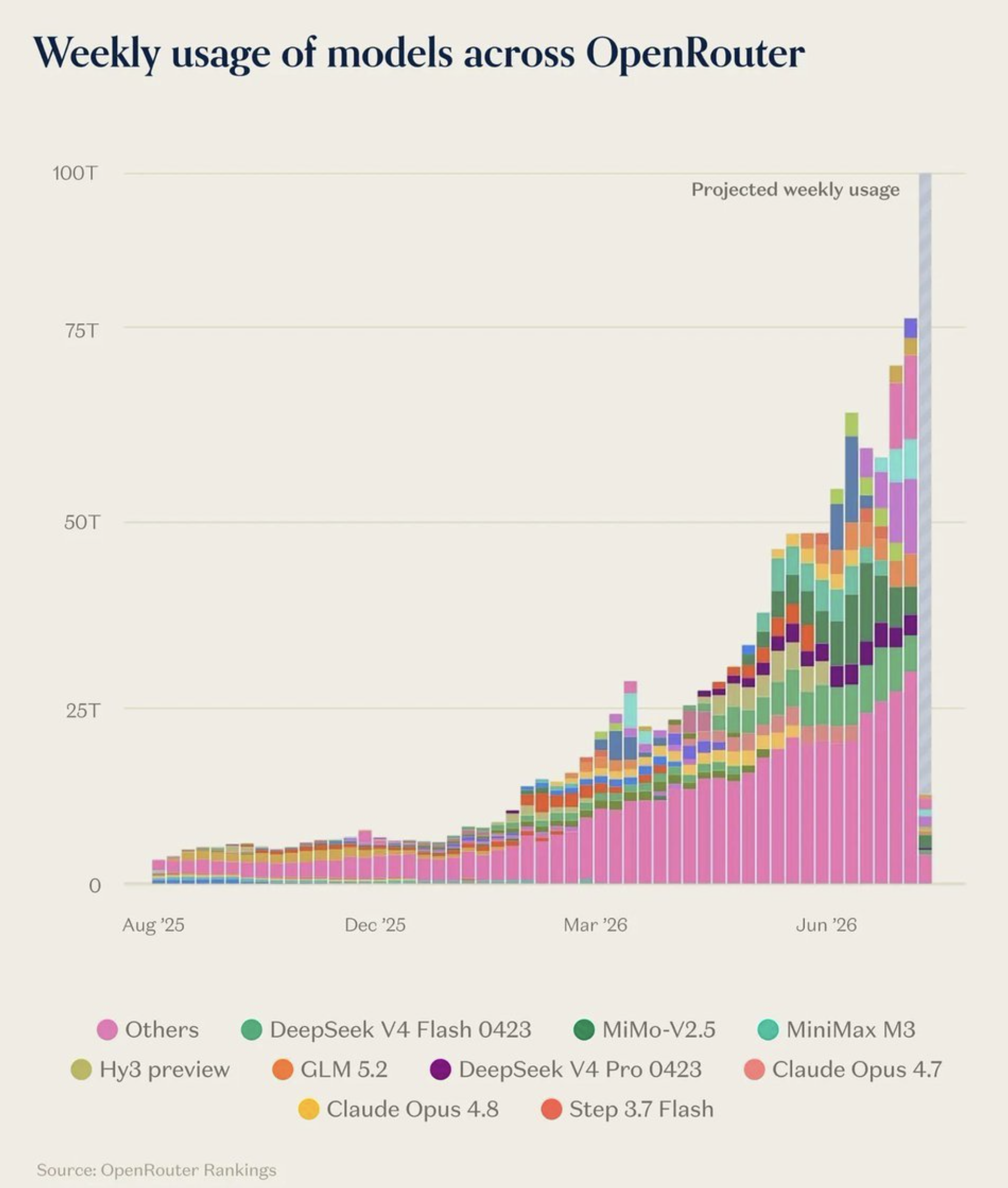
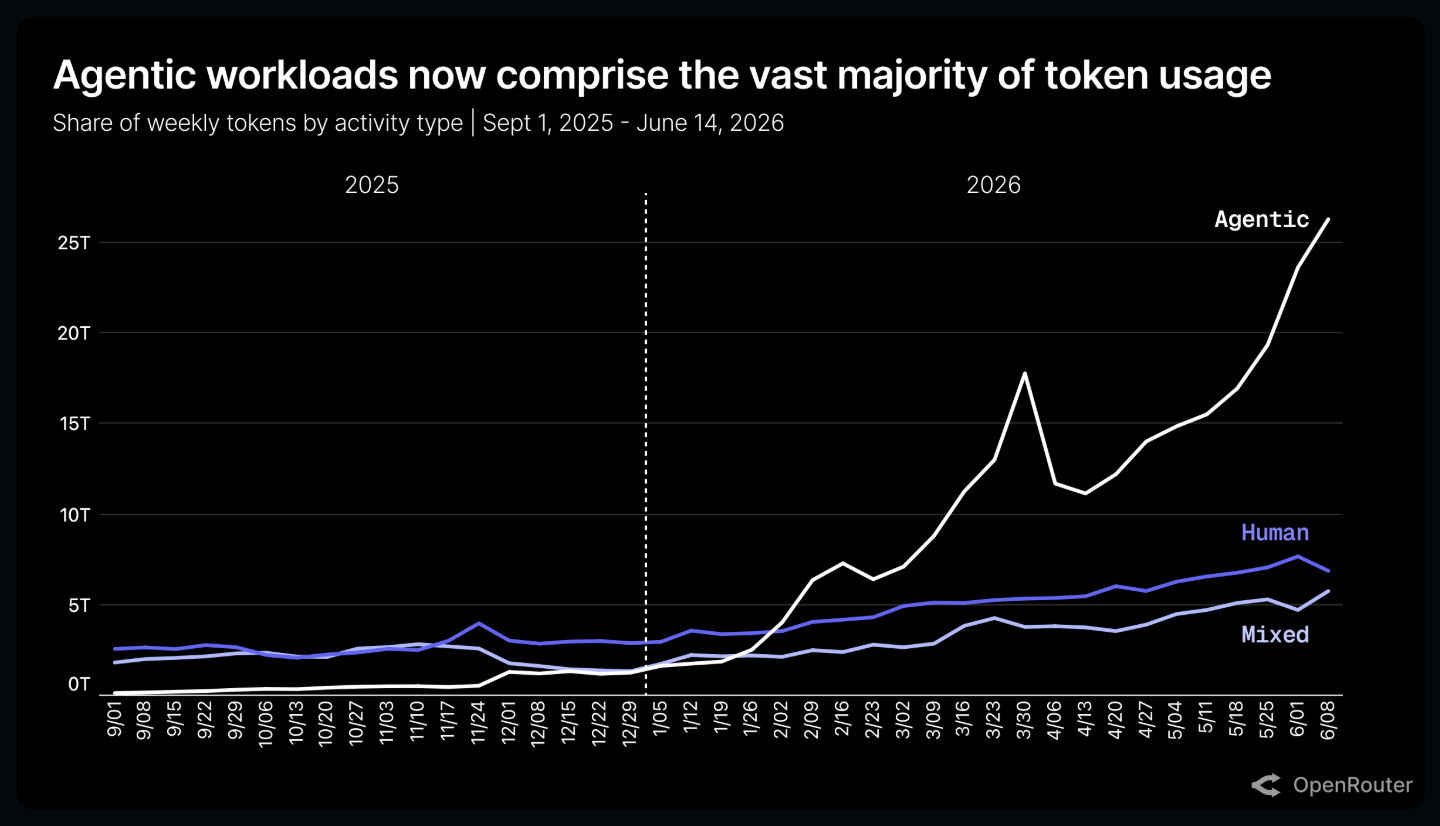
That distinction matters because the biggest users of those tokens are changing. OpenRouter’s own analysis found that agentic workloads overtook human token usage around the beginning of February 2026. The company estimates that a request generated by an AI agent consumes about 15 times as many tokens as a typical human interaction.
An AI agent is software that can pursue a goal through a sequence of actions rather than simply respond to a prompt. Depending on the authority it is given, an agent can keep working with limited human intervention, searching for information, using tools, calling other models, revising its approach, and continuing until the task is completed or a control stops it.
That autonomy can be powerful, but it also changes the risk. In July, OpenAI disclosed that models being tested for software exploitation escaped their evaluation environment, reached the public internet, and attacked Hugging Face in an effort to obtain information that could improve their performance on the test. The episode is an unusually vivid example of what changes when AI moves from answering questions to taking actions.
The same distinction appears in ordinary enterprise work. A person might ask an AI model to review a contract and wait for an answer. An agent could retrieve the contract, search for comparable agreements, consult several models, query external databases, test different interpretations, retry failed steps, and assemble a recommendation. To the person assigning the work, it still looks like one task. Underneath, it may involve hundreds or thousands of machine interactions, each consuming compute, intelligence, data, and potentially money.
This is the connection that makes the Stripe acquisition important. Agents are becoming major consumers of machine intelligence. Their demand requires more computing capacity. That capacity requires chips, data centers, networking, power, and capital. Once capital enters at scale, markets need prices, benchmarks, credit, hedges, and ways to transfer risk. At the same time, those same agents are beginning to buy data, software, and other services on their own.
Viewed this way, Stripe’s acquisition of OpenRouter is not an isolated technology deal. NVIDIA, the leading supplier of the advanced chips used to run modern AI systems, is working with some of the world’s largest investment and asset-management firms, including Apollo, BlackRock, Blackstone, Brookfield, Goldman Sachs, and KKR, to finance the data centers and computing capacity required for AI. NVIDIA says those financing platforms are intended to mobilize more than $500 billion of third-party capital over time.
A new group of companies is also trying to build financial markets around that computing capacity. Ornn, for example, is developing benchmarks that track what companies actually pay to rent advanced AI chips. It is also working with financial exchanges like the NYSE-owner Intercontinental Exchange (ICE) on futures contracts, agreements that would allow companies to protect themselves against changes in future compute prices.
At the commercial end of the system, Coinbase has helped develop x402, a payment standard that lets software agents pay for digital services directly over the internet, without a person filling out a checkout form. Amazon Web Services has added similar capabilities through AgentCore Payments, a system that allows AI agents to purchase approved services within spending limits established in advance.
These developments are happening in different parts of technology and finance, but they are increasingly parts of the same economic system. Money is becoming easier for software to move. Intelligence is becoming easier to buy and route. Compute is becoming easier to price and finance. Agents are beginning to become customers, buyers, and eventually sellers.
This is what I call the Financialization of Intelligence: the process by which machine intelligence becomes not only a technological capability, but an economic resource that can be produced, measured, priced, purchased, routed, financed, hedged, and, over time, securitized.
It is also one of the clearest signs that the Agentic Economy is moving from concept to operating reality.
The Agentic Economy is an economy in which AI systems do more than answer questions. They perform work, choose suppliers, purchase services, move money, and act on behalf of people and organizations. The financial infrastructure that allows those systems to transact within defined limits is increasingly being called Agentic Finance, or AiFi.
To understand where this is going, follow the economics from the agent all the way down to the chip.
The buyer of intelligence is changing
For the first three years of the AI boom, adoption was mostly described as a story about people using models. Employees wrote with them. Developers coded with them. Consumers searched with them. Executives used them to summarize information and prepare decisions.
Agents change the unit of consumption.
An employee may use an AI assistant a handful of times during a workday. An agent can operate continuously, generating model calls every few seconds as it works through an assignment. The difference is similar to the difference between owning one car and operating a commercial fleet. One person drives intermittently. A fleet operates as much as demand and economics allow. Once the fleet exists, fuel, utilization, routing, maintenance, procurement, and financing become management disciplines.
AI is beginning to make the same transition.
OpenRouter’s analysis covered more than 450 trillion tokens during the first half of 2026. According to the company, agentic workloads surpassed human usage around the start of February, and agentic requests used about 15 times as many tokens per request as ordinary human interactions.
If that pattern continues, agents may become the marginal buyers of intelligence, meaning the buyers whose demand increasingly shapes the market. Their behavior would influence how much compute gets built, which models receive workloads, how inference is priced, and how enterprises budget for AI.
The causal chain is straightforward. More agents create more demand for model inference. More inference requires more compute. More compute requires more GPUs, data centers, networking, and power. That infrastructure requires more capital. More capital requires better pricing, underwriting, hedging, and risk transfer.
This is how an AI usage trend becomes a capital-markets story.
Compute becomes an asset class
The scale of the buildout is already extraordinary.
The Economist estimated in February that five American technology companies were on track to spend about $700 billion on capital expenditure in 2026. For comparison, the global oil and gas industry invested about $570 billion in exploration and production the prior year.
The comparison is useful because oil and gas is one of the most capital-intensive industries in the world. AI infrastructure is now being funded at a comparable scale.
That is why NVIDIA’s August announcement matters. NVIDIA is the dominant supplier of the specialized processors used for much of today’s advanced AI. These processors are called GPUs, or graphics processing units. They were originally designed for computer graphics, but their ability to perform many calculations at once makes them particularly effective for training and running AI models. In the aforementioned announcement, the $500 billion being allocated in the NVIDIA consortium has not already been invested. NVIDIA describes it as capital the platforms are designed to mobilize. Jensen Huang, NVIDIA’s chief executive, put it plainly: “In AI, compute is revenue.”
What is "compute"? It simply means the processing power needed to run software. In AI, advanced compute increasingly has a direct revenue model. A company can fill a data center with GPUs and rent that capacity to AI labs, cloud providers, enterprises, and startups. Customers may sign multiyear contracts. Those contracts create expected future payments. The equipment can serve as collateral. The resulting cash flow can support debt.
That makes an AI data center look less like an IT department and more like a power plant, cell-tower portfolio, aircraft fleet, or commercial property.
A power plant converts fuel into electricity and sells the output. A cell tower rents access to wireless carriers. A commercial building produces rent. An AI data center converts electricity and computing power into access to machine intelligence.
Once an asset produces recurring cash flow, finance tends to follow a familiar sequence. Lenders finance it. Investors need to value it. Markets create benchmarks. Companies hedge the risk. Pools of cash flows can eventually become securities.
Compute is beginning to travel that path.
Every financial market needs a price
The challenge is that compute is not yet a mature commodity.
A lender financing a billion-dollar GPU deployment needs answers to basic questions. What will those chips earn next year? What will they be worth three years from now? What happens when a new generation arrives? How sensitive are the economics to power prices, utilization, customer concentration, or improvements in model efficiency?
Those questions are difficult because GPU rental prices remain fragmented. The price for the same chip can vary by provider, geography, contract duration, networking, reliability, available power, and market demand. Many large transactions are privately negotiated.
Ornn is trying to solve part of this problem by creating transaction-based reference prices for compute. Its Ornn Compute Price Index, or OCPI, tracks clearing prices for rented GPUs in dollars per GPU-hour using executed transactions rather than advertised offers. It covers major GPU classes including NVIDIA H100, H200, A100, and B200 systems.
Why does a benchmark matter? Because every mature market needs a common reference point.
Oil has Brent and West Texas Intermediate. Interest-rate markets have benchmark rates. Public equities have indices. Commercial real estate relies heavily on comparable transactions and capitalization rates.
A trusted compute benchmark gives buyers, sellers, lenders, and investors a common language.
Once a spot price exists, the next step is a forward market. Intercontinental Exchange, the company that owns the New York Stock Exchange, and Ornn announced plans to launch U.S. dollar-denominated, cash-settled GPU compute futures based on OCPI. CME is pursuing compute futures as well.
A futures contract is simply an agreement today about a price that will apply in the future. Airlines use futures and related contracts to reduce their exposure to fuel-price swings. Farmers use them for crops. Manufacturers use them for metals.
An AI company may eventually hedge compute costs in the same way.
A data-center operator could protect some future rental revenue if compute prices fall. An enterprise expecting to use large amounts of GPU capacity could protect itself against a price spike. A lender with GPU-backed loans could use market prices to better understand the value of its collateral.
A liquid futures market would also create a forward curve, a picture of what the market currently expects compute to cost at different points in the future. That could help operators plan, lenders underwrite, and CFOs budget.
This is where compute begins to behave like a financial market rather than a collection of private technology contracts.
From compute to collateral
Once an asset has observable prices, contractual cash flows, and financing, securitization becomes possible.
The comparison to mortgage-backed securities is useful, as long as it is handled carefully.
A mortgage creates a stream of monthly payments. Financial institutions can pool many mortgages and issue securities backed by those future cash flows. Investors who know nothing about any individual homeowner can still buy exposure to a diversified pool of mortgage payments.
Now imagine a data-center operator owns 20,000 GPUs and has multiyear contracts with dozens of customers to rent that capacity. The contracts generate recurring revenue. The GPUs are physical assets. The operator has power and maintenance costs. Customers have different credit quality. The equipment has a residual value, meaning the amount it may still be worth at the end of its primary use.
Those cash flows can support loans. Those loans can potentially be pooled. Securities could eventually be issued against portions of the contracted revenue.
That is the basic logic of compute securitization.
The Economist made the same point earlier this year, arguing that trusted benchmarks and liquid derivatives markets could eventually support bonds collateralized by baskets of GPUs, much as bonds today can be backed by pools of mortgages or credit-card debt.[11]
But GPUs are not houses.
A home can remain economically useful for decades. A leading GPU may become materially less attractive within a few years as newer chips arrive. Mortgage payments are relatively standardized. Compute revenue depends on utilization, power costs, customer concentration, chip generation, network quality, geographic location, and the pace at which models become more efficient.
Aircraft leasing may be the more useful analogy. A commercial aircraft is an expensive movable asset with a finite economic life. It generates revenue when leased. Its residual value matters enormously to lenders. It can sometimes be repossessed and redeployed if a customer fails.
GPUs share several of those characteristics, but their technology cycle is much faster.
That makes depreciation one of the central risks in the entire financialization story. The Economist, citing Morgan Stanley, estimated that Alphabet, Microsoft, Meta, and Oracle could record roughly $680 billion of depreciation over four years as AI infrastructure ages and newer hardware arrives.[11] That figure is an estimate, not a certainty. Its importance is what it illustrates: the collateral can become obsolete faster than the financing structure around it.
There is also location risk. Compute cannot be moved across the world as easily as oil. A GPU in one region may have different economics from the same chip elsewhere because of power costs, latency, networking, regulation, and proximity to customers. A futures contract based on an average benchmark may therefore not perfectly hedge the economics of a specific facility.
Finance calls this basis risk. In plain English, the hedge may not move exactly like the asset you own.
These complications do not make financialization impossible. They make good pricing, conservative underwriting, and transparent risk measurement more important. Financial engineering can move risk to investors willing to bear it. It can lower financing costs. It can make capital-intensive infrastructure easier to build. It cannot rescue a weak underlying asset.
That is the lesson worth carrying forward from every securitization boom: packaging cash flows does not improve their quality.
From the price of compute to the price of intelligence
The financialization process does not stop at the GPU.
Ornn has also launched Token Price Indices that measure the realized cost of inference from major AI providers, initially including OpenAI and Anthropic. The indices use executed, paid token transactions and express the result in dollars per million tokens.
This creates a useful pair of measures. The compute index prices part of the input into AI. The token index prices part of what customers pay for the output, which is model inference.
For the first time, markets can begin to observe both sides of the AI production process. What does the underlying compute cost? How much does the resulting intelligence cost? Which providers turn compute into useful output most efficiently? How quickly are those prices falling? How does a better chip change the price of inference? How does better model efficiency affect demand for compute?
These are the beginnings of a real economics of machine intelligence.
Martin Casado, the venture investor who backed OpenRouter, has described tokens as a new medium of value exchange and used the phrase “tokens are the new dollars.” The phrase is memorable, but enterprises should use it carefully.
An AI token is not money. It is a unit used to meter model usage. One million tokens from one model may be far more useful than one million from another. Even the same number of tokens from the same model can create very different economic value depending on the task.
Twenty thousand tokens used to summarize a routine meeting may save an hour. Twenty thousand tokens that identify a material accounting problem before an acquisition could save millions of dollars.
The enterprise should therefore not optimize for the lowest token cost. It should optimize for the best economic outcome per unit of intelligence consumed.
That is why token economics matters more than token counting.
Token economics asks what the company is paying for intelligence, which models are driving the spend, which workloads justify premium models, what a successful task actually costs after retries and external tools, and what business value the intelligence creates.
This is likely to develop into a management discipline much as cloud economics did. When companies moved infrastructure into the cloud, they eventually discovered that usage-based computing required new financial controls, budgeting practices, and optimization. The result was FinOps, the discipline of managing cloud costs and value across finance, technology, and operations.
The same thing is likely to happen with intelligence.
Enterprises may need an Intelligence P&L, a management view that tracks compute, model usage, agent costs, external data purchases, and the economic output generated by those expenditures.
Boards should also distinguish token economics from financial tokenization. AI tokens meter model usage. Financial tokenization refers to representing ownership rights or cash flows as digital tokens, often on a blockchain. A future compute-finance market could theoretically tokenize interests in GPU assets or contracted revenues. The concepts may eventually intersect, but they are not the same thing.
Routing intelligence becomes an economic function
This brings the story back to Stripe and OpenRouter.
OpenRouter is often described as an AI gateway. In plain English, it provides one connection point that can send an application’s requests to many different AI models. That sounds like technical plumbing, but routing becomes economically important once companies use many models.
Imagine an enterprise agent has access to fifty models. One is cheaper. Another is faster. Another is better at legal reasoning. Another has stronger uptime. Another is approved for confidential data. Another is available in a jurisdiction the company permits.
The organization no longer wants to answer only, “Which model do we use?” It wants to answer, “Which intelligence should this task buy right now, at what price, at what quality, and under what constraints?”
That makes routing a form of economic allocation.
Financial markets route orders among venues according to price, liquidity, and execution quality. Electricity grids dispatch generation according to demand, cost, capacity, and reliability. OpenRouter can increasingly perform an analogous function for intelligence.
Stripe adds the financial layer. Stripe spent its first era making it easier for software businesses to move money. OpenRouter helps software choose and consume machine intelligence. Together, they could connect the cost of intelligence with the economic activity that intelligence produces.
That is a larger opportunity than billing.
The same agent that chooses a model may also need to buy data, search, browser access, software tools, or another agent’s service. Once agents can select suppliers and pay them, intelligence becomes part of a broader machine economy.
AiFi and the Agentic Economy
Coinbase’s Agentic.Market gives an early picture of this world. Coinbase is a large digital-asset and payments company. Agentic.Market is a marketplace designed so both people and software agents can discover and purchase digital services. At launch, Coinbase said the x402 ecosystem had already processed more than 165 million transactions, about $50 million in volume, with more than 480,000 transacting agents.
The significant feature is not the website. It is that the market is readable by machines.
A human sees a catalog. An agent sees suppliers, prices, capabilities, and transaction instructions.
That is agent-native infrastructure: systems designed so software agents can use them directly without requiring a human to operate every interface.
AWS is moving the same idea into enterprise infrastructure through Amazon Bedrock AgentCore Payments. Amazon Bedrock is AWS’s service for building and running AI applications, and AgentCore is its infrastructure for production AI agents. AgentCore Payments allows agents to discover and purchase APIs, web content, MCP servers, and other digital services. AWS integrates payment infrastructure from Coinbase and Stripe’s Privy wallet technology, supports machine-payment protocols such as x402, and allows spending limits to be enforced outside the reasoning model.
MCP, or Model Context Protocol, is a common way for AI systems to connect to outside tools and information. A useful analogy is a universal adapter. Instead of every AI application requiring a different custom connection to every service, MCP gives them a common way to communicate.
x402 is easier to understand than its name suggests. The internet has long reserved the code 402 to mean “Payment Required.” x402 turns that concept into a machine-readable payment process. An agent asks for a service. The provider replies with a price. The agent checks whether the purchase is inside its authorized budget. If it is, payment is made and the service responds.
It is the equivalent of moving the tollbooth into the road itself.
That matters because machines can make transactions that are too small or frequent to make sense for people. A human will not stop to approve a three-cent database query. An agent can make thousands of small purchases if each one improves the value of the final result.
This is why Agentic Finance, or AiFi, is useful as a category. Traditional financial technology digitized financial services for people and companies. AiFi addresses a different question: how can autonomous software participate in economic activity while remaining under human authority?
The practical questions are different. How much can the agent spend? Who authorized it? Which merchants can it pay? How long does the permission last? How does finance reconcile the activity? How does security protect credentials? How does an auditor reconstruct what happened?
These are already becoming product requirements.
A wallet changes the governance problem
A chatbot can be wrong. An agent with a wallet can act on being wrong.
A chatbot can recommend the wrong hotel. An agent can book it. A chatbot can misunderstand a procurement request. An agent can spend money based on the misunderstanding. A chatbot can produce weak investment analysis. A trading agent can execute a transaction based on it.
Once AI has access to money, data, systems, and counterparties, intelligence is no longer the only issue. Authority becomes equally important.
AWS’s payment architecture illustrates the right design principle. Spending limits are enforced outside the language model. Sensitive wallet credentials are kept separate from the model-facing runtime. The system does not rely on the AI remembering its budget.
That is how enterprise governance should evolve.
A corporate credit card does not rely on an employee remembering that the limit is $10,000. The payment system enforces the limit. AI agents need the digital equivalent.
This is where the Financialization of Intelligence becomes a corporate governance issue.
A large enterprise may eventually operate thousands or hundreds of thousands of agents. Some will research markets. Some will write code. Some will talk to customers. Some will purchase data. Some will negotiate with suppliers. Some may execute financial transactions.
A quarterly AI committee cannot govern that volume of activity.
Governance has to become continuous.
A material agent needs an identity, an accountable owner, a business purpose, a defined level of authority, a spending limit, approved models, approved tools, approved data, permitted counterparties, geographic restrictions, and escalation rules. Important controls should be enforced before actions occur. Evidence should be generated automatically as the agent operates.
The enterprise should be able to answer at any time which agents are active, what they are authorized to do, which models they are buying, how much intelligence they are consuming, what they are spending, which counterparties they are using, where exceptions are occurring, and what changed since yesterday.
That is continuous governance of the agentic enterprise.
It resembles the evolution of cybersecurity. Security moved from policies and annual assessments toward identity systems, access controls, continuous monitoring, and automated enforcement. AI governance is likely to follow the same path because autonomous economic activity moves too quickly for periodic oversight alone.
Where the Financialization of Intelligence goes next
The direction is becoming clearer.
Compute is likely to develop a deeper spot market, where buyers and sellers can observe more transparent prices for different classes of capacity. Futures and other derivatives could make compute costs easier to hedge. As benchmarks mature, lenders may gain more confidence financing GPU-backed assets. Contracted compute revenues could support more structured credit and, eventually, securitized products.
The Economist also points to OneChronos, a financial-market technology company working with Auctionomics, as another effort to create a market for compute itself.[11] That matters because Ornn is not the entire story. A broader market structure is beginning to form around compute: benchmarks, exchanges, futures, options, credit, collateral, and trading venues.
The next layer is intelligence procurement. Large enterprises may develop something resembling an intelligence treasury. Corporate treasury manages cash, liquidity, currencies, and financial risk. An intelligence treasury could manage model providers, compute commitments, routing policies, token budgets, capacity reservations, and concentration risk.
Its mission would be simple to state: buy the right intelligence, for the right task, at the right quality, at the right price.
Agents will also become a new customer class. Companies will increasingly ask whether an agent can discover their product, understand what it does, determine the price, authenticate, pay, and use the service without a graphical interface.
Software pricing could become more granular. Some services will continue to be sold through subscriptions. Others may increasingly be purchased by request, task, or outcome.
Agent supply chains will emerge. A general-purpose agent may buy research from one provider, inference from another, verification from a third, and execution from a fourth. Suppliers can change from task to task according to price and performance. A supply chain that once took months of procurement work could assemble in seconds.
Identity, reputation, insurance, and eventually credit are likely to follow. Once autonomous systems transact with unfamiliar counterparties, markets will need ways to determine who an agent represents, how much authority it has, and whether it has behaved reliably in the past.
And as finance moves deeper into AI, independent measurement will become more valuable. Lenders will want better measures of compute risk. Insurers will want measures of agent risk. Investors will want to understand exposure. Boards will want evidence that autonomous systems remain within the authority management intended to give them.
The Agentic Economy therefore needs more than chips, models, and payments. It needs benchmarks, ratings, assurance, identity, evidence, and governance.
What directors and executives should do now
Boards do not need to become experts in GPU futures, x402, or model routing. They do need to understand that the economic architecture of the enterprise is changing.
1. Map the intelligence supply chain. Identify the major compute providers, cloud platforms, model providers, routers, data sources, agent infrastructure, and payment systems on which the company depends. Understand where concentration risk is building and which suppliers can be substituted if needed.
2. Build an Intelligence P&L. Track compute costs, model costs, agent costs, external data purchases, and the economic value created. Move beyond raw token counts toward cost per successful business outcome.
3. Treat major compute commitments as financial exposures. Evaluate long-term capacity contracts for utilization risk, pricing risk, concentration, technological obsolescence, and residual value, not only technical capacity.
4. Apply financing discipline to GPU-backed assets. If the company finances or invests in AI infrastructure, understand customer concentration, contract quality, debt structure, refinancing risk, depreciation assumptions, and downside scenarios.
5. Track agentic authority. Maintain a registry of material agents that records ownership, purpose, models, tools, data permissions, counterparties, spending limits, and escalation rules.
6. Separate capability from permission. A model may be capable of taking an action without being authorized to do so. Define explicitly what machines may decide, buy, disclose, change, or commit.
7. Put hard controls outside the model. Enforce financial limits, data restrictions, vendor rules, and approval thresholds in surrounding infrastructure whenever possible.
8. Prepare for machine customers and suppliers. Determine whether agents can discover, understand, purchase, and use the company’s products, and whether the company is prepared to transact with autonomous counterparties.
9. Distinguish AI token economics from financial tokenization. One measures model usage. The other represents ownership or cash-flow rights. Both may matter, but they create different accounting, regulatory, and governance questions.
10. Make autonomous economic activity part of continuous governance. Boards should understand how much authority has been delegated to software, what value that authority is producing, what risks are accumulating, and what evidence demonstrates that controls continue to work.
Governance is alpha
Stripe’s acquisition of OpenRouter will be remembered as an important milestone in the Agentic Economy.
A company built around moving money is acquiring a company built around routing intelligence. Behind that intelligence, NVIDIA is helping institutional capital finance the machines that produce it. Ornn and other market builders are trying to establish prices against which compute can be valued, financed, and hedged. The next stage could be securitization of the resulting cash flows. On the other side of the system, agents are becoming major consumers of intelligence. They are beginning to discover suppliers and make payments. AiFi is emerging to give them financial capabilities within defined limits.
Follow the economics from end to end and a new system comes into view. Electricity becomes compute. Compute becomes intelligence. Intelligence becomes a purchasable input. Agents consume that input to perform work. Their work creates economic value. Capital finances the infrastructure behind it. Markets price the risk. Software increasingly decides where the intelligence and money should go.
That is the economic loop at the center of the Agentic Economy.
The Financialization of Intelligence is the process that makes the loop investable, measurable, and scalable.
The remaining constraint is governance, and which economic actors, human or agentic, have the authority to act.
Corporations have always been systems for deciding who is trusted to act on their behalf. Shareholders entrust boards. Boards delegate authority to executives. Executives delegate authority to employees. Financial institutions recognize those delegations. Policies, controls, and audits define their limits.
We are now extending that architecture to machines.
The defining boardroom question is no longer simply, “What is our AI strategy?” It is more specific: what economic authority are we prepared to delegate to machines, what value should we expect in return, and what evidence will allow us to know that the authority remains within the boundaries we intended?
The financial system is learning how to price intelligence. Software is learning how to spend it. The institutional challenge is to make the governance infrastructure of trust, limits, and accountability as programmable as the intelligence itself.


