

On February 26, 2026, Block (NYSE: XYZ) released Q4 2025 earnings and confirmed it was cutting roughly 40% of its workforce, reducing headcount from 10,000 employees to 6,000. The stock jumped as much as 24% in after-hours trading and held nearly 18% higher in the next morning's premarket. Investors were not rewarding the layoffs. They were rewarding the redesign.
Jack Dorsey did not obscure the logic. On an X post, he argued publicly that intelligence tools, paired with smaller and flatter teams, were changing what it meant to build and run a company.
The headline was the headcount. The signal was the redesign.
A month later, Dorsey and Roelof Botha , Block's lead independent director and a Sequoia Capital partner, co-authored a post titled "From Hierarchy to Intelligence." Read that again. The CEO and the lead independent director put their names to the same manifesto. The board was not briefed on the redesign. It was authoring it. One passage captures the logic:
At Block, we're questioning the underlying assumption: that organizations have to be hierarchically organized with humans as the coordination mechanism. Instead, we intend to replace what the hierarchy does. Most companies using AI today are giving everyone a copilot, which makes the existing structure work slightly better without changing it. We're after something different: a company built as an intelligence (or mini-AGI).
Their argument was not that AI would make the company faster. It was that AI would make the company's existing structure obsolete. Block was not trying to give every employee a copilot inside the same hierarchy. It was building the company itself as an intelligence.
That is the turn every board now has to understand. The agentic enterprise is not an enterprise with AI added to it. It is an enterprise whose operating core is AI-native. Its knowledge, workflows, decisions, policies, agents, and human judgment are organized around a single living model of the business.
That model is the Company World Model. Every company is going to need one.
As we prepare for the new world of the agentic enterprise, "workflow" is becoming the buzzword of 2026.
That's because every material workflow must become an agentic workflow. It's only a matter of time until the Company World Model becomes the operating core of the firm. And continuous governance will inevitably become the only governance model that can keep up with a system that updates itself 24/7/365.
The data is already moving in that direction. The underlying AI technology is improving exponentially, the compute is growing roughly 5x annually, the algorithmic efficiency is improving 3x per year, all while the inference costs are halving every two months.
Today's agents are the worst they will ever be. So what does this mean for today's companies?
From Hierarchy to Intelligence
For two thousand years, hierarchy solved an information problem.
The Roman legion, the Prussian General Staff, the railroad company, the McKinsey matrix, the modern enterprise pyramid: each was designed around the same constraint. Humans could only coordinate so much information at once. The org chart was not primarily a map of authority. It was an information-routing protocol. The nesting existed because a human leader can manage three to eight people before information loss sets in. Every layer that followed was a workaround for that ceiling.
Daniel McCallum drew the first modern corporate version in the 1850s to manage the New York and Erie Railroad. Frederick Taylor optimized the work inside the boxes. McKinsey designed the matrix in 1959 for multinational complexity. Every iteration tried to solve the same defect: information moves slowly because humans are the routers.
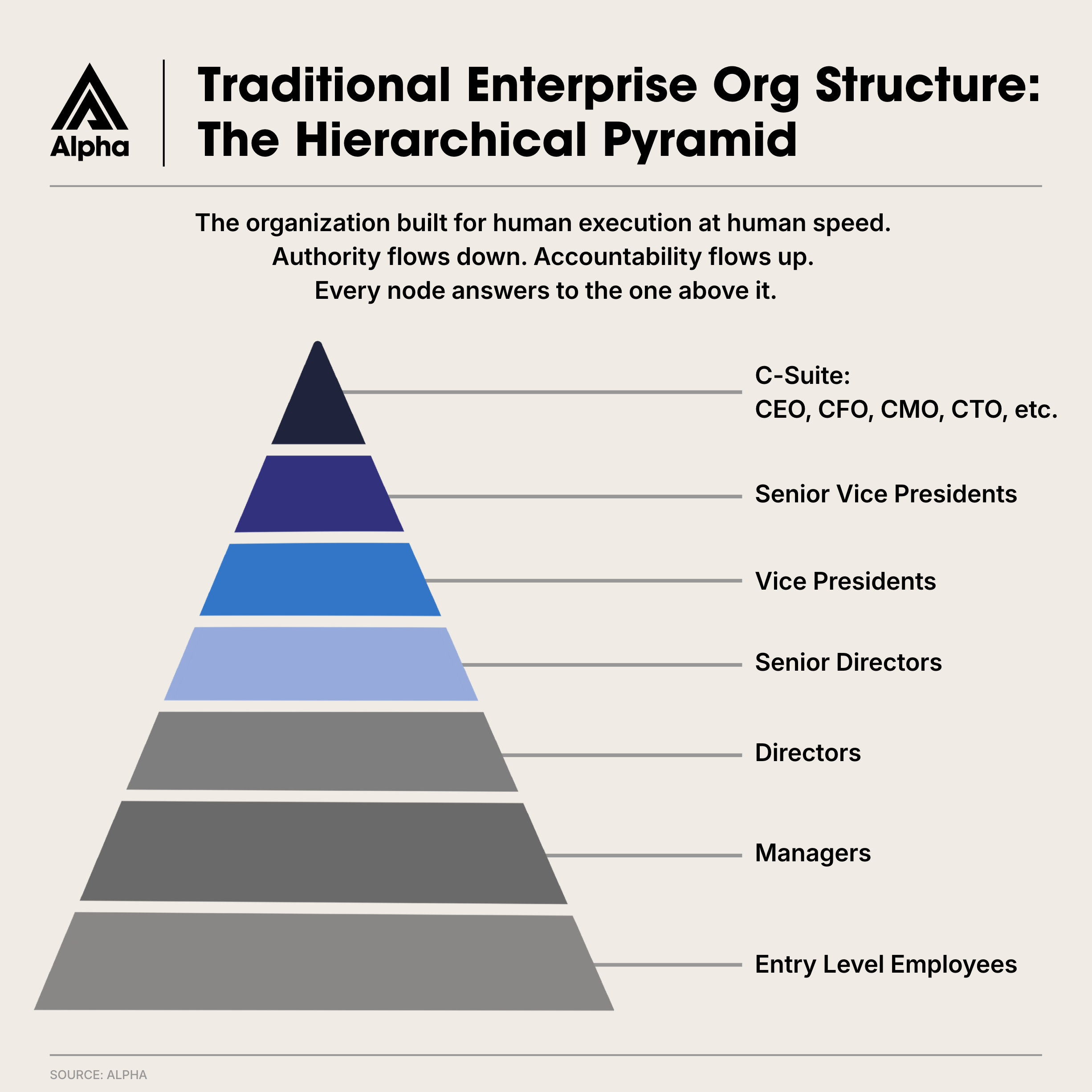
The flattening experiments of the last twenty years confirmed the constraint was real. Spotify's celebrated squad model quietly became its own bureaucracy and was walked back. Zappos's Holacracy cost roughly 18% of its workforce in the first year and was never adopted at scale elsewhere. Valve's flat structure produced invisible hierarchies that were less accountable than the visible ones it replaced. Every reorg your board has approved was a workaround. The problem was never the org chart. The problem was human cognition, and nobody had figured out how to remove that ceiling.
A leader can manage three to eight people before information loss sets in. Add more, add a layer. Add enough layers and the bottom cannot tell the top what is happening fast enough for the top to act on it. The middle of the pyramid existed for one purpose: translating strategy into tasks on the way down, and translating activity into reports on the way up. McKinsey research has put the cost of that layer at roughly one-third of payroll in large enterprises. Boards have been paying that bill for decades and treating it as a fixed cost of doing business.
That constraint is dissolving. When a continuously updated model of the business can be queried by every employee and every authorized agent at the same time, the routing function of the hierarchy becomes optional.
A New Model for the Agentic Era: The Company World Model
Fei-Fei Li, who helped build ImageNet and co-founded World Labs, published "From Words to Worlds" in November 2025 arguing that spatial intelligence represents AI's next frontier: a continuously updated representation of an environment that allows a system to reason, simulate, and act inside it. She is building it for physical and virtual space. Dorsey is building the equivalent for the enterprise, treating Block as a mini-AGI. Every artifact the business produces, Slack messages, pull requests, contracts, telemetry, customer transactions, gets indexed into an intelligence layer that any employee can query and any agent can act on. Dorsey's framing of what corporate hierarchy was doing for two thousand years is spot on as it was all an exercise in information-routing protocols. The world model replaces this.
The Company World Model is spatial intelligence applied to the firm. A knowledge graph tells the company what it knows. The Company World Model tells the company what it knows, what is changing, what should happen next, and what its agents are authorized to do. The graph is a map. The world model is the simulator the company runs on. The distinction is fiduciary, not just technical. A knowledge graph requires data governance: access controls, lineage, integrity. A Company World Model requires decision governance: who may act, under what authority, with what traceability, and who is accountable when the system is wrong. Boards have committee structures for the first. They have almost nothing for the second.
The Four Components of the Company World Model
To build a Company World Model, you need to have four key components.
1. Data. CRM, ERP, code repositories, contracts, support tickets, Slack, email, meeting transcripts, financial systems, product telemetry, plus external signals: regulatory filings, competitor intelligence, market data, customer activity, and partner systems. Most of this data already exists. It sits in fragments across systems never designed to function as a single intelligent substrate. The Data pillar stitches those fragments into a common operating canvas, with working memory for active tasks, episodic memory for what happened and when, and procedural memory for how the company actually works.
2. Reasoning. The continuously trained, continuously updated cognitive layer that turns data into queryable intelligence: prediction, retrieval, synthesis, simulation, causal reasoning, and interpretability. This is what allows any employee or any agent to ask the company a question and receive a coherent answer grounded in the company's own context. And it is what allows a human to inspect why the system reasoned the way it did. Without the interpretability layer, the Company World Model is a brilliant employee who refuses to explain themselves. Boards cannot govern what they cannot inspect.
3. Action. The tools, APIs, interfaces, and agents that let the Company World Model do something with what it knows. Read access turns it into a search and intelligence layer. Write access turns it into an operator. Sending a contract, routing a pricing exception, deploying code, approving a refund, scheduling a meeting, drafting a regulatory filing: all become actions the system can coordinate. Agents are not adjacent to the Company World Model. They are the action interface of the Company World Model. The fiduciary questions of accountability, safety, and corrigibility live here. This is the pillar most companies are deploying first and governing last.
4. Constitution. The policies, values, permissions, identity controls, provenance, audit trails, and sovereignty rules that make the system governable. What is the company permitted to do with this intelligence? Who can authorize action? Where did the information originate? What changed, when, and under whose authority? Whose infrastructure is the model running on, under whose jurisdiction, with whose legal claim on the underlying weights and outputs? Without the Constitution, the other three pillars produce a powerful and ungovernable machine. This is the pillar that turns a technical asset into a governable one, and it is the pillar most companies have not yet built.
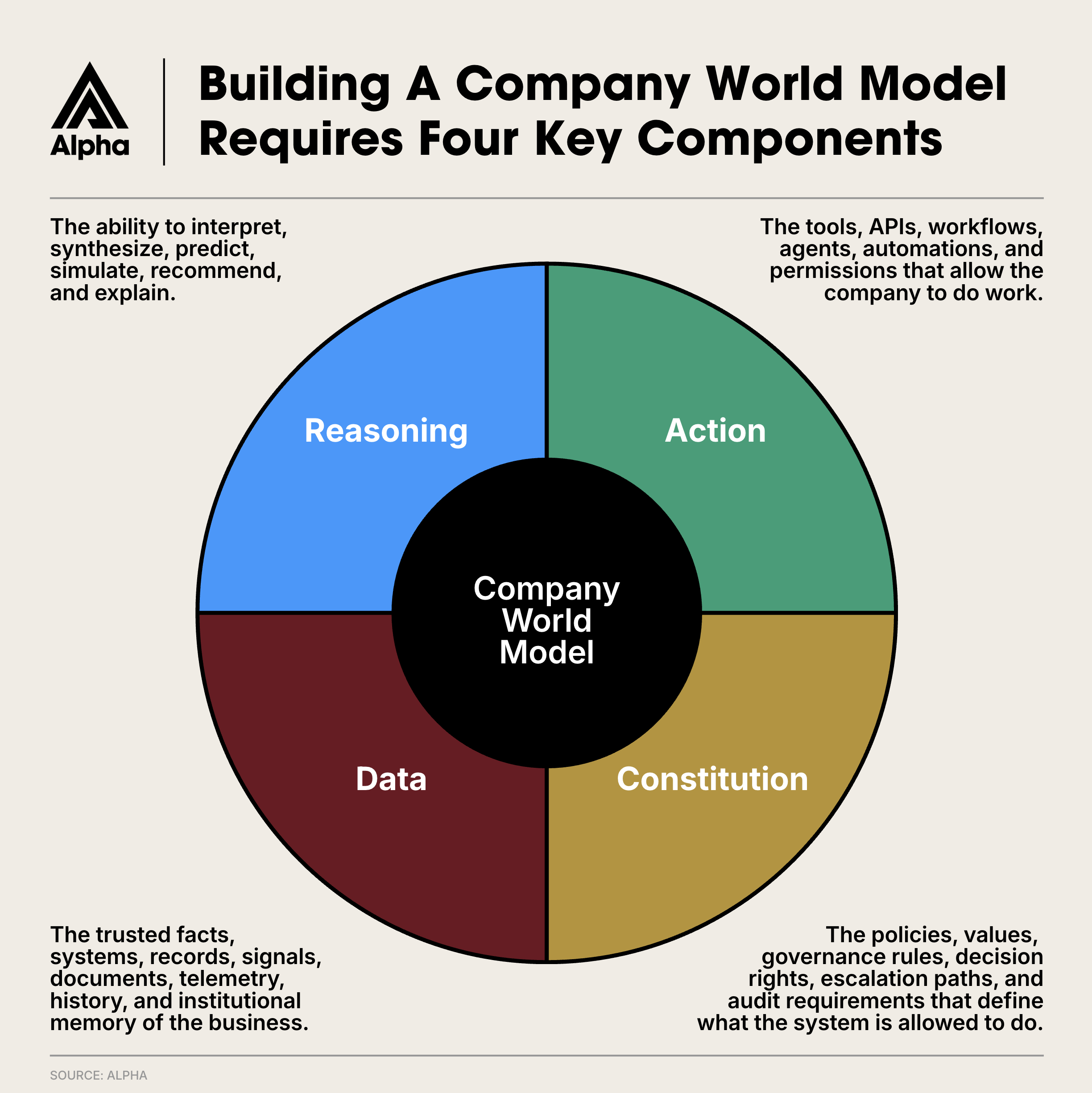
Governance Debt accumulates the moment the Action pillar runs ahead of the Constitution pillar. Every additional agent shipped without answers to ownership, authority, and traceability widens that gap.
The precedent is established across the technology industry. Glean (private, $7.2 billion valuation) calls it a permissions-aware knowledge graph. Microsoft (NASDAQ: MSFT) calls it the Copilot graph. Sundar Pichai disclosed on Alphabet's (NASDAQ: GOOGL) Q1 2026 earnings call that 75% of all new Google code is now AI-generated and approved by engineers, up from 50% the prior fall, with engineers moving toward agentic workflows with autonomous digital task forces. The systems that build the company's products are now improving themselves faster than humans can review them. If your board does not know who is reviewing those reviews, your board is not governing the company.
The advantage in the AI era is never the model alone. It is the data flywheel feeding the model. Every company that does not build a Company World Model is renting intelligence from companies that did.
Why the Window Is Now
Two technology curves are converging to make the Company World Model economically inevitable.
The first is the cost curve. Per Epoch AI, large language model inference costs have been halving roughly every two months. Algorithmic efficiency improves around 3x per year. Global compute capacity doubles approximately every seven months. The marginal cost of running an agent doing the work of a knowledge worker has dropped by orders of magnitude in two years and continues to fall. What cost ten cents to run in 2024 costs fractions of a cent in 2026, with quality holding or improving.
The second is the capability curve. METR, the AI evaluation laboratory, has documented that the length of tasks frontier models can complete autonomously is roughly doubling every seven months. Two years ago, an agent could complete a single task. Today, it can complete a multi-step workflow running for hours. By the end of 2026, credible projections put autonomous agent runtime at days, with persistent memory across sessions. An agent that can run for one day with stable goals and persistent memory is functionally a remote employee. The cost is a fraction. The throughput is multiples. The error rate, in narrow domains, is already lower.
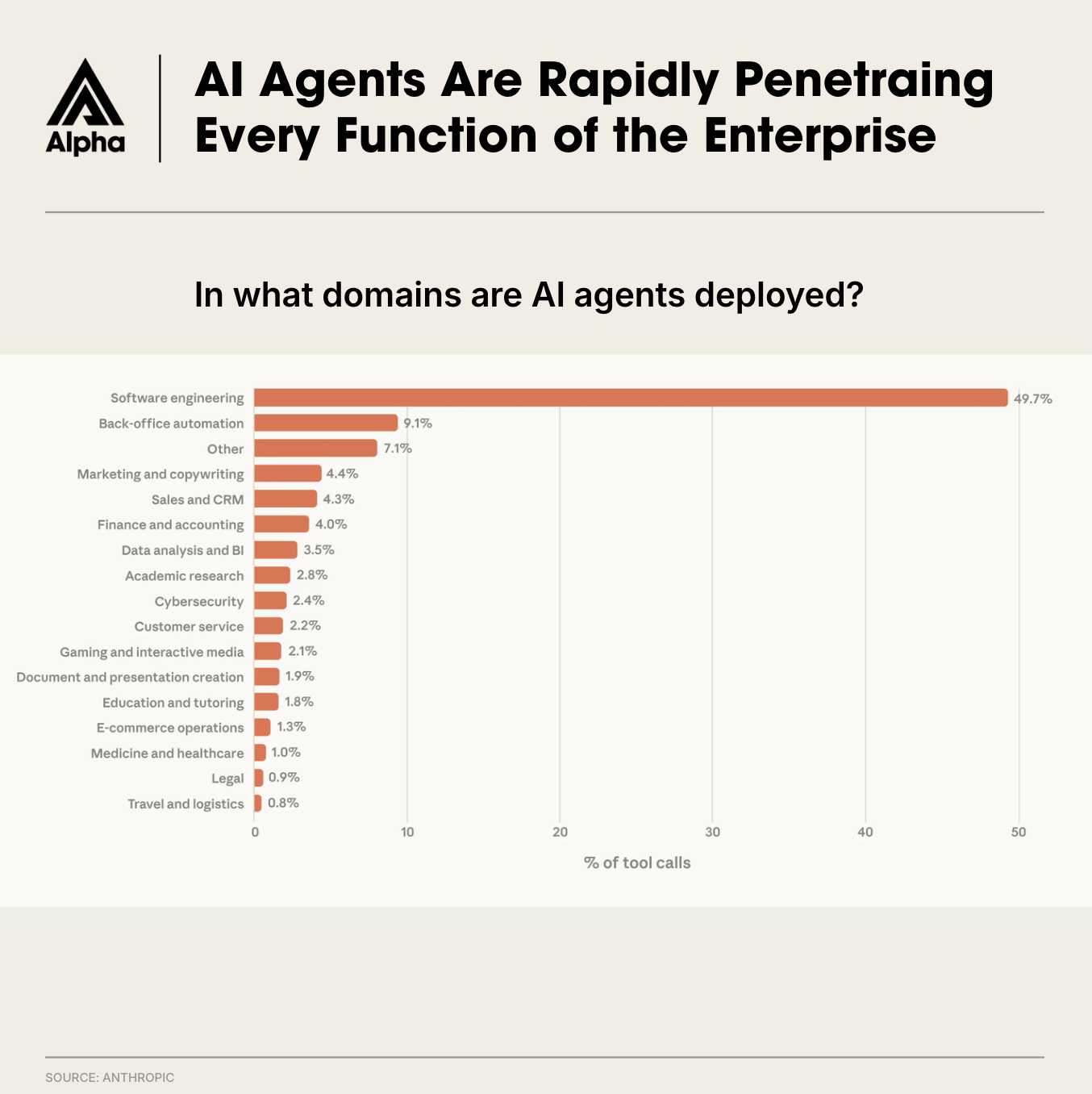
A third measurement, from Anthropic's February 2026 study of millions of human-agent interactions, describes what is actually happening in deployment. Among the longest-running Claude Code sessions, the time the agent works autonomously before stopping nearly doubled in three months: from under 25 minutes in October 2025 to over 45 minutes in January 2026. The success rate on the most challenging tasks doubled. The average number of human interventions per session dropped from 5.4 to 3.3. The pattern Anthropic calls deployment overhang: the autonomy models are already capable of exceeds what they exercise in practice. The constraint on agent autonomy today is not capability. It is trust, product design, and the workflow redesign the company has not yet done.
Challenger, Gray and Christmas reported that U.S. employers announced 217,362 job cuts in Q1 2026, the lowest first-quarter total since 2022. AI was cited as the reason for roughly a quarter of cuts announced in March. The rest were attributed to cost-cutting, restructuring, and shifting demand. Both numbers are real. Both matter for boards. The directors who cannot reconcile them are not yet ready for what comes next.
As long as compute gets cheaper and agents get more capable, every quarter a company defers workflow redesign is a quarter in which competitors who did not defer compound their lead. That is the cost-of-delay calculation activist investors are about to begin running on earnings calls.
Every Workflow Becomes Agentic
The legacy enterprise was organized around functions because functions were how human work could be coordinated. Marketing generated leads. Sales qualified them. Legal reviewed contracts. Finance billed. Customer success onboarded. Each handoff lost information, added latency, and created the opportunity for misalignment.
McKinsey's June 2025 "Seizing the Agentic AI Advantage" named the resulting condition the "gen AI paradox": nearly eight in ten companies report using generative AI, yet just as many report no significant bottom-line impact. The diagnosis is structural. McKinsey's November 2025 State of AI found that only 21% of companies have redesigned workflows end to end, and AI high performers are nearly three times as likely to have done so. Everyone else bolted agents onto an org chart designed around handoffs. The handoffs are where the value leaked.
In the agentic enterprise, work is organized around workflows because workflows are how value is created. The workflow becomes the unit. A single workflow now runs end to end across what used to be five departments. Three examples illustrate the pattern.
Lead-to-Cash
An intent agent detects a high-fit prospect from website signals and third-party data. A research agent synthesizes the prospect's recent earnings calls, competitor moves, and stated priorities. An outreach agent personalizes the first touch and adapts based on response. A configuration agent prices and quotes within approved guardrails. A negotiation agent handles standard objections. A contracting agent drafts and routes for human signature. An onboarding agent provisions the account and triggers the success workflow. A telemetry agent monitors adoption and escalates to a human when intervention risk is detected. Marketing, sales, legal, finance, operations, and customer success are all present. None of them owns the workflow. The workflow owns itself.
Procure-to-Pay
A spend-analysis agent identifies a category where contract terms are no longer competitive. A sourcing agent runs a structured RFP against approved suppliers and synthesizes responses. A negotiation agent handles routine commercial terms. An accounts payable agent matches invoices, validates against the contract, and releases payment. Procurement, legal, finance, and treasury are all present. The workflow runs in hours, not weeks. The audit trail is richer than what humans produced because every decision was machine-readable from the start.
Hire-to-Onboard
A sourcing agent identifies candidates against a calibrated profile. A screening agent runs structured interviews and produces comparable evaluations across the slate. A scheduling agent coordinates human interviews. An offer-modeling agent runs comp-band scenarios and routes for human approval. An onboarding agent provisions systems, schedules training, and tracks 30, 60, and 90-day milestones. Recruiting, HR, IT, finance, and the hiring manager's function all appear. The hiring manager spends time on judgment moments. The agents do everything else.
The pattern is general: claims-to-settlement in insurance, prescription-to-fulfillment in healthcare, underwrite-to-disburse in lending. Which existing department owns any of these workflows? None of them. The agentic workflow does not respect the org chart because the org chart was a coordination artifact, not a value-creation unit. Moderna went further, merging its HR and IT functions in May 2025 on the logic that AI is no longer a tool but a workforce-shaping force. The structural move is the strategic move.
In the workflow-organized enterprise, every important workflow spans multiple committee domains simultaneously. A single agentic lead-to-cash workflow touches Audit (controls), Risk (vendor and data exposure), Compensation (workforce design), and the Full Board (strategy). Mapping committee accountability to the workflows that actually move the company is no longer a once-a-year charter exercise. It must be continuous because the workflows themselves are continuous. Alpha calls this Committee Accountability Mapping, and it belongs on the agenda of any board serious about governing the agentic enterprise.
The New Shape of the Firm
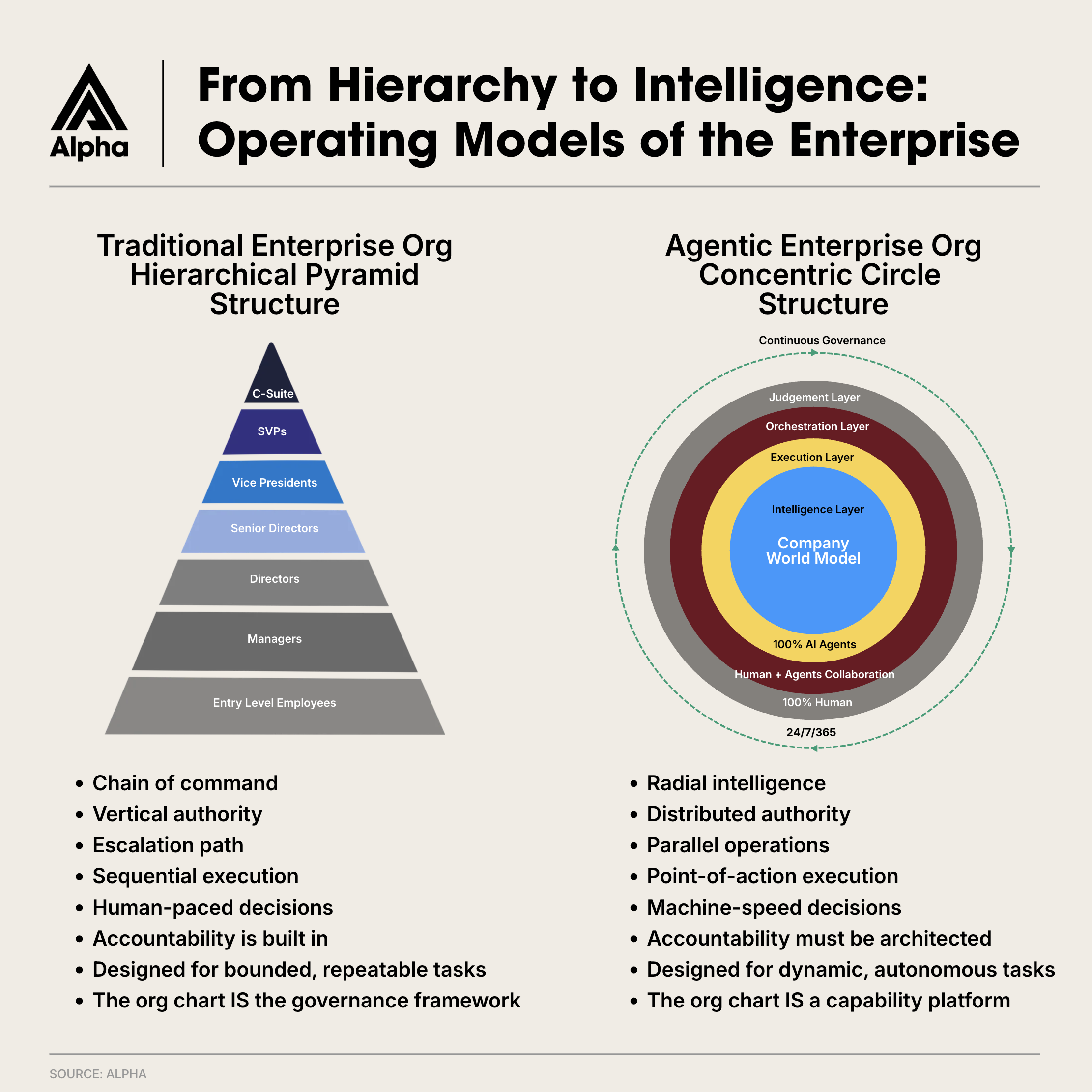
The pyramid had a top. The agentic enterprise has a center. The new shape is one of the concentric circle because the company now has a center of gravity: the Company World Model. Four rings work outward from it. Beyond the outer ring, the board sits as a continuous line of fiduciary oversight over the system as a whole.
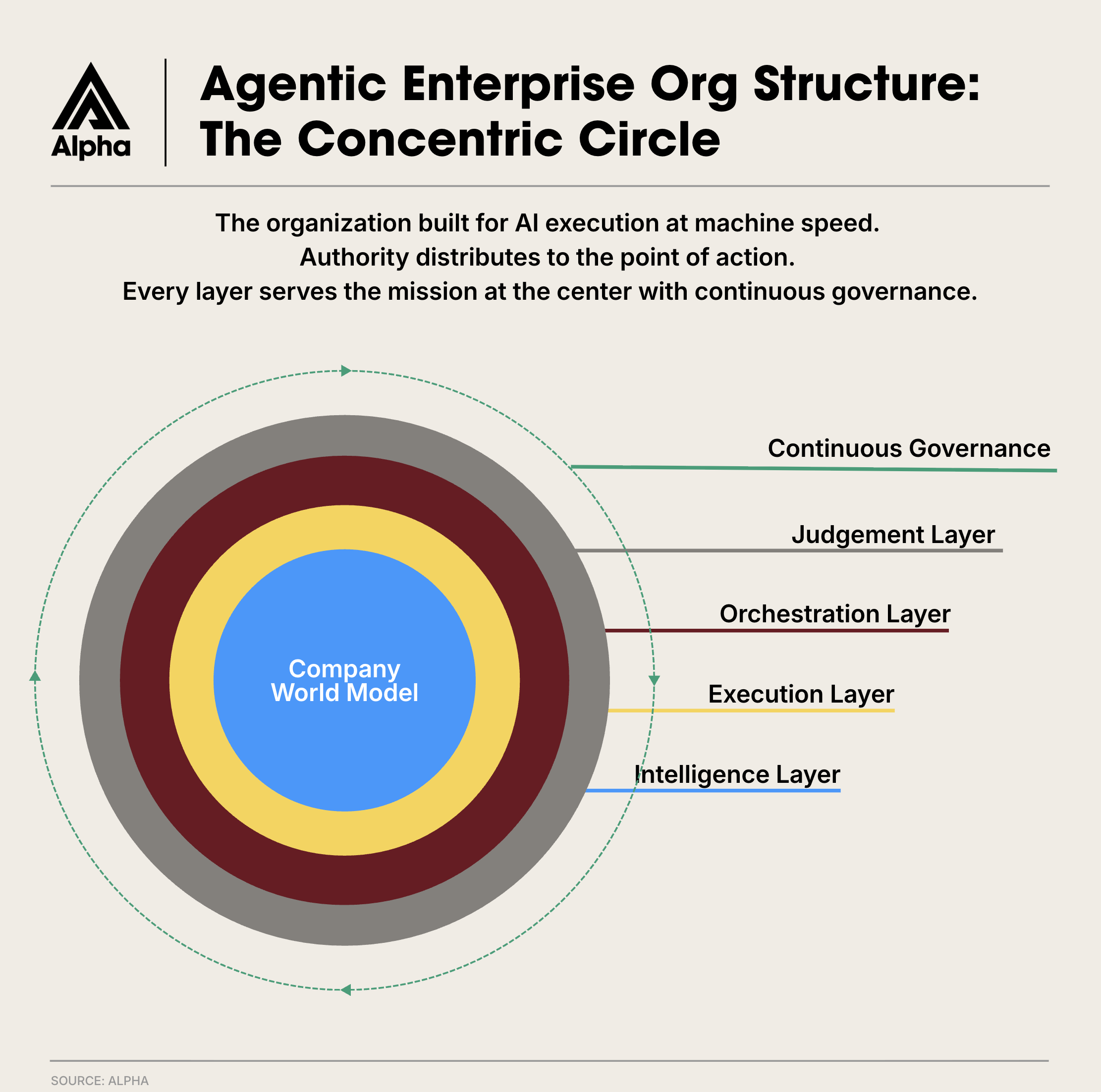
Intelligence Layer: The Company World Model: The center is not a database, not a knowledge base, not a CRM. The Company World Model is a continuously updated, machine-readable representation of how the enterprise actually works: its products, customers, contracts, commitments, controls, financials, dependencies, regulatory exposure, and strategic intent. Every ring above it queries it, writes to it, and is governed by it. McKinsey's most recent State of AI reports that 78% of organizations now use AI in at least one business function, but most are wiring agents into the org chart they already have. The companies pulling ahead are doing the opposite: building the model first, then wrapping the org around it. Without a Company World Model, every agent below operates on stale, partial context, and every decision above is made on lagging indicators.
Execution Layer: 100% AI Agents, 24/7/365: If a task is bounded, repeatable, and reversible, it is going to be automated. Not in five years. Now. This is the ring where AI agents do the work that used to fill spreadsheets, ticket queues, and inboxes. The list is already concrete: tier-one customer service (Klarna disclosed that its AI assistant did the work of 700 full-time agents in its first month), invoice and expense processing, contract metadata extraction, compliance log scanning, KYC and AML checks, lead enrichment and scoring, code review against style guides, vulnerability scanning, content moderation, supplier onboarding, data reconciliation, routine procurement matching, regulatory filing assembly, and SOC ticket triage. The Anthropic Economic Index shows AI usage concentrated today in software development, writing, and information processing, which maps directly to the work that historically filled entry-level and mid-level seats. The shift is not "AI assists employees." The shift is that the work runs continuously, the unit cost drops toward zero, and human attention is freed for the rings above.
Orchestration Layer: The Messy Middle: This ring is where governance fails first, and where most enterprises are not paying attention. Orchestration is humans working with humans, humans overseeing agents, agents overseeing humans, and agents working with agents. A procurement agent negotiates with a supplier's pricing agent: who signs? A marketing agent commits the company to a campaign that violates a regulator's interpretation of a consent decree: who is liable? An engineering agent introduces a security vulnerability that another engineering agent reviews and approves: where is the audit trail? A sales rep escalates a complex deal an agent could not close, while that same agent reschedules the rep's calendar around the customer's: who controls the workflow? These are not theoretical questions. They are 2026 questions. Gartner projects that by 2028, 33% of enterprise software applications will embed agentic AI (up from less than 1% in 2024) and 15% of day-to-day work decisions will be made autonomously by agents. The middle of the old pyramid was middle management, whose job was translation: turning strategy into tasks and tasks into reports. That layer compresses because the Company World Model carries context natively. What replaces it is orchestration as a capability, not a permanent reporting tier. Accountability has to be architected in this ring, not assumed.
Judgment Layer: 100% Human: This is where the new C-suite lives. Judgment is what does not delegate to a model: business strategy, capital allocation, mission, the creativity that defines a category, ethical exceptions, crisis response, M&A, board disclosures, and the choice of which guardrails to set in the first place. The CEO's primary product is judgment. The CEO's primary activity is orchestration: setting goals, allocating capital, resolving exceptions. The CFO orchestrates capital and risk. The CTO orchestrates the agentic infrastructure including the Intelligence ring itself. None of them sit purely in one ring. All are anchored in Judgment and reach through Orchestration to set conditions for Execution. The same is true for senior leaders across the enterprise. The skill premium shifts: pattern recognition, taste, ethical reasoning, and the willingness to be personally accountable for an outcome a machine cannot be accountable for. These are the human contributions that compound. Everything else gets cheaper.
Continuous Governance of the Agentic Enterprise: The dotted outer ring is continuous governance, wrapping the entire system. It runs 24/7/365 because the system inside it does. This is where the board, the audit committee, the risk committee, and the disclosure controls live. It cannot run quarterly. AI systems do not. The EU AI Act becomes fully applicable on August 2, 2026, with penalties reaching up to 7% of annual worldwide turnover for prohibited practices and 3% for other covered violations. Regulation is moving toward continuous accountability because AI systems are moving toward continuous action. Yet ISS analysis of 3,048 U.S. companies found just 8% disclose board-level AI oversight and only 9% have a public AI policy. The gap between continuous action and quarterly oversight is the largest governance gap in modern corporate history. Closing it is the work.
A Framework for Continuous Governance
The concentric model explains the architecture. The 5A Framework explains the governance logic. Continuous governance works only when the board can answer five questions across every ring of the enterprise.
Awareness: Can you see it? Every data source feeding the Company World Model must be inventoried, with no shadow data and no silent updates. Every agent in the Execution ring must be visible in real time, with no dark agents operating outside the inventory. Every workflow boundary in the Orchestration ring must be mapped, with no invisible escalations. Every material decision in the Judgment ring must be logged with a named owner. A board that cannot see the agents cannot govern them. Most boards today fail this question on every ring.
Articulation: Can it explain itself? The Company World Model must be queryable in plain language. Agent reasoning must be surfaced, not buried in logs: intent, confidence, and chain of action visible as the agent works. Exceptions must be stated clearly enough that a human can read what broke, why, and what decision is required, without translation. Decisions in the Judgment ring must be reasoned in language a successor, regulator, or court can reconstruct. Without articulation, the company has intelligence without inspectability. That is not governance. That is faith.
Authentication: Do you know who or what acted? Data and model provenance must be verified: source, lineage, version. Agent identity and version must be known: which model, which permissions, which human owner. "Manager approved" is not authentication. "Sarah Chen approved at 2:47 p.m. under Policy X with stated rationale Y" is authentication. The agentic enterprise needs Know Your Agent as much as it needs Know Your Customer. The buck stops somewhere specific, with a name on it.
Authority: Do you control what it can do? Every agent must have scoped permissions, action limits, escalation thresholds, blast-radius caps, and kill-switch architecture. Read access is one risk category. Write access is another. Autonomous commit authority is another. External communication, financial, legal, regulatory, and customer-facing actions require explicit authorization boundaries. Authority is the layer regulators will reach for first. It is also the layer most companies have left implicit.
Audit: Can you prove what happened? The Company World Model needs immutable state logs. Agents need replayable traces for every action, tool call, and output. Workflows need exception logs that record every handoff, escalation, and human intervention. Board minutes need to match the operational facts on the ground. Audit turns a self-modifying enterprise into a defensible one. It is also what the plaintiffs' bar will subpoena first.
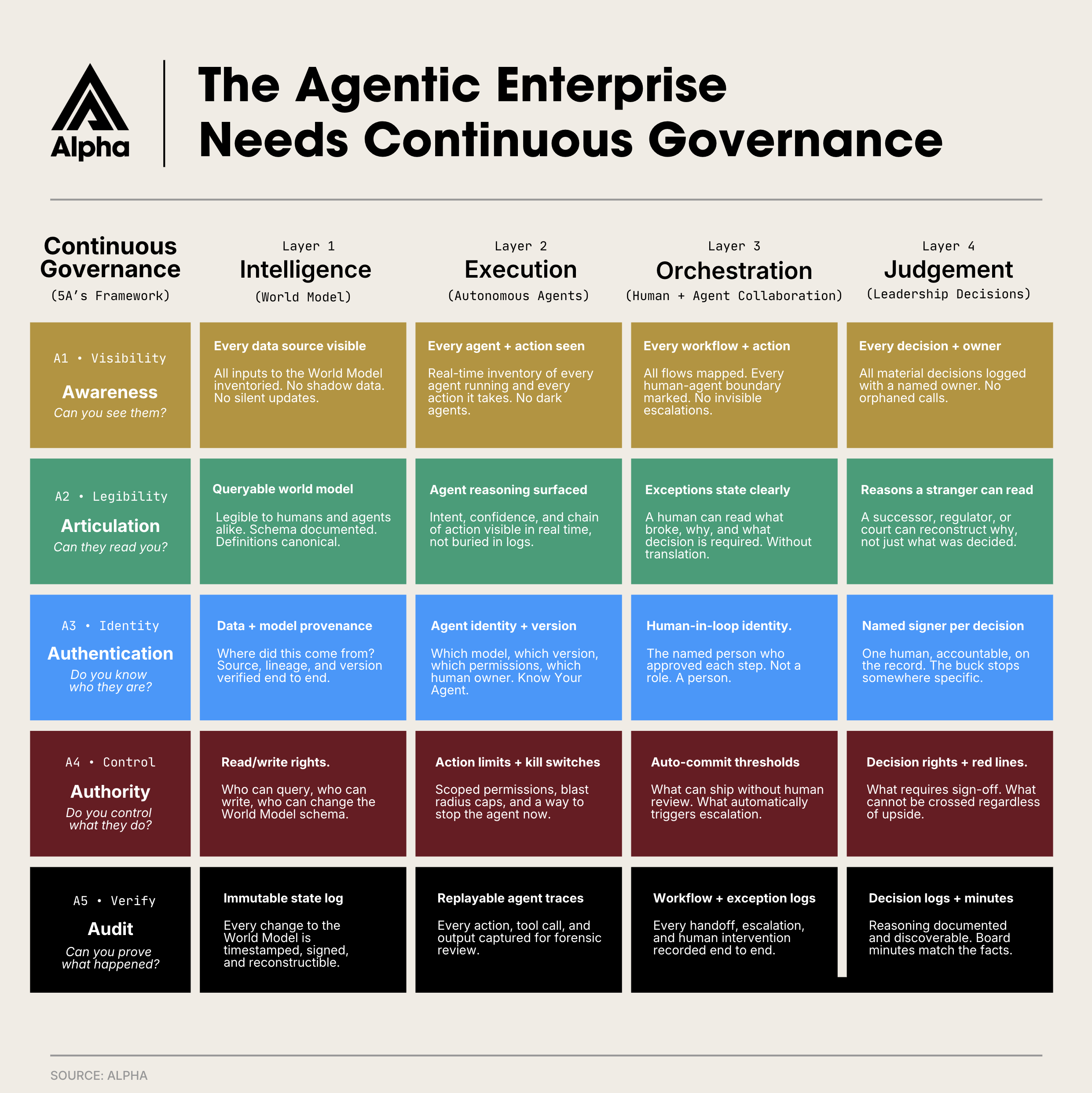
The 5A's are not a checklist. They are a coordinate system. Every ring has to answer all five questions, and the board must know who owns each cell. That is 25 governance accountabilities, each assignable to a committee, an executive, and a deliverable. Three cells are where boards fail first, and the failures are predictable enough to name now.
Awareness x Execution: the shadow agent. Employees deploy agents the company never authorized. Procurement does not see them. Risk does not inventory them. They are calling APIs, touching customer data, and committing the company in ways that aggregate. The board has no idea they exist until one of them breaks something visible.
Authentication x Orchestration: the role instead of the person. Approval workflows record "Manager approved" instead of "Sarah Chen approved at 2:47 p.m. with this stated rationale." When something breaks, the audit trail points to a job title, which is to say nowhere. The buck stops at a box on the org chart that no one signed.
Audit x Judgment: the minutes that do not match the facts. The agent fleet logged what it did, in detail, with timestamps. The committee minutes describe a different company, the one the directors thought they were governing. Discovery will surface the gap. The plaintiffs' bar will price it. If your board is failing any of these three cells today, that is a disclosable event waiting to happen, and the remediation timeline is shorter than the next proxy season.
Anthropic's February 2026 deployment study found that 80% of tool calls come from agents with at least one kind of safeguard, 73% appear to have a human in the loop in some way, and only 0.8% of actions appear irreversible. The numbers are reassuring at the average. They mask deployments at the frontier where risk and autonomy compound. Average safeguards are not the question. Whether the board can see, read, identify, control, and prove every action across every ring is the question.
Continuous governance means running this agentic system continuously, not reviewing it quarterly.
The Governance Boundary: What Not to Automate
The conversation about agentic transformation is dominated by acceleration. Faster adoption. Faster deployment. Faster ROI. However, I truly believe that governance is alpha, and an important governance strategy must include selective refusal.
Every board needs a written refusal list: decisions and workflows the company will not automate, regardless of technological capability or short-term cost pressure. Three categories belong on it from day one.
- Decisions without clear human accountability. If no named human can be held responsible for the outcome, the workflow should not run autonomously. Not because agents are wrong more often than humans. Because when they are wrong, no one is accountable.
- Decisions with asymmetric downside. Some mistakes are recoverable. A bad support chat response is one category. A false regulatory filing, a discriminatory credit decision, an unsafe medical recommendation, or a mispriced trading exposure that liquidates the desk are another category all together. The asymmetry decides the boundary.
- Decisions involving social license. Hiring, firing, promotion, lending, insurance, healthcare, education, and law-enforcement-adjacent decisions require more than technical accuracy. The perception that a machine made the decision can itself be the harm, regardless of the outcome.
The refusal list should be reviewed continuously, not once a year. Continuous governance is not only about what the company automates. It is equally about what it refuses to automate, and why. Every company will have an AI adoption roadmap. The savviest of companies will also maintain an AI refusal roadmap.
From Legacy Governance to Continuous Governance
Legacy governance assumes the company is stable enough to inspect at intervals. Quarterly board meetings. Annual audits. Periodic policy reviews. Point-in-time certifications. That cadence worked when the company moved at human speed. It does not work for a Company World Model that updates continuously, ingests data constantly, retrains on short cycles, and enables agents to act in milliseconds.
Continuous governance does not mean directors become operators. It means the board governs the design, instrumentation, accountability, and escalation architecture of a system that operates between meetings. A board that meets quarterly cannot govern a model that retrains weekly, ingests data hourly, and acts in milliseconds. Either the governance cadence matches the system cadence, or the governance is theater.
This is where most boards will fail first. Legacy governance does not become absent in the agentic enterprise. It becomes a liability. It produces oversight artifacts that look like governance but no longer correspond to the system actually operating. The board minutes are clean. The audit is signed. The policy is current. And the company has already moved.
Governance Debt is the gap between what the company has deployed and what the board can actually oversee. It accumulates when agents ship faster than controls, when workflows become autonomous faster than audit trails, when employees deploy shadow AI faster than procurement can inventory it, and when committee charters lag the systems they are supposed to govern.
The Governance Gap Will Be Priced In
ISS reported in March 2026, in an analysis of 3,048 U.S. companies across the Russell 3000 and S&P 500, that only 8% disclosed board-level AI oversight, 9% had formal AI policies, 16% had at least one AI-skilled director, and only 4% had two or more. NACD now reports that 47.4% of directors identify AI as one of the two top factors expected to impact performance in 2026, with 49.5% naming it a top concern as of late 2025. Yet Deloitte separately finds that nearly one‑third of boards (31%) say AI is still not on the board agenda, and 66% of board members report “limited to no knowledge or experience” with AI. The gap between 78% of companies now using AI in daily operations and governance maturity is not a delta. It is a structural failure that compounds every quarter.
Gartner projects that 40% of agentic AI initiatives will be canceled by 2027 due to unclear business value, while 42% of companies already scrapped most AI initiatives in 2025, up sharply from 17% the year before. Most of those cancellations will be Governance Debt manifesting as wasted capital: projects that scaled faster than the oversight needed to make them defensible. The activist investors will know it. The regulators will know it. The plaintiffs’ bar will know it next. Governance Debt, like every other form of debt, eventually comes due.
The market is already pricing it. Four mechanisms are forming, none of them theoretical, each capable of arriving before regulators do.
1) Proxy advisors are integrating agent leverage. ISS and Glass Lewis will not announce this. They will publish guidance once the metric is normalized in financial reporting, and the publication will arrive after the integration is already in their models. Say-on-pay votes will turn on whether the Compensation Committee priced in the agentic transformation pace. By the 2027 proxy season, every Comp and Nom/Gov chair on a covered company should expect at least one letter referencing agent leverage directly.
2) Activist funds are running automated screens. Companies with declining agent leverage against AI-native sector benchmarks become standing candidates for restructuring campaigns. 13D filings will increasingly cite the metric directly. The targeting list writes itself. Boards that develop a defensible narrative now will be better positioned than boards that wait for the screen to find them.
3) D&O insurance is repricing on Governance Debt. Underwriters are adding AI governance debt as an explicit risk factor. Boards without documented agent oversight, without clear committee accountability for the Company World Model, and without incident response plans tied to the agent fleet pay premium first. Eventually, they cannot obtain coverage at any price. This is how the insurance market enforces what the SEC has not yet written.
4) External audit is transforming. The Big 4 cannot opine on a company's controls without opining on its agent oversight. PCAOB and AICPA are developing new standards. Audit committees will begin asking their auditors a new question: what is your firm's capacity to audit our agentic operations, not just our financial statements?
These are not predictions for 2030. They are the system already forming in 2026. Boards that anticipate them will be governing the design. Boards that wait will find their committee charters being written for them by activists, regulators, underwriters, and proxy advisors who do not work for the company.
All of this flows back to a single design choice: whether there is a company‑wide model at the center that can actually be governed. If AI lives as scattered tools, point solutions, and shadow agents, Governance Debt is invisible until it crystallizes as a crisis, a restatement, or an enforcement action. If the enterprise runs on a Company World Model with continuous governance wrapped around it, the board can see, explain, authenticate, control, and audit what the system is doing in real time.
Legacy governance assumes the company is stable enough to inspect at intervals. Continuous governance assumes the company is now a continuously learning, continuously acting system. The Company World Model is the only architecture that makes that assumption governable. Without it, the agentic enterprise runs on borrowed intelligence and borrowed time.
What This Means for the Institution
Three structural implications follow from the Company World Model that most governance frameworks have not yet named.
The first is regulatory. The SEC will add AI-specific disclosure requirements within the next 24 months. Company World Model dependencies will become Item 1A risk factors with required granularity. The EU AI Act enforcement deadline of August 2, 2026, with penalties up to 7% of annual worldwide turnover, is the first signal of a disclosure regime that will reach every major economy.
The second is geopolitical. Concentration of foundation models in a small number of frontier providers makes every public company functionally a tenant of an intelligence layer it does not own. Nations without indigenous frontier AI capabilities watch their major employers become tenants of foreign intelligence layers. Sovereign AI mandates, chip export controls, and strategic compute stockpiles follow. The board of a global enterprise has to plan for the possibility that the agent fleet running its operations in one jurisdiction will not be permitted in another.
The third is institutional. The public corporation as a legal form was built around stable hierarchies, predictable headcount economics, and human decision-making at the top. When all three change simultaneously, the legal form bends to fit. New fiduciary doctrines emerge. New disclosures become standard. New committee structures become best practice and then mandatory. The corporate governance question of the next decade is not which AI strategy your company should pursue. It is which agentic systems your company is governed on, who controls it, and what your fiduciary duty looks like when the answer is not entirely you.
Committee Accountability Mapping
The Agentic Enterprise does not require new committees, per se. It requires existing committees to accept ownership of the questions that already live in their domain. Alpha calls this Committee Accountability Mapping.
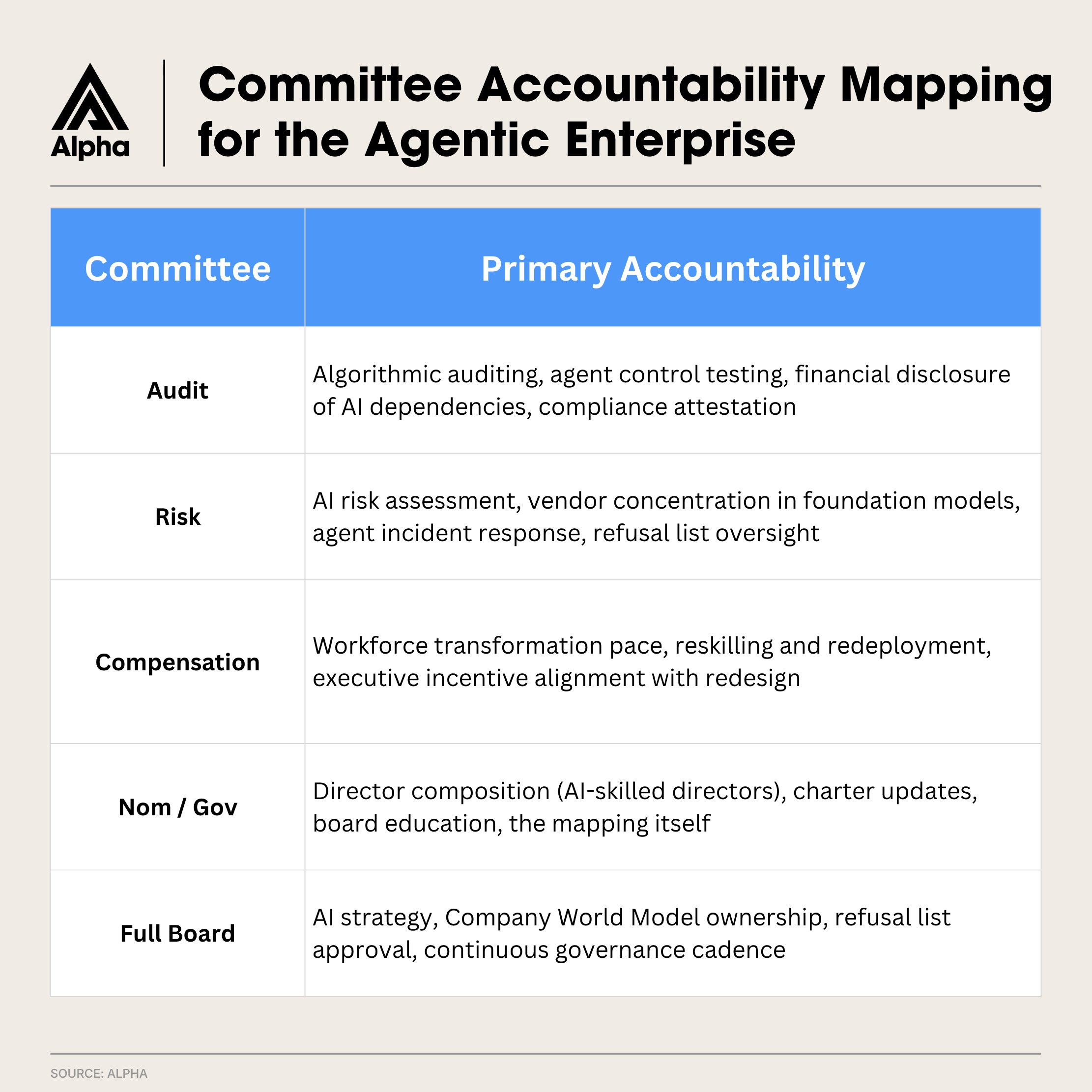
Continuous governance is not a new committee. It is a new cadence. Same committees. Same meetings. Different questions, different metrics, and a governance rhythm that matches the pace of the system being governed.
The Diagnostic Question
For directors and executives, governance of the agentic enterprise comes down to a single test. Ask one question at your next board meeting. The speed of the answer is the answer.
Which director or committee on this board can tell you, today, who owns the Company World Model: its integrity, its security, its access architecture, and the agents that act through it?
If the answer does not come quickly, the rest of this essay is your governance agenda.
If the answer is "the CTO has it," the board is confusing management of the asset with governance of the asset. The CTO runs the architecture. The board governs whether it is being run with the integrity, controls, and access discipline appropriate to its strategic concentration. Those are not the same job.
If the answer is "nobody yet," that is the most important governance gap on the company's risk register. The most valuable asset on the balance sheet has no named director accountable for it. Every other question in this essay flows from that one.
If the answer names a specific committee, with specific charter language, a recurring telemetry review, defined escalation rights, a completed 5A grid across every ring of the enterprise, and a named executive accountable, the board is governing the agentic enterprise. That answer is rare today. It will be standard within eighteen months. Where your board sits on that arc is the only competitive question that matters.
Action Items Before Your Next Meeting
Continuous governance starts with two parallel work streams. The board governs the design. Management operationalizes it.
For the Board
- Name the executive accountable for the Company World Model. Not a council. Not a shared mandate. One named C-suite officer with charter authority, board reporting cadence, and a budget. Owner: Nom/Gov. Deliverable: charter amendment by next regular meeting.
- Inventory every agent in the enterprise. Authorized and unauthorized. Read-access and write-access. Vendor and internal. Build the agent registry before writing the policy. Owner: Risk. Deliverable: full inventory with quarterly refresh.
- Approve the refusal list. Identify decisions and workflows the company will not automate, regardless of capability. Review continuously, not annually. Owner: Full Board. Deliverable: written refusal list, ratified.
- Map the 5As Agentic Governance grid. Five questions across four layers. Twenty cells. Each owned by a committee, an executive, and a deliverable. Owner: Audit and Risk jointly. Deliverable: 5As map with named owners.
- Reset management reporting to match the new shape of the firm. Headcount-by-department describes the pyramid the company is leaving behind. The agentic enterprise has a center and four rings, and value is created by workflows that cross every old function. The board cannot govern what the report does not show. Add material workflows running end-to-end as agentic, agent fleet inventory by layer with named human owners, the share of business decisions running on the Company World Model, and the cycle time from decision to execution. Owner: Compensation and Audit. Deliverable: redesigned reporting package within two cycles.
- Update committee charters. Reflect Committee Accountability Mapping and the continuous governance cadence. Charter language is what plaintiffs and regulators will read first. Owner: Nom/Gov. Deliverable: amended charters by year-end.
- Move governance to a continuous cadence. Monthly telemetry review, quarterly committee deep-dive, annual full-board governance review of the Company World Model. Owner: Full Board. Deliverable: published governance calendar.
For Management
- Stand up the Company World Model as an asset class. Inventory the data. Stand up the reasoning layer. Define the action permissions. Write the constitution. Treat it as the single most consequential piece of corporate infrastructure built this decade.
- Audit the architecture honestly. If the company were being built today with 2026 tools, would it look the way it currently does? Document the answer. Identify the three workflows that would be redesigned first.
- Redesign three workflows end to end. Not pilots. Not copilots. End-to-end agentic recompositions: lead-to-cash, customer service-to-retention, and one sector-specific workflow that materially affects revenue, risk, or customer trust.
- Build the agent registry and the kill-switch architecture before scaling. Authority and Audit are the two cells where boards lose control first. Both require infrastructure, not policy.
- Replace the headcount-led narrative for investors. Lead with workflows redesigned, agent fleet under governance, and capability per dollar of governed compute. The reporting cadence is the mindset shift made visible.
Govern the Design
The agentic enterprise is not coming. It is forming now.
The Company World Model is becoming the operating core of the firm. Every workflow is becoming an agentic workflow. Every silo is being challenged by end-to-end automation. Every board will have to govern not just a company, but a continuously learning representation of the company that agents read from, write to, and act upon.
The central risk is not that companies move too fast. The central risk is that they move continuously while governance remains periodic.
Stop putting AI into the business. Put the business into AI. Make every workflow an agentic workflow. Place the Company World Model at the center. Govern it continuously, because the asset learns continuously, and there is no version of periodic oversight that can keep up.
The boards that govern the design in 2026 will succeed in the agentic era. The boards that wait will find the design was built without them, by the systems they never learned to see.


