

At 3:17 a.m. last Tuesday, an AI agent representing a procurement team in Frankfurt arrived at a Fortune 500 supplier's website. It scanned the product catalog, cross-referenced pricing against three competitors, evaluated lead times and compliance certifications, and made a shortlist decision. Total time on the site: 84 milliseconds. The supplier's CFO will never see this transaction in any dashboard. The marketing team spent that same Tuesday debating a new homepage hero image. The audit committee meets next Thursday. Nobody plans to discuss any of it.
This is the new normal. Most boards are governing the wrong internet.
The Web As We Know It Is Dead
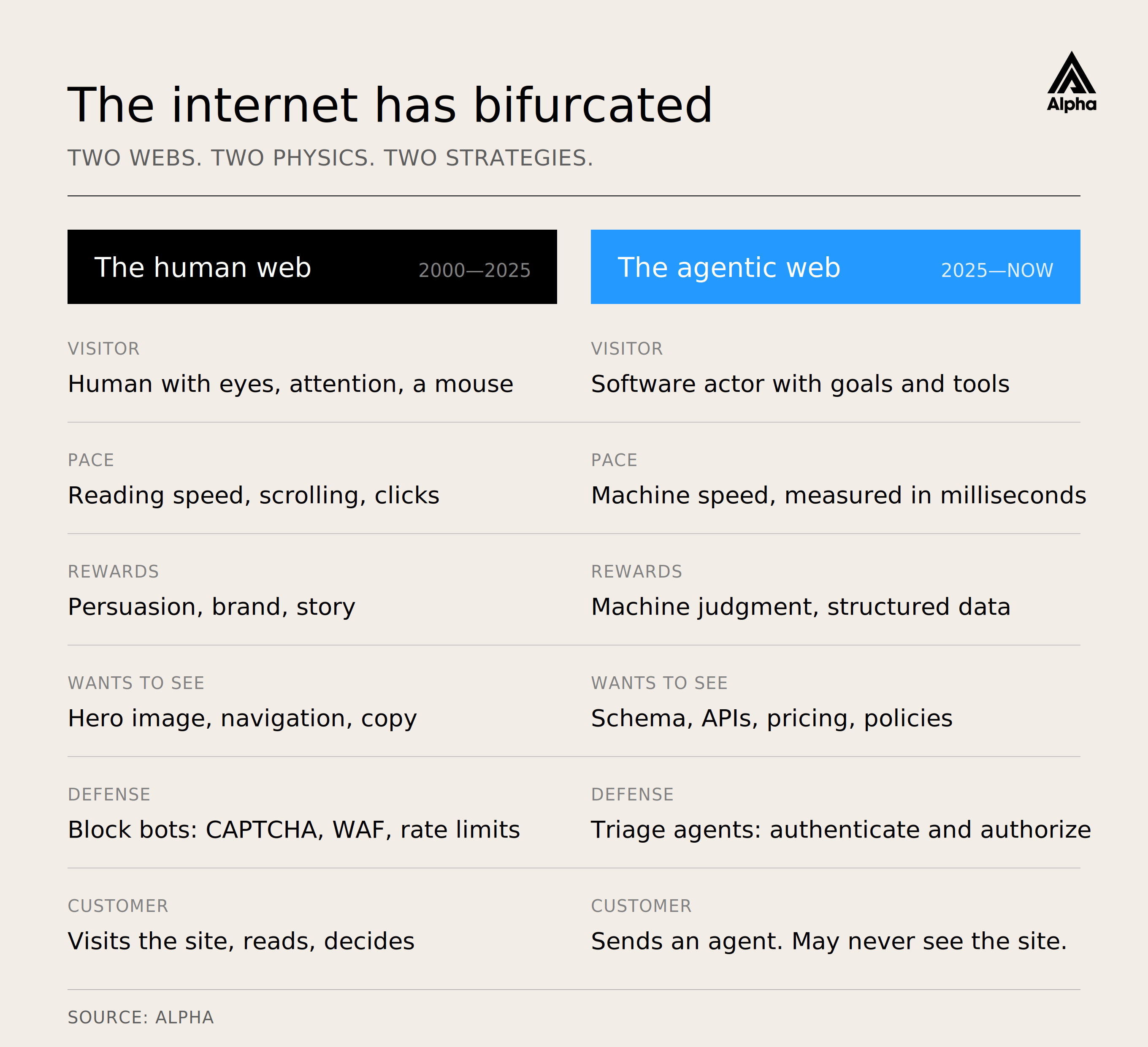
The internet has bifurcated into a human web and an agentic web. They run on different rails and serve different masters.
The human web is what we built over the last 25 years. Storytelling, brand, navigation, hero images, the careful choreography of attention. Win the click. Win the conversion. Win the human. The entire digital operating model assumes the visitor has eyes, patience, preferences, and a mouse.
The agentic web runs on structured data, machine-readable pricing, schema markup, API surfaces, authenticated agent identities, and autonomous software actors transacting at machine speed. The visitor has no eyes. It has goals.
This is not generative AI with extra steps. Generative systems produce outputs. Agentic systems plan, reason, use tools, write to databases, authorize transactions, and coordinate with other agents to achieve goals on behalf of humans. Different in kind, not in degree.
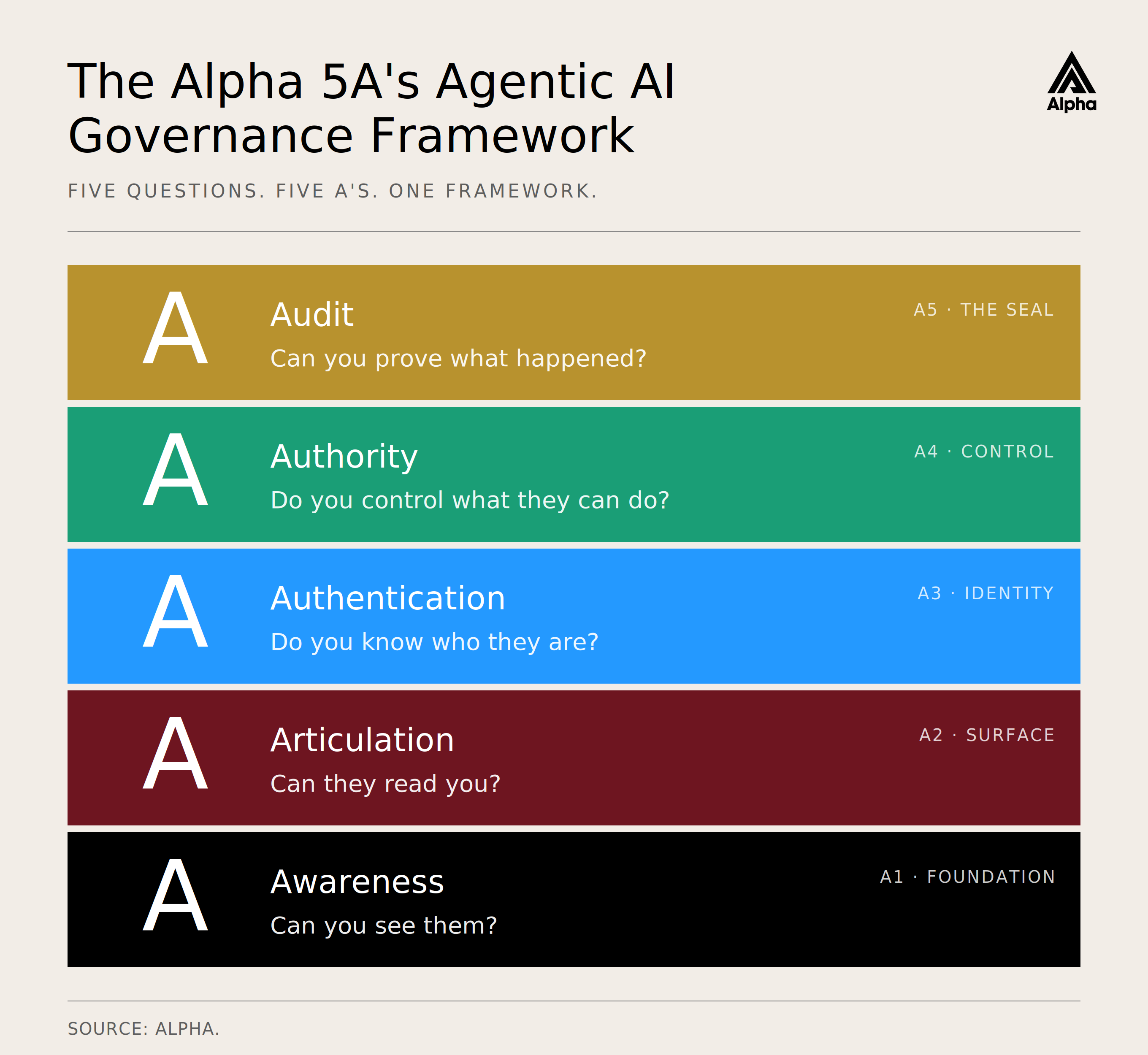
Your next customer may not be human. It may be a procurement agent comparing vendors, a financial agent reviewing contract terms, a regulator's automated review system, or an internal enterprise copilot acting under delegated authority. It will arrive in milliseconds, scan your pricing, policies, product catalog, reviews, API documentation, and terms of service, and decide whether a human ever sees your company at all.
The traffic data already shows the transition. ChatGPT serves over 800 million users. In April, conventional searches in Apple's (NASDAQ: AAPL) Safari browser declined for the first time as users shifted their questions to AI. Similarweb estimates that the share of news-related searches ending in no onward click rose from 56% to 69% after Google (NASDAQ: GOOGL) launched AI overviews. Dotdash Meredith, owner of People and Food & Wine, used to get more than 60% of its traffic from Google. That number is now in the mid-30s. Cloudflare (NYSE: NET), which sits in front of about a fifth of the web, is rolling out a pay-per-crawl system. CEO Matthew Prince frames the goal simply: "We have to set the rules of the road".
Meanwhile, Google's own crawlers report that the web has expanded by 45% in the past two years. The pages are being read. Just not by people.
This is not a future scenario. It is the new operating environment.
For the first time in a decade, automated traffic surpassed human activity in 2024, accounting for 51% of all web traffic, with malicious bots alone making up 37%, according to Imperva's 2025 Bad Bot Report. Cloudflare's 2025 Year in Review tells the same story from a different angle: as of December 2, humans generated 47% of HTML requests on the Cloudflare network, while non-AI bots generated 44%, and the human share was getting closer to crossover, not pulling away.
Cloudflare (NYSE: NET) CEO Matthew Prince put a date on the full crossover at SXSW in March: AI bot traffic will exceed human traffic by 2027. His reasoning was concrete. A human shopping for a digital camera might visit five sites. The agent doing the same task on behalf of that human visits five thousand. "That's real traffic, and that's real load, which everyone is having to deal with."
This is not just more traffic. It is a different kind of traffic, with different incentives and different consequences.
The Hidden Concentration Risk
Three companies generate roughly 96% of the AI traffic hitting your properties.
HUMAN Security's 2026 State of AI Traffic & Cyberthreat Benchmark Report measured the operator universe and found extraordinary concentration. OpenAI's bots, including ChatGPT User, OAI-SearchBot, GPTBot, and ChatGPT Agent, account for approximately 69% of all observed AI-driven traffic. Meta's external agent contributes another 16%. Anthropic's ClaudeBot and Claude-SearchBot together add roughly 11%. Perplexity trails at 2.4%. Google at 1.4%.
This is concentration risk dressed as innovation. If your AI strategy is really an OpenAI strategy, your fiduciary exposure to a single vendor's terms-of-service change is unhedged. The board cannot govern a dependency it has not named. Most have not.
The implication is operational. A 30-day notice from one of three companies could materially change the company's customer acquisition surface, training-data exposure, content licensing position, or fraud profile. That is the definition of a fiduciary issue. It belongs to the audit committee, the risk committee, and the full board, not the marketing team.
The implication is also temporal. HUMAN's data shows that AI-driven traffic spiked sharply in October 2025, peaking at 3.61 times January's volume, before plateauing. The cause was not consumer demand. Between November 17 and December 11, four major AI companies released frontier models in rapid succession: xAI's Grok 4.1, Google's Gemini 3, Anthropic's Claude Opus 4.5, and OpenAI's GPT-5.2. The October crawl surge was pre-release training-data acquisition. Crawler volume now correlates with model-release cycles. Retail, media, and travel will see predictable seasonal spikes. The infrastructure team should already be modeling this. The board should already be asking whether they are.
From Crawlers to Agents
OpenAI's GPTBot grew its share of AI crawling traffic from 2.2% to 7.7% in twelve months, a 305% rise in raw request volume. Anthropic's ClaudeBot crawls roughly 27,100 pages for every one referral it sends back. Training-purpose crawling now accounts for nearly 80% of all AI bot activity, meaning the crawlers are taking content to feed models, not driving humans to your site.
Within that broader AI traffic universe, the autonomous-agent subset is the fastest-moving line. HUMAN Security found that traffic from agentic AI, software that navigates and acts rather than merely reads, grew 7,851% year over year in 2025. Crawlers are background. Agents are the foreground that most boards have not yet noticed.
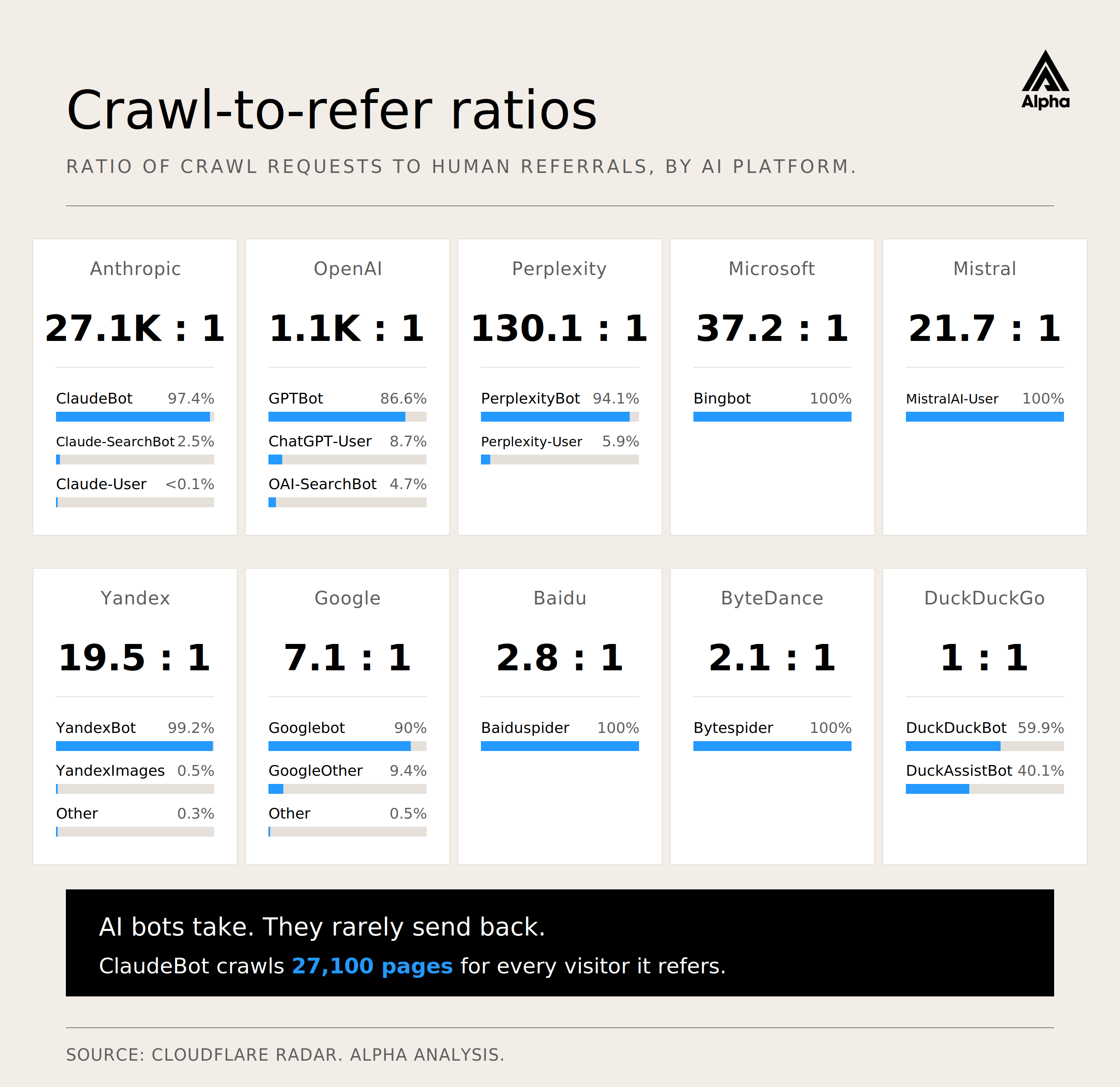
The old bargain of the open web was simple: let the crawler in, get traffic back. The crawl-to-click gap has broken that bargain. The new bargain is being written in front of us, and it does not yet have rules.
For retailers, the shift is sharper. Adobe's Digital Economy Index found that traffic from AI sources to retailers surged 1,200% year-over-year while traditional search traffic declined 10%. Bain & Company estimates that 30% to 45% of US consumers already use generative AI to research and compare products. Salesforce (NYSE: CRM) reported that during 2025 Cyber Week alone, AI-driven interactions influenced approximately $67 billion in global online sales, roughly 20% of total digital orders. Morgan Stanley projects that by 2030, AI shopping agents will account for around 25% of online consumer spending. McKinsey forecasts $900 billion to $1 trillion in US retail revenue flowing through agentic commerce by 2030, and $3 to $5 trillion globally.
The numbers say this: the customer interface is becoming non-human, faster than most boards have absorbed.
The 25-Year Inversion: From Bot Defense to Bot Triage
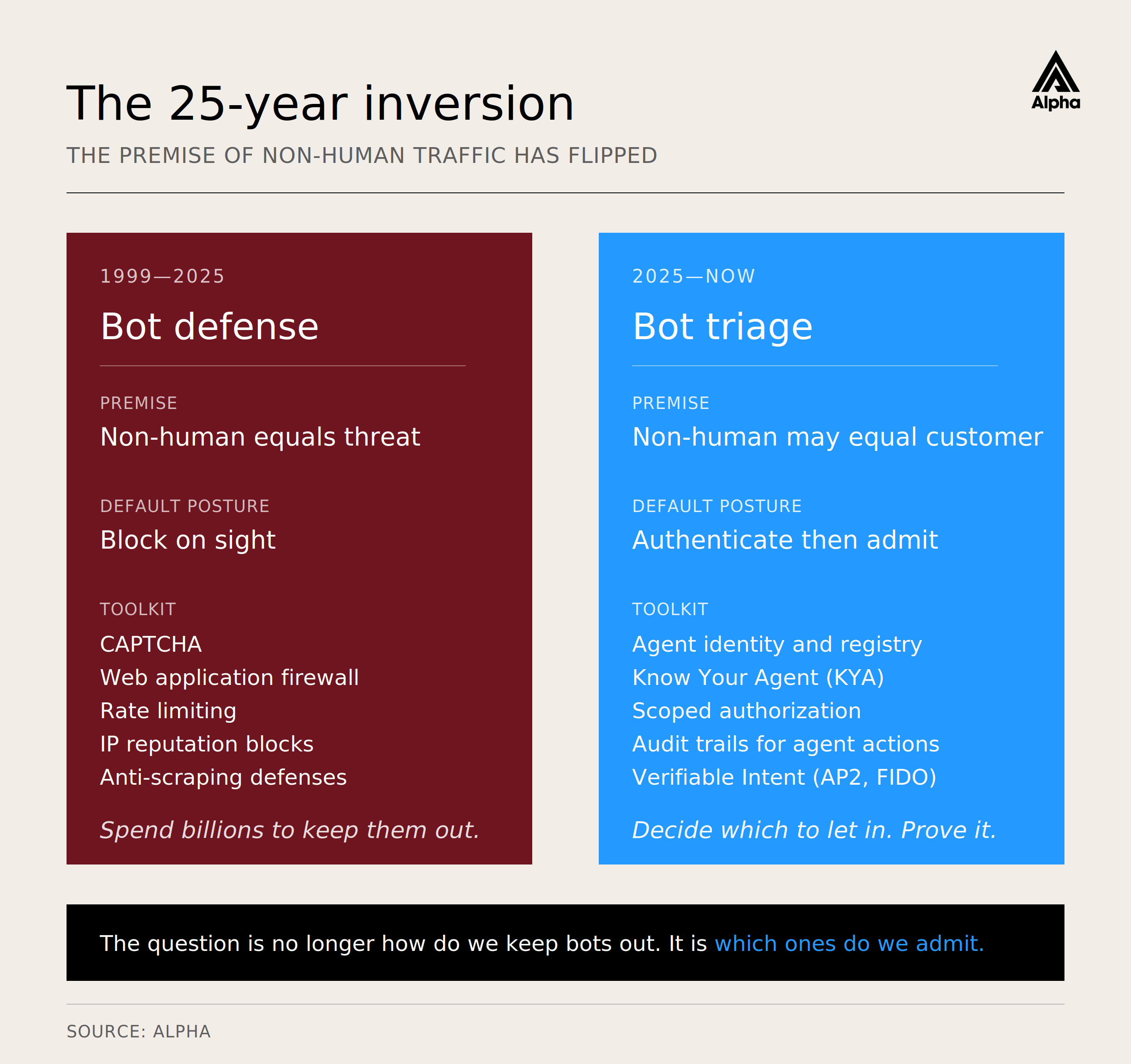
For a quarter century, the entire architecture of enterprise digital security was built on a single premise: keep the bots out. CAPTCHAs, rate limiters, web application firewalls, bot detection stacks, anti-scraping defenses. Companies spent billions on the proposition that non-human traffic was, by default, a threat.
In the agent economy, that premise inverts.
The question is no longer how to keep bots out. It becomes which non-human actors should we trust, admit, throttle, authenticate, monetize, monitor, or reject? A malicious credential-stuffing bot is not the same as a search crawler. A search crawler is not the same as an LLM training crawler. An LLM crawler is not the same as a customer's shopping agent. A customer's agent is not the same as an enterprise procurement agent representing a major account. A partner agent is not the same as an internal finance agent. A regulator's automated review agent is not the same as a competitor's scraper.
Yet most companies still treat non-human traffic as binary: allow or block. That is no longer enough. Imperva's data shows that 44% of advanced bot traffic now targets APIs, aiming directly at the business logic that runs the company. Your security stack was not designed to distinguish a paying customer's agent from a hostile scraper. It cannot. And the entire defense posture, the org chart, the budget allocation, and the underlying assumption that "non-human equals threat" all need to be rebuilt for a world in which non-human equals customer.
This is not a technology problem. It is a governance problem. Who in your organization makes that distinction? Under what authority? With what audit trail? With what board oversight?
From Search Optimization to Agent Legibility
The collapse of the search-driven traffic model is no longer a forecast. It is a measurable shift. Companies that grew up on search engine optimization are scrambling toward answer engine optimization, generative engine optimization, and the discipline that ultimately matters: agent legibility.
The old customer journey began with a typed query and ended at a blue-link search result. That journey is fragmenting. The new customer journey begins with a directive: "Find me the best vendor under this budget, with these compliance requirements, that ships before Thursday." The answer is not a list of links. It is a recommendation. A cart. A renewal. A completed transaction. The human may never see your homepage at all.
In that world, the most important visitor to your site may be a machine that never renders your page visually. It reads your schema, ingests your documentation, parses your pricing, evaluates your terms, and ranks you against competitors before a human ever knows you exist.
This is where most companies are dangerously unprepared. AI agents do not care whether your hero image is beautiful. They do not pause over your founder story. They do not feel reassured by polished landing-page copy. They parse, extract, compare, and judge. The human web rewards persuasion. The agentic web rewards machine judgment.
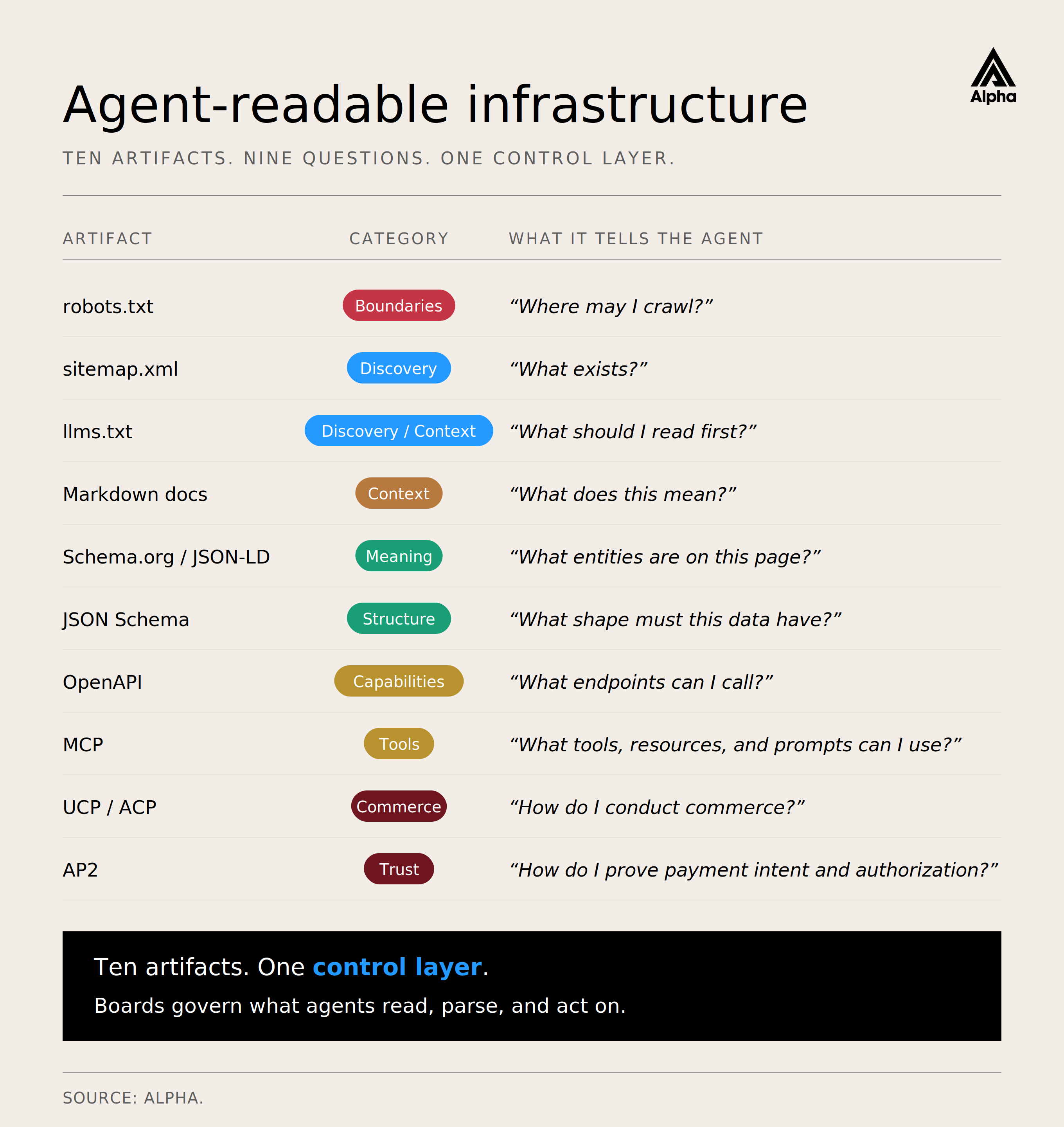
What agents want is structured data. Clean pricing schedules. Machine-readable product catalogs. Service-level commitments. Return policies. API access. Authenticated identity. Verifiable claims. The PDF buried on page four with the actual technical specifications? To an agent, that is the asset. The eight-figure homepage redesign is the noise the agent has to push through to reach it.
They are very judgy. And they are judging at machine speed, 24 hours a day, in milliseconds.
Agentic Commerce Is Becoming Infrastructure
The agentic web is not just a traffic phenomenon. It is becoming a protocol layer, and the foundation of the protocol layer is being laid brick by brick right now.
In January 2026, at the National Retail Federation conference, Alphabet (NASDAQ: GOOGL) announced the Universal Commerce Protocol, an open standard for agentic commerce co-developed with Shopify (NYSE: SHOP), Etsy (NASDAQ: ETSY), Wayfair (NYSE: W), Target (NYSE: TGT), and Walmart (NYSE: WMT), and endorsed by 20-plus additional partners including Adyen, American Express (NYSE: AXP), Best Buy (NYSE: BBY), Mastercard (NYSE: MA), Stripe, The Home Depot (NYSE: HD), Visa (NYSE: V), and Zalando. UCP standardizes how AI agents discover products, build carts, authenticate identity, transact, and produce audit trails across retailers.
The story since then is that the rest of the industry showed up. On April 24, 2026, Amazon (NASDAQ: AMZN), Meta (NASDAQ: META), Microsoft (NASDAQ: MSFT), Salesforce (NYSE: CRM), and Stripe joined the UCP Tech Council, the technical body that governs the protocol, bringing the governance body to ten members spanning search, marketplaces, social commerce, enterprise software, payments, and retail infrastructure. Stripe is also a co-developer of OpenAI's Agentic Commerce Protocol. The signal isn't just that one protocol won, but rather ten of the most important technology companies on the planet now sit inside the same governance body and are actively shaping the standard. UCP won what early adoption rarely wins: the governance layer.
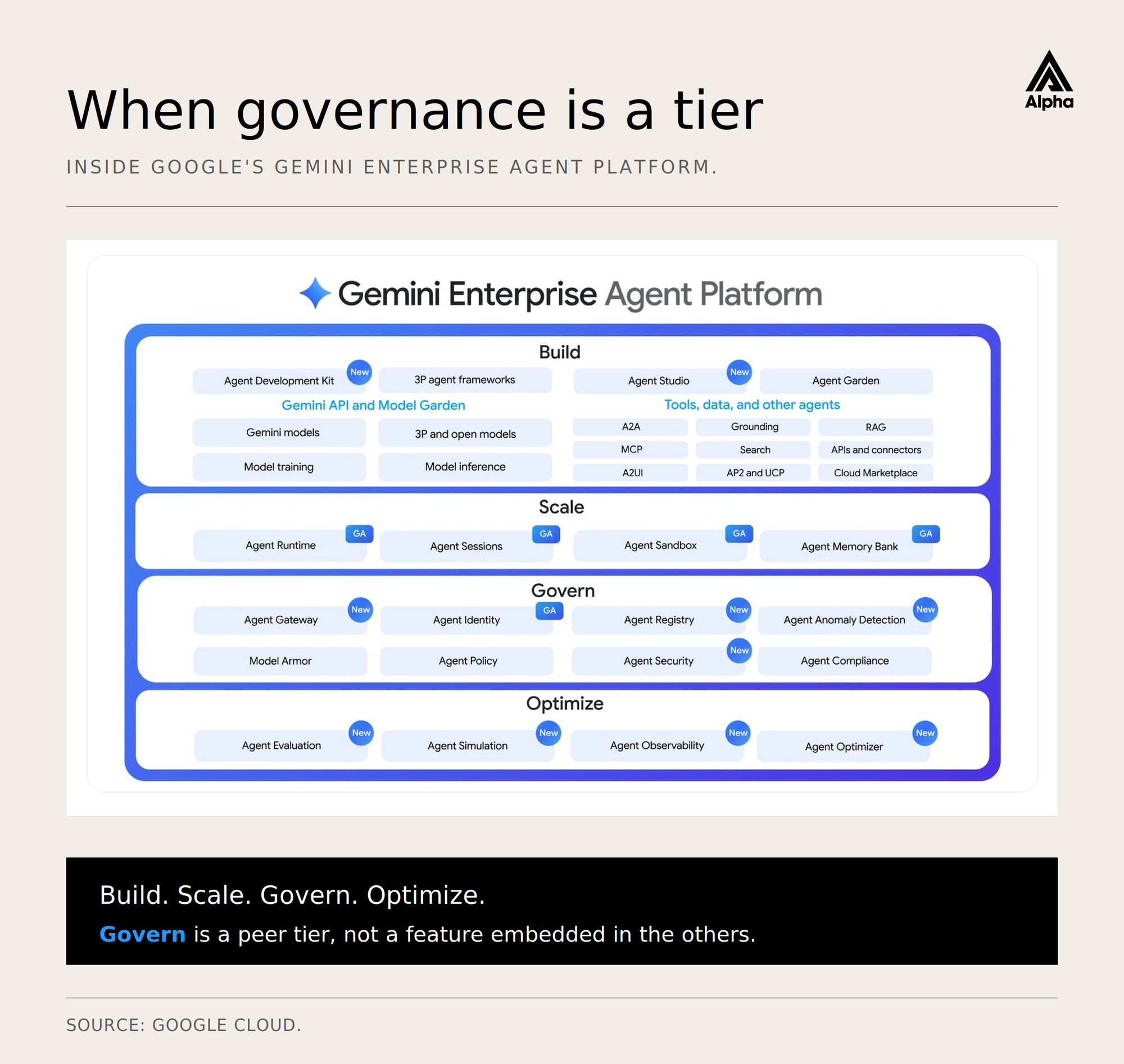
The trust layer is hardening alongside it. At Google Cloud Next 2026, Google introduced Agent Identity, Agent Registry, Agent Gateway, and anomaly detection on the new Gemini Enterprise Agent Platform. Cloudflare (NYSE: NET) launched Project Think, a durable agent-execution platform with sandboxed code execution and built-in agentic payments primitives. Google donated the Agent Payments Protocol (AP2) to the FIDO Alliance, with Mastercard contributing its Verifiable Intent framework so users can authorize and control actions performed by digital agents.
Visa moved in the same window. On April 8, Visa launched Intelligent Commerce Connect, a single integration on the Visa Acceptance Platform that supports the four major agent payment protocols (Trusted Agent Protocol, Machine Payments Protocol, Agentic Commerce Protocol, and UCP) and lets merchants accept agent-initiated payments without picking a winner. Today, April 29, Visa expanded its Agentic Ready program to Asia Pacific and Latin America, having already piloted in Europe and the United States. The program lets banks test agent-initiated payments in live environments with real cards and real merchants.
To put this in context, this is jus as important as the launch of SSL or the Apple App Store. Agentic commerce is being built right before our eyes. Most boards have not been briefed on it. Almost none have asked their general counsel where the company stands on UCP, ACP, MPP, AP2, MCP, or A2A, or who is accountable for that position.
The Money Question
There is a question hiding inside agentic commerce that most boards have not asked. When an AI agent transacts on behalf of a user, who pays, and through what rails?
The honest answer is uncomfortable. AI agents have no legal personhood. They cannot pass Know Your Customer screening because there is no customer to know. They cannot open bank accounts. They cannot sign contracts in their own name. They cannot be sued, jailed, or subpoenaed. The architecture of human-mediated finance, including banks, credit cards, KYC, AML, OFAC screening, and the settlement networks built on the assumption that the actor is a person, was designed for a different species of buyer.
Two responses are now competing in real time.
The first is the human-rails retrofit. Visa Trusted Agent Protocol, Visa Intelligent Commerce Connect, the Agentic Ready bank pilot program, Mastercard's $1.8 billion acquisition of stablecoin infrastructure firm BVNK, Google's AP2, and PayPal and OpenAI's Agent Checkout Protocol are each attempts to extend existing payment networks into a world they were not designed for. They will partially succeed. Card networks have decades of fraud, settlement, and compliance infrastructure that does not get rebuilt overnight.
The second is the crypto-native alternative. On April 2, 2026, Coinbase (NASDAQ: COIN), Cloudflare, and Stripe formed a nonprofit foundation under the Linux Foundation to govern x402, the open protocol that activates the dormant HTTP 402 "Payment Required" status code so software can pay software in stablecoins. Microsoft, Google, Amazon Web Services, American Express, Circle (NYSE: CRCL), and the Solana Foundation joined as members. A competing protocol, Machine Payments Protocol, launched by Stripe and Paradigm with the $500 million Tempo blockchain, has Visa, Mastercard, OpenAI, Anthropic, and Deutsche Bank as design partners.
The crypto rails were not designed for AI agents on purpose. They were designed for code: programmable, borderless, always-on, machine-readable, and indifferent to whether the originating actor has a passport. That makes them, by accident, the cleanest fit for a buyer who has none. "Crypto was built for AI agents, not humans," Alchemy CEO Nikil Viswanathan recently put it. Banks have operating hours because humans do. Agents do not sleep, do not live anywhere, and do not carry cards.
The prediction worth making is structural, not speculative. A meaningful share of agent-initiated transactions will settle on chain, in stablecoins, on rails like x402 and MPP, alongside parallel routing through Visa and Mastercard for high-trust merchant relationships. The two systems will coexist for some time. The shift is that crypto stops being a treasury allocation question for boards and becomes a settlement-layer question.
The implication is direct. The treasury function, the AML program, the SOX controls, and the risk register were built around the assumption that human-rails finance is the only finance the company touches. That assumption has a shelf life. If a meaningful share of customer agents pay in stablecoins routed through x402 within the next 18 months, the finance organization needs to know what that means before it happens, not after.
The question is no longer whether AI agents will transact. It is what currency they will transact in, and whether the company is ready to receive it.
Governance Frameworks Are Just Beginning to Catch Up
While commerce is racing, governance is starting to move.
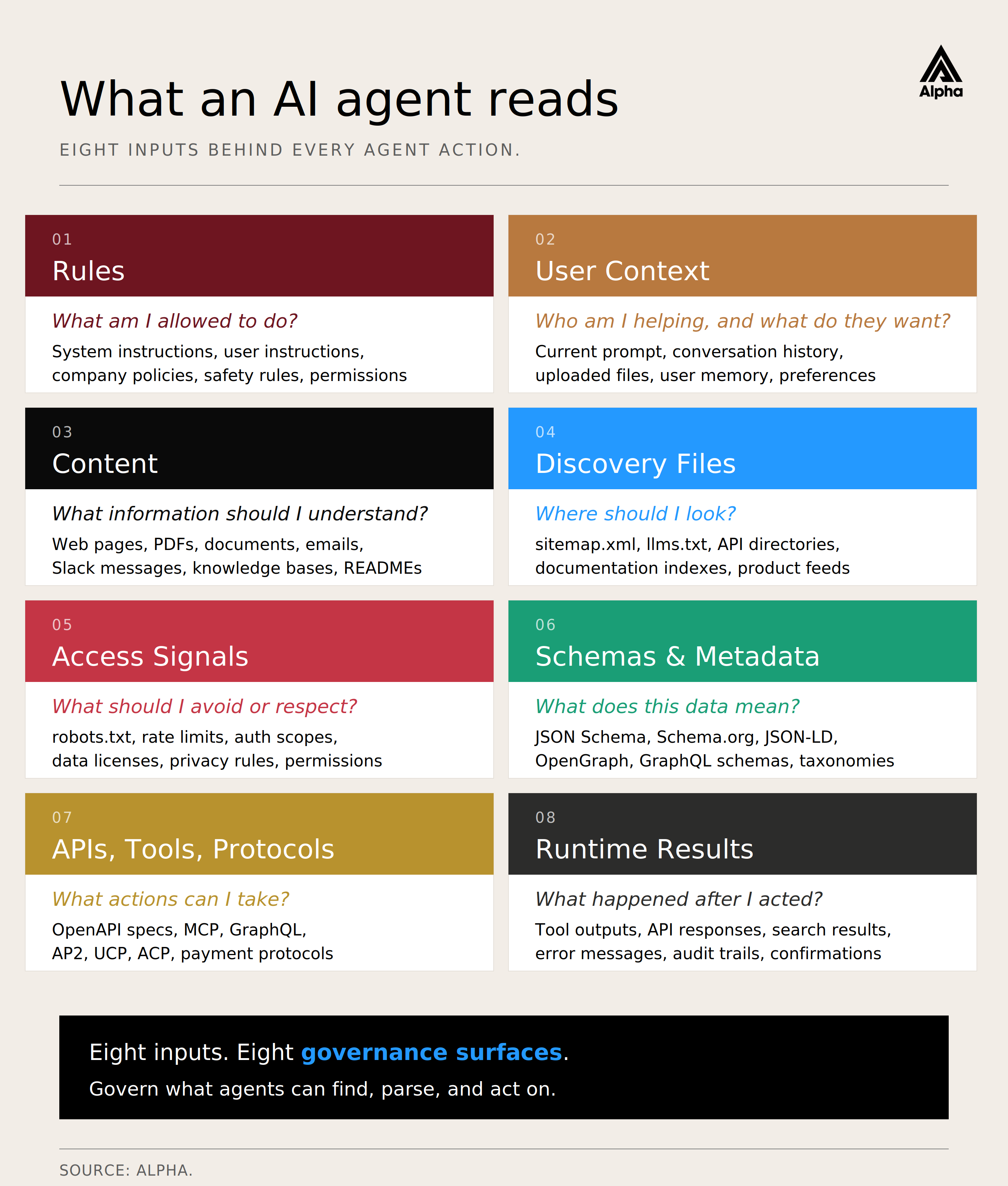
On January 22, 2026, at the World Economic Forum, Singapore's Infocomm Media Development Authority published the world's first national governance framework specifically for agentic AI. The Model AI Governance Framework for Agentic AI is built on a simple recognition: agentic systems are different from generative systems, and the existing playbooks do not cover them. Where generative AI risk centers on wrong answers, agentic AI risk centers on wrong actions.
The MGF organizes governance into four dimensions: assess and bound the risks upfront (limiting what agents can access and do, by design); make humans meaningfully accountable (clear allocation of responsibility across the agent lifecycle, with human approval gates at consequential checkpoints); implement technical controls and processes (testing, monitoring, logging, gradual rollout); and enable end-user responsibility (transparency about what agents can do, training to counter automation bias, preserving human tradecraft as agents take over routine tasks).
The framework is explicitly labeled a "living document." Singapore is asking organizations for feedback and case studies because, in its own words, best practices in this space are still being written. Regulators in the EU, the UK, the US, and elsewhere are watching closely; expect convergent guidance from each over the next 12 to 18 months. The EU AI Act enforcement deadline of August 2026 will force the issue.
The takeaway for boards is not that Singapore has the answer. The takeaway is that even the most sophisticated regulators are at the beginning. They are publishing version 1.0 frameworks and asking for input. Boards that wait for a finished playbook will be waiting through the period in which the agentic enterprise is being built around them.
The Alpha Lens: The 5A Framework
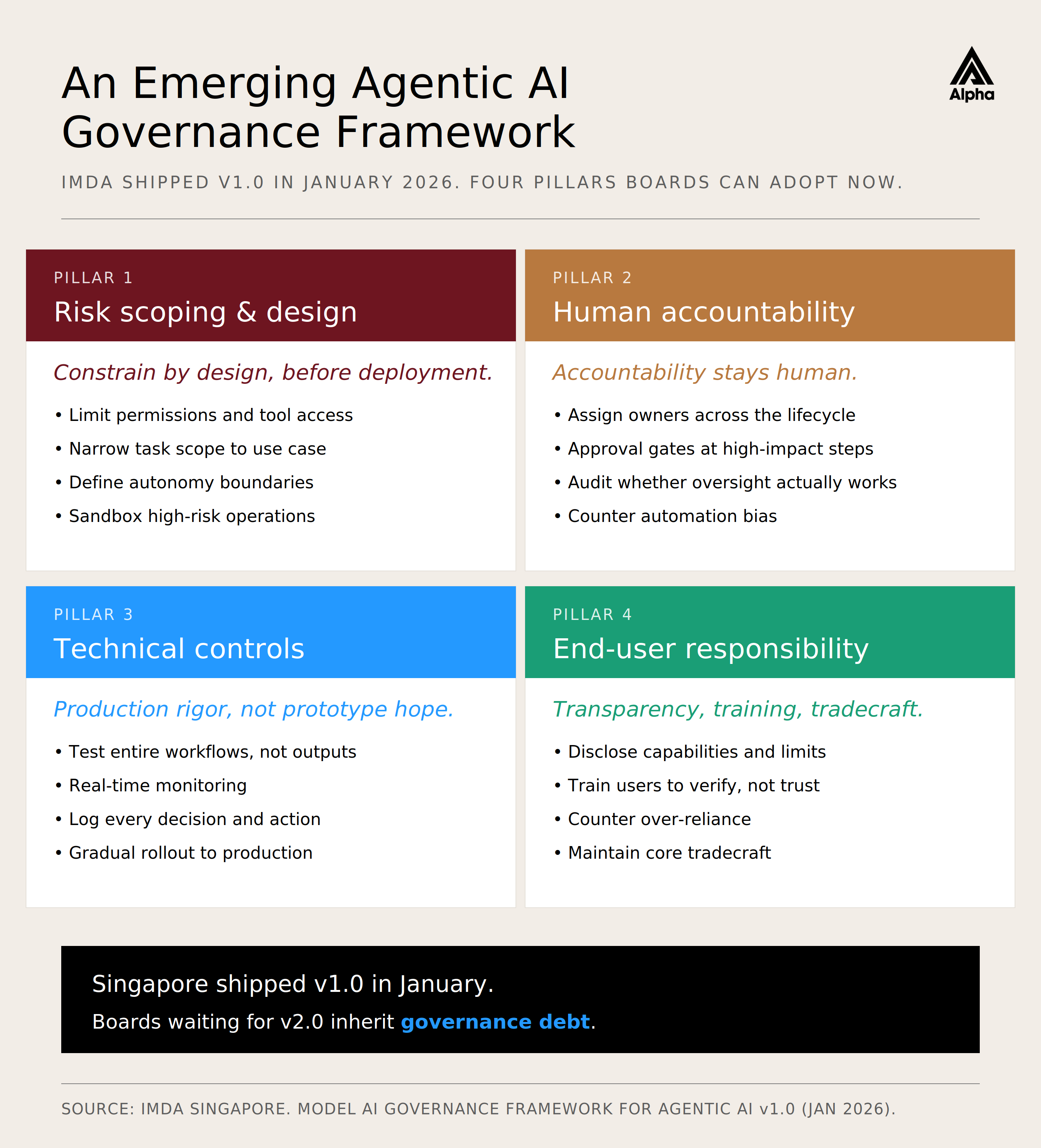
To translate all this into something an audit committee chair can act on tomorrow, the Alpha 5A Framework offers five questions. Five A's. One framework. It is consistent with the direction emerging from regulators including Singapore's IMDA, but it is built specifically for board-level oversight and each layer builds on the previous one.
1. Awareness — Can you see them?
What percentage of your digital traffic is human versus non-human? Can you measure it weekly, by property, by surface, by industry? If management cannot produce a chart, the rest of the conversation is hypothetical. Awareness is the foundation. Without it, governance is fiction.
2. Articulation — Can they read you?
Is your pricing, product, policy, and service data exposed in machine-readable form, or trapped in marketing copy and PDFs? An agent cannot recommend what it cannot parse. The active voice matters: the company articulates itself to machines. Companies that fail to articulate become invisible to the layer where decisions are now being made.
3. Authentication — Do you know who they are?
Can you distinguish among malicious bots, search crawlers, LLM training crawlers, customer agents, partner agents, procurement agents, and internal enterprise agents? Authentication is the technical term your CISO already uses. The agent economy demands a Know Your Agent discipline comparable to the Know Your Customer regimes that govern financial services.
4. Authority — Do you control what they can do?
Have you defined, in policy and in code, what each class of agent is permitted to see, query, transact, and bind? Does your terms of service answer whether an agent can accept terms on behalf of a user? Can an enterprise agent bind a contract? Can it negotiate a renewal? Authority converts identity into permission, and permission into safety.
5. Audit — Can you prove what happened?
When an agent acts on your platform or on your behalf, do you have a complete, immutable trail of who authorized it, what it accessed, what it transacted, and what changed? Is that trail sufficient to satisfy SOX, your auditors, your insurers, and a regulator? Audit is the seal. Without it, the four layers above are not defensible.
Awareness. Articulation. Authentication. Authority. Audit. That's the Alpha 5A's Agentic Governance framework.
The Governance Pivot: From "Noses In" to Continuous Governance
This is also where the traditional governance posture begins to break.
"Noses in, fingers out" was workable when the pace of change was annual and the actors were human. Management operated. The board reviewed. Committees met periodically. Metrics were packaged. Risks were summarized. Oversight happened in cycles.
Agentic systems do not operate in cycles. They operate continuously. They crawl continuously. They query continuously. They compare continuously. They transact continuously. They learn continuously. They can also fail continuously. And as Singapore's MGF makes explicit, agentic risk is not just about wrong answers. It is about wrong actions: erroneous, unauthorized, biased, or disruptive actions that can cascade across connected systems at machine speed.
The replacement is what Alpha calls Continuous Governance of the agentic enterprise. Continuous Governance does not mean directors become operators. It means boards insist that management build the instrumentation, controls, policies, reporting, and escalation paths required for an environment where non-human actors are constantly interacting with the business. Govern the design, not the decisions. Set the policies and audit trails that make autonomous activity legible to the board, in real time, by default.
Continuous Governance is a fiduciary requirement, not a technology preference. Directors are charged with overseeing how the company creates and protects value. If a meaningful share of customer interactions, supplier negotiations, and revenue-generating transactions now flows through autonomous agents, and the board cannot see, account for, or govern that activity, the duty of care is not being met. Not because directors are negligent. Because the model of oversight they inherited was designed for an internet that no longer exists.
Committee Accountability Mapping for the Agentic Web
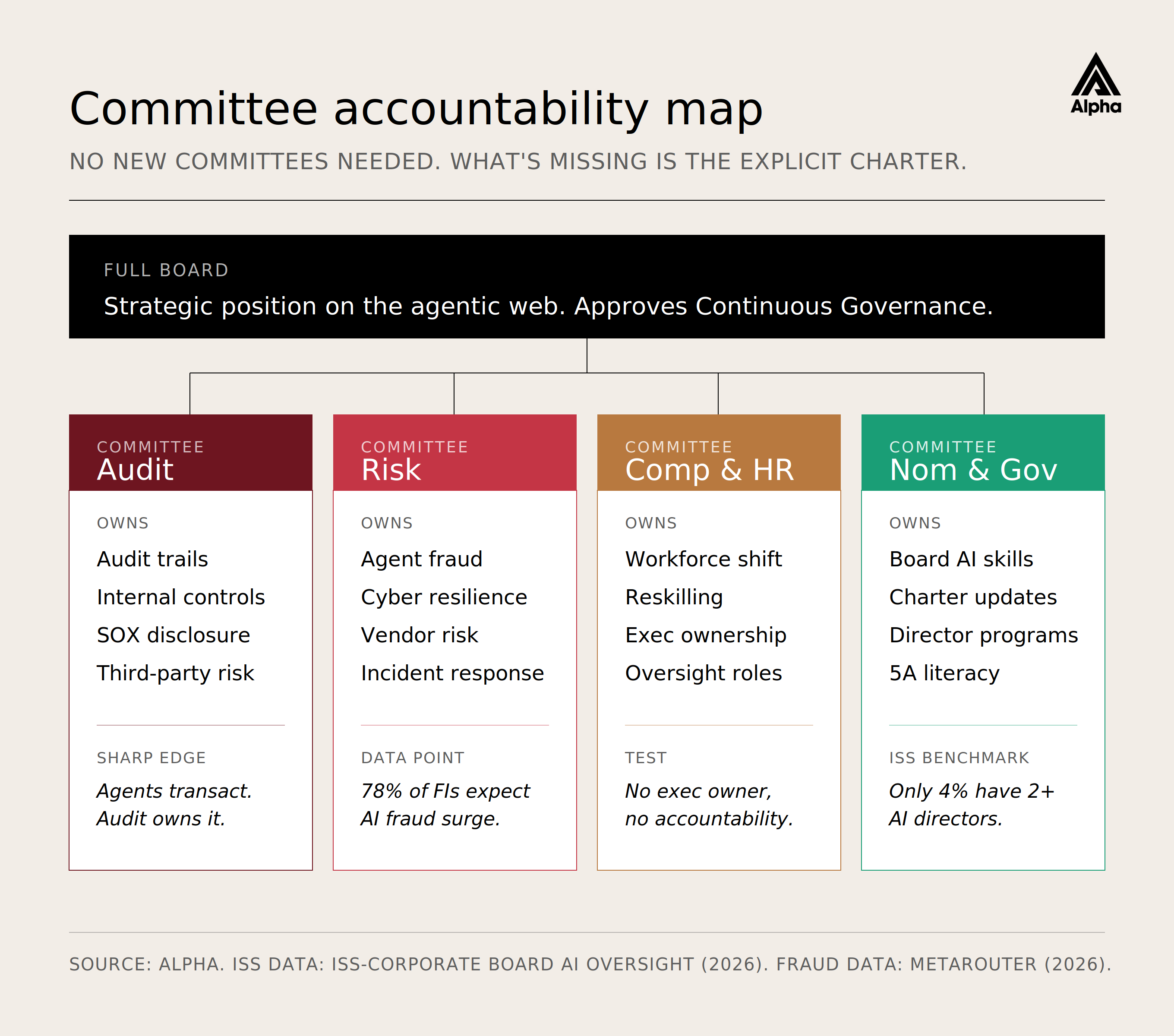
The good news is that no board needs to invent new committees. Existing committees already hold the relevant authority. What is missing is the explicit charter.
Audit Committee. Owns transaction integrity, internal controls, financial disclosures, third-party risk, SOX compliance, and audit trails. When AI agents transact, the audit committee is on the hook. Period.
Risk Committee. Owns AI agent cyber risk, fraud exposure, vendor and platform dependency risk, and incident response. 78% of financial institutions expect fraud to spike from AI shopping agents. The risk committee should already have this on the agenda.
Compensation and Human Capital Committee. Owns the workforce implications of agent-mediated customer interaction, the reskilling pathway for employees whose roles change, and the executive accountability for agentic governance. If no executive owns it, no executive is accountable.
Nominating and Governance Committee. Owns board composition, charter updates, and director education. Boards that lack a single director who can interrogate an agent governance framework are exposed. Of the 3,048 companies in ISS's universe, only 4% have two or more directors with disclosed AI skills. Two is not redundancy. Two is a quorum.
Full Board. Owns the strategic positioning question. Is the company building toward the agentic web, accidentally drifting into it, or actively excluded from it? In the human web, companies competed for attention. In the agentic web, companies compete for machine trust.
The Audit Committee Question Set
For the audit chair reading this on a Sunday afternoon, the next meeting is the right meeting. Put these questions on the agenda. Insist on data, not narrative.
- Traffic visibility. What percentage of traffic to our digital properties is human versus non-human, and is that share growing or shrinking quarter over quarter?
- Agent classification. Can we distinguish among malicious bots, search crawlers, LLM training crawlers, customer agents, partner agents, procurement agents, and internal enterprise agents?
- Access policy. Which AI agents do we explicitly allow, block, throttle, authenticate, or monetize, and who in management made each decision?
- Data legibility. Is our pricing, product, and policy data machine-readable, or is our most valuable commercial information trapped in marketing copy and PDFs?
- Protocol position. What is our position on Universal Commerce Protocol, Agentic Commerce Protocol, Machine Payments Protocol, Agent Payments Protocol, Model Context Protocol, and Agent2Agent, and who is accountable for it?
- Transaction integrity. When an AI agent transacts on our platform, what is our audit trail, and is it sufficient for SOX, our auditors, and a regulator?
- Control design. How do our internal controls handle non-human actors, and were they designed for this scenario or retrofitted to it?
- Platform dependency. What is our exposure if a major AI agent platform changes, deprecates, or monetizes its access protocol with 30 days' notice?
- Disclosure and IP risk. Are we exposing confidential, regulated, or commercially sensitive information to LLM crawlers and third-party agents without authorization?
- Fraud surface. What is our Know Your Agent framework, and how does it interact with our existing fraud, anti-money-laundering, and account-takeover controls?
- Settlement layer. What is our policy on accepting agent-initiated transactions settled in stablecoins via x402, MPP, or other emerging crypto payment rails, and who has reviewed our treasury, AML, and SOX controls for that scenario?
- Accountability. If a material misstatement, transaction error, or compliance breach originated from an autonomous agent acting on our platform or on our behalf, who is accountable, and is that accountability documented in our charter?
- Briefing cadence. When did this committee last receive a substantive briefing on agent traffic, agent identity, agentic commerce, and agent payment rails, and from whom?
If management cannot answer these questions in the next meeting, the question is not when they can. The question is why they cannot.
The Bottom Line
The internet has bifurcated. The human web is what we built. The agentic web is what is building us. The economic activity is moving, the protocols are being poured, the settlement layer is being chosen, the first regulatory frameworks are being drafted, and the governance work has only just begun.
This is not a technology story. It is a fiduciary story. For 25 years, boards governed an internet of humans visiting websites. That internet still exists, but it is no longer the whole internet, and it will not be the most important internet for much longer. The board that does not know what percentage of its company's traffic is non-human, what agents are doing on its behalf, what currency they are transacting in, and what audit trail it has when an agent acts, is a board that is accepting blindness as a strategy.
Continuous Governance of the agentic enterprise is the work. The audit committee is the starting point. The agentic web is not waiting for your charter update.


