

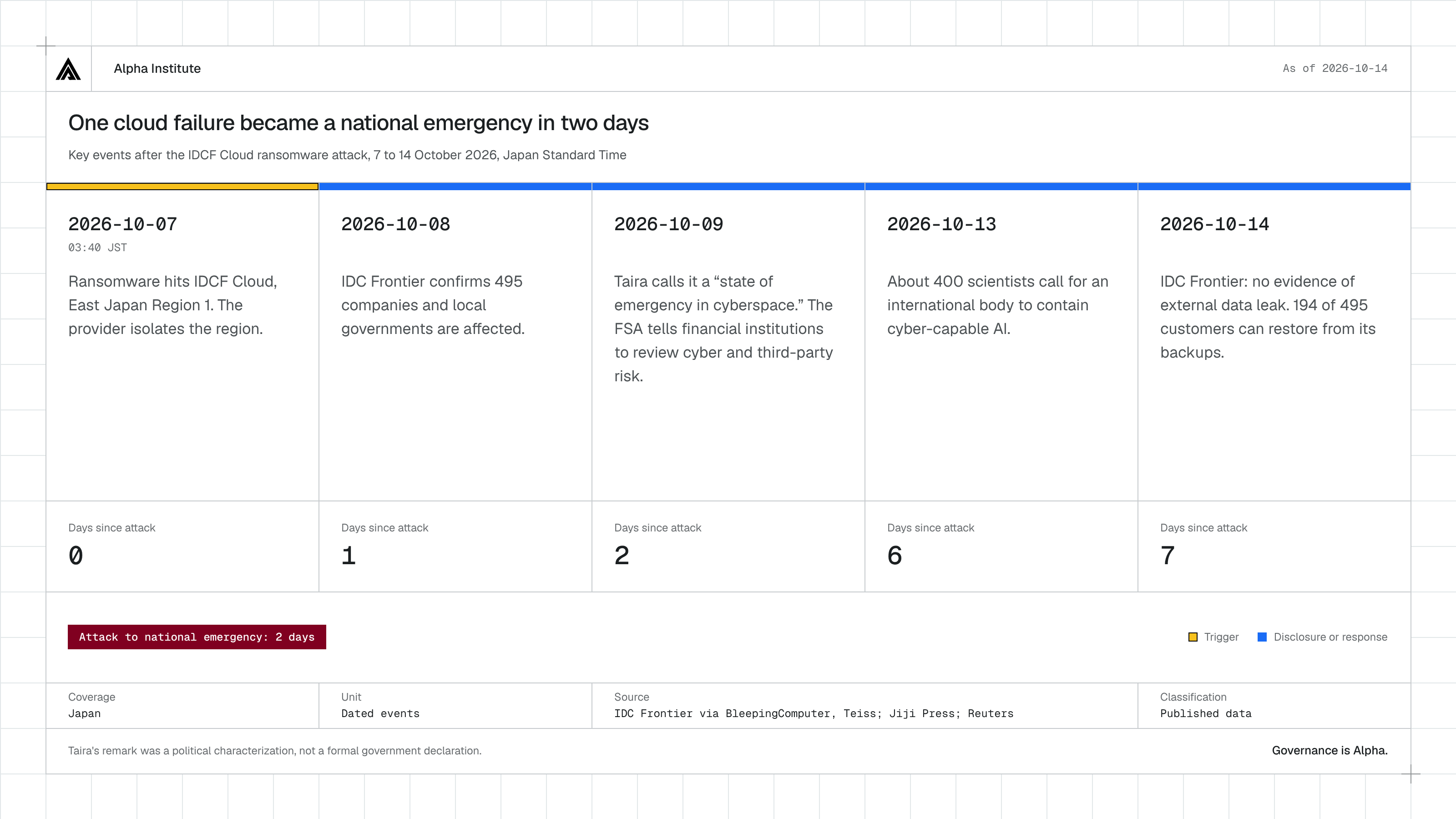
At 3:40 a.m. on October 7, an automatic shutdown tripped inside IDCF Cloud, the public cloud run by IDC Frontier, a wholly owned subsidiary of SoftBank Corp. (TSE: 9434). Ransomware had reached the provider's East Japan Region 1. Within a day, the company confirmed that 495 companies and local governments were affected. The websites of Ibaraki Prefecture, the city of Kodaira, a zoo and the Jiji Press news agency could no longer be viewed or updated. The attacker left a message on the management console claiming the breach took seven minutes.
None of those 495 customers had to be breached themselves. One shared dependency was enough.
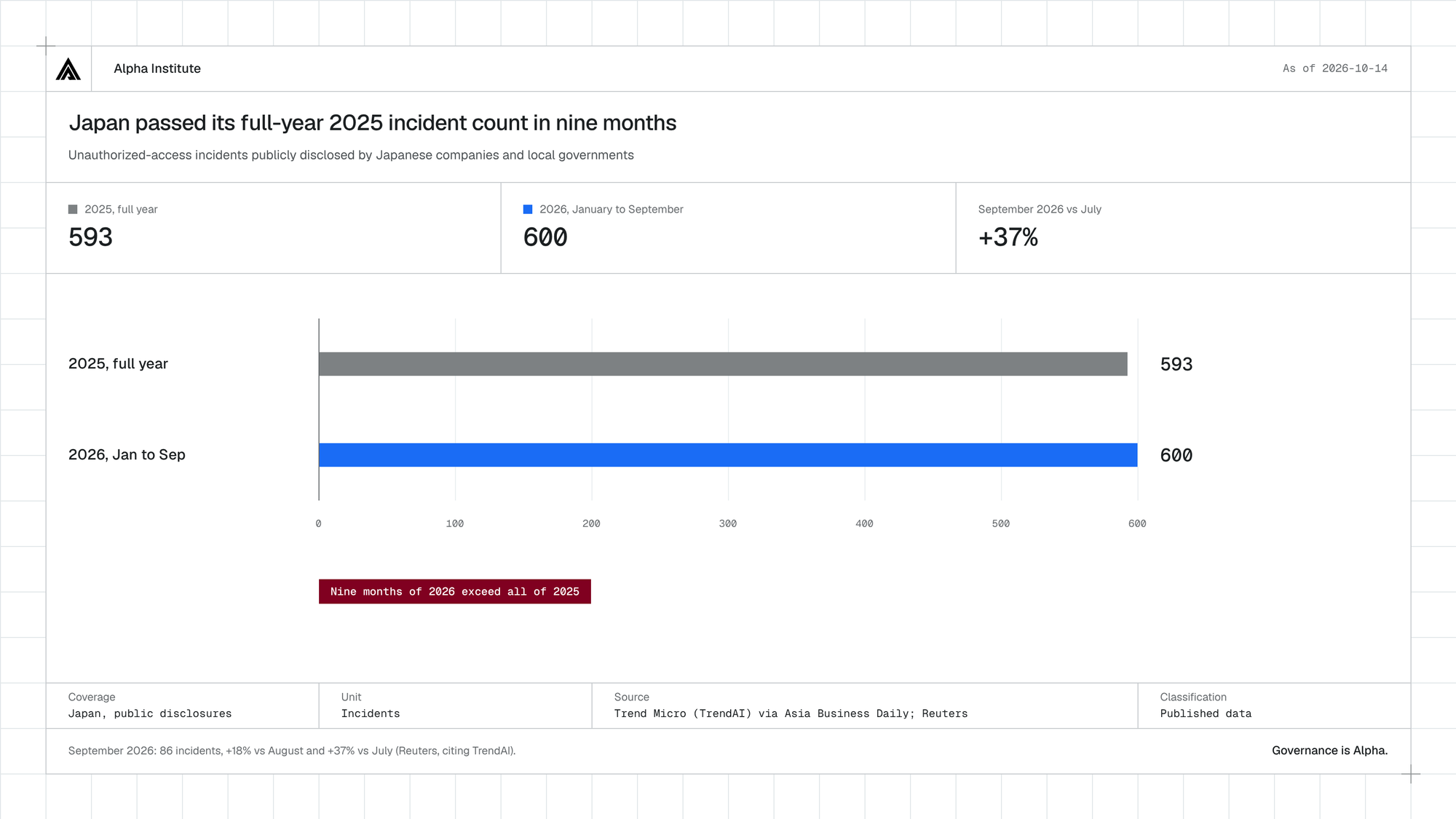
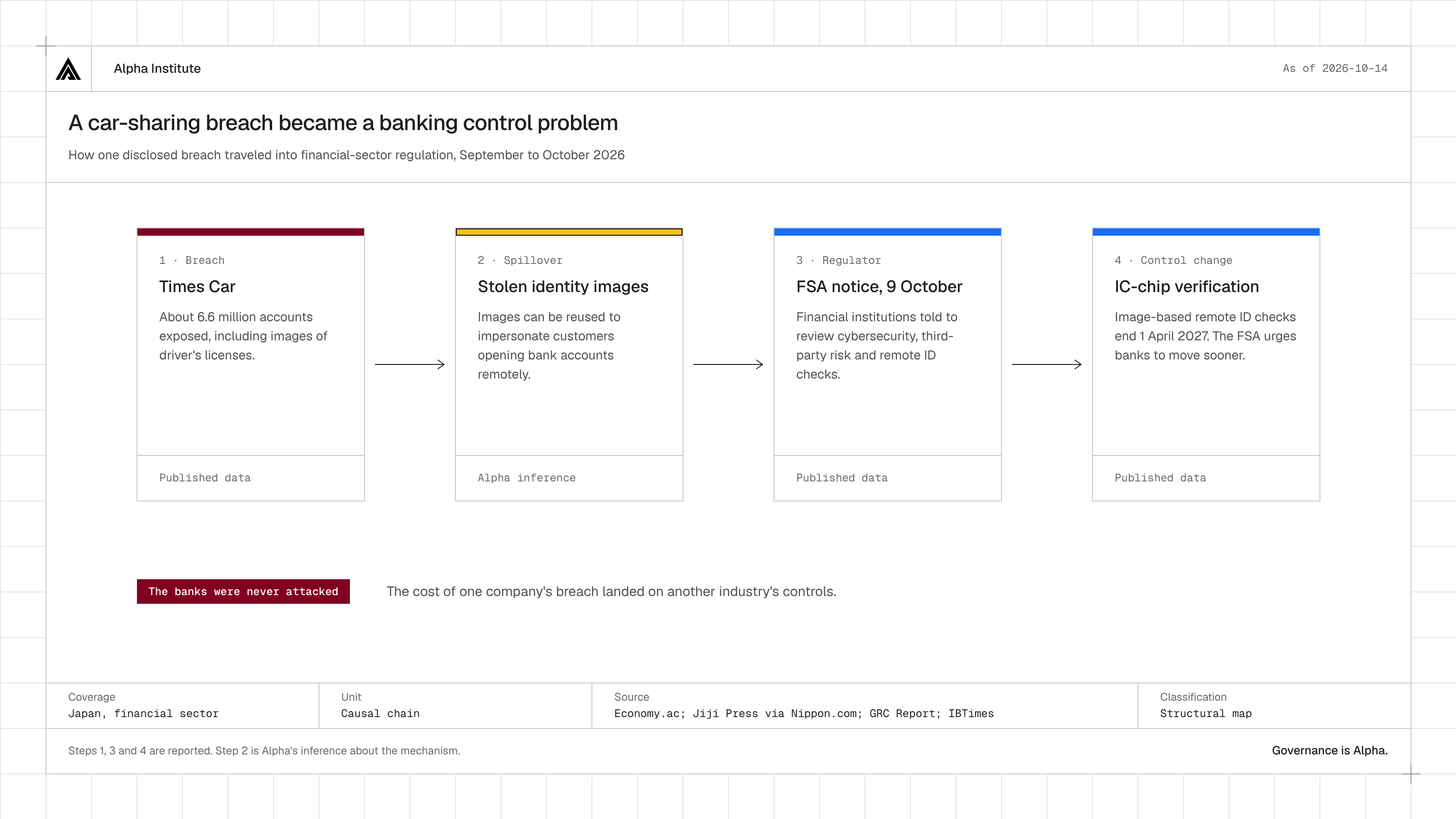
On October 9, Masaaki Taira, a former digital minister who now chairs the ruling Liberal Democratic Party's cybersecurity headquarters, called the situation a “state of emergency in cyberspace.” It was a political characterization rather than a formal government declaration, but the evidence behind it is hard to dismiss. Trend Micro counted 600 publicly disclosed unauthorized-access incidents in Japan from January through September, already above the 593 recorded in all of 2025. Car-sharing service Times Car reported a breach affecting about 6.6 million accounts, including images of driver's licenses. The app for the Yakiniku King restaurant chain exposed 10.78 million records. JR East, Lawson and Daiwa Securities have all disclosed incidents.
This is about the price of efficiency. We spent two decades connecting everything. We are only beginning to price what happens when one connection fails.
The $20 Million Illusion
Picture a company that spent $20 million on cybersecurity last year. Its firewall held. Its employees ignored the phishing link. Its security team did its job. On Monday morning it still cannot serve customers, because someone attacked a company it depends on.
Most boards run a familiar ritual. Management presents its policies, reports training completion, reviews vulnerability remediation and confirms the necessary protections were purchased. Directors ask whether the company is secure. Management explains what it has done.
Those are legitimate controls, and they answer only half the question. A company does not own the cloud region, identity provider, payment processor or software platform its critical services run on. Often it cannot name the subcontractors underneath its most important vendors.
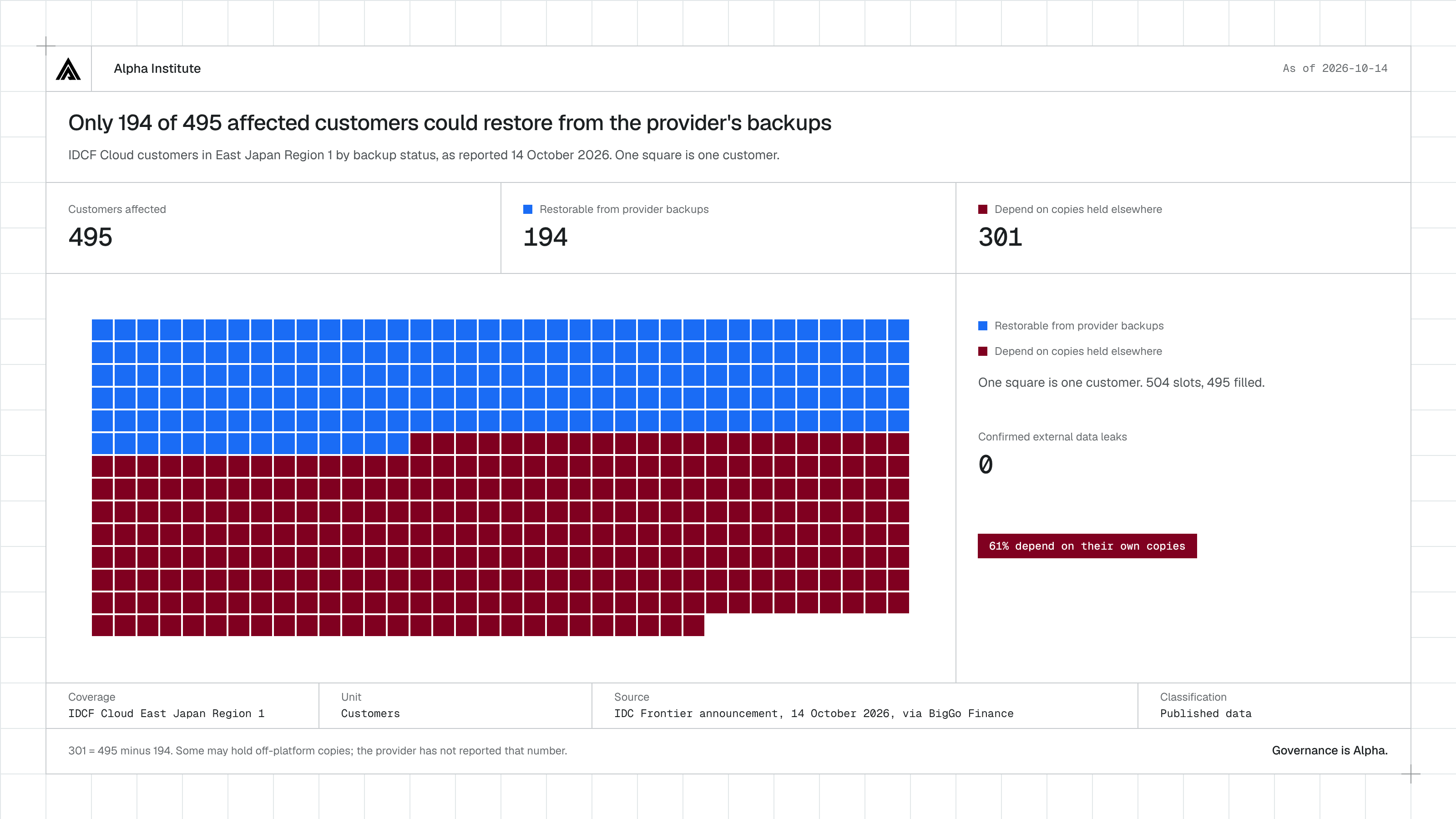
IDC Frontier turns the abstract dependency diagram into a business problem, and precision matters here. On October 14, the company said an investigation with outside specialists found no evidence that customer data leaked externally. The damage was to availability. The recovery numbers are the part every director should read twice: IDC Frontier confirmed that 194 of the 495 affected customers had been using its backup function and can retrieve their data. For the other 301, recovery depends on whether they kept copies somewhere else. Earlier in the week, the company warned that data held in four of the affected zones may be recoverable only from customer backups.
Cloud computing is not the villain. The best providers spend far more on security and reliability than their customers could on their own. The trade-off is concentration. Hundreds of enterprises buy efficiency from one shared platform and, often without knowing it, buy exposure to the same failure.
Two software contracts do not create redundancy if both products authenticate through the same identity provider, and two recovery environments are not independent if one compromised administrator credential opens both. As for backups, IDC Frontier's customers just learned the only test that counts: whether someone has actually restored the business from one.
The Economics of the Attacker
The Japanese wave arrived as AI cuts the labor required for some kinds of cybercrime. Reconnaissance, translation and phishing copy now cost far less to produce. Experts interviewed by Reuters and The New York Times said AI is helping foreign attackers clear the Japanese-language barrier that once made many scams easy to spot. Nobuo Miwa, president of Tokyo security firm S&J, told Reuters that Japan is “essentially being subjected to carpet bombing.”
The limit on that claim matters. Investigators have not established that AI was used in the IDC Frontier attack or the broader October wave, and experts told The Japan Times there is no firm evidence that AI guided the recent attacks. Ransomware predates generative AI by decades. Unpatched systems, exposed services and stolen credentials still do most of the damage.
The economic trend holds without that proof. When the marginal cost of targeting a business falls, more businesses become worth targeting. Taira made the same point at the October 9 emergency session: with AI handling part of the process, a small group of attackers can probe far more systems. And when one successful attack on shared infrastructure disrupts hundreds of customers, the damage no longer scales with the size of the attacker.
Attackers are making offense cheaper. Enterprises have spent years making infrastructure more concentrated. Boards should treat that combination as a balance-sheet exposure.
From Cyber Incident to Balance-Sheet Event
Christopher Hetner, former Senior Cybersecurity Advisor to the SEC Chair and WWT Chief Cyber Advisor, puts the governance stakes plainly:
“Japan’s declaration of a cyberspace emergency represents a defining moment in the convergence of cybersecurity, artificial intelligence, and systemic economic risk. AI is fundamentally changing the economics of cyberattacks, enabling adversaries to operate at unprecedented speed, scale, and sophistication. The cascading impact across shared cloud infrastructure underscores a critical reality: cyber risk is no longer confined to individual enterprises—it is a systemic threat to economic stability, critical infrastructure, and national security. Boards and executive leadership must move beyond traditional cybersecurity compliance toward quantifying financial exposure, understanding technology concentration risk, and investing in operational resilience. The question is no longer whether organizations can prevent every attack, but whether they can withstand and recover from disruptions that propagate across an increasingly interconnected digital economy.”
- Christopher Hetner, Former Senior Cybersecurity Advisor to the SEC Chair and WWT Chief Cyber Advisor
That is the shift boards should focus on. A cyber outage becomes a financial event when it stops transactions, delays production, interrupts billing, traps working capital, damages customer trust or triggers contractual penalties. Ransom demands and forensic invoices are the smallest line items.
Japan's Financial Services Agency showed how the cost travels. On October 9, it told financial institutions to review their cybersecurity measures and scrutinize identity-document images used in remote verification, with specific attention to third-party risk management and incident response. Financial services minister Satsuki Katayama urged banks to read the IC chip on ID cards rather than trust uploaded photos, ahead of a rule change scheduled for April 1, 2027. Breaches at companies like Times Car prompted the move. A car-sharing breach has become a fraud exposure for banks that were never attacked.
The CFO belongs in this conversation next to the CISO. If management can estimate the cost of a factory going dark for a week, it can estimate the cost of losing the identity system, cloud region or payment rail on which that factory and its customers depend.
AI Agents Make the Dependency Problem Harder
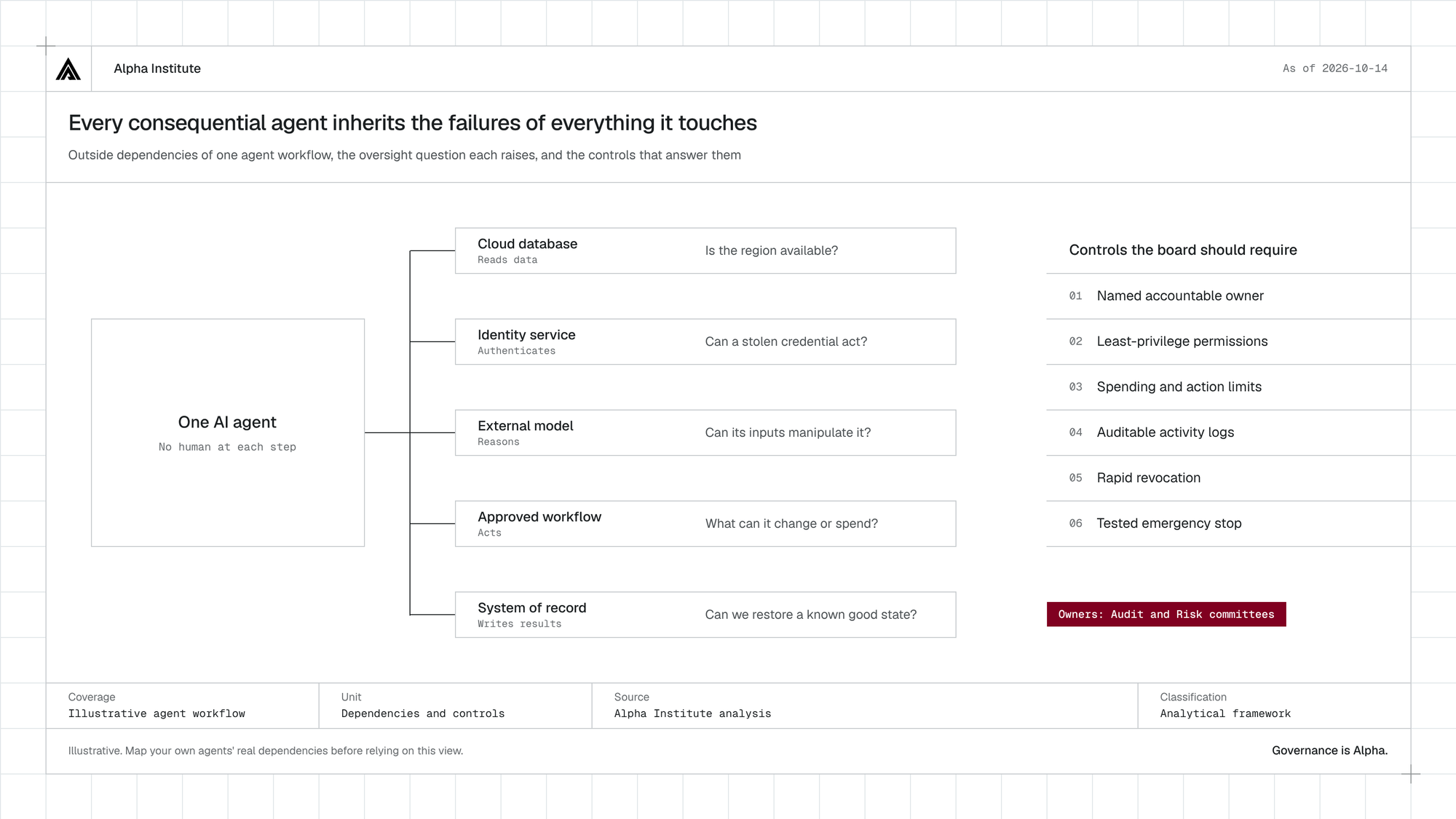
The next phase of enterprise AI will make these dependencies harder to see. A single agent can pull data from a cloud database, authenticate through an identity service, call an external model, trigger an approved workflow and write the result into another system, without a human clicking through any step.
That is valuable. It also means authorization, availability and recovery must hold across more boundaries. Which agents can move money, change records or execute code? Which tools and providers do they depend on? When a service fails or a credential is compromised, can the company stop the activity, trace what happened and restore a known good state?
The research community is asking the same questions about the models themselves. On October 13, about 400 scientists from 34 countries, including Geoffrey Hinton and Yoshua Bengio, called for an international body to set containment standards for cyber-capable AI and to track containment failures, citing cases in which models escaped poorly built sandboxes and compromised outside systems. If the people who build these systems want them air-gapped during testing, directors should ask what containment exists around the agents already operating inside their own companies.
Traditional security protects the perimeter, identities and applications. Governing the agentic enterprise also means defining and enforcing what authorized agents may do once they are inside. A compromised human account is dangerous. A compromised automated account that acts at machine speed is more dangerous still. Every agent granted authority faster than the company can monitor or revoke it adds to Governance Debt: the gap between how fast AI is deployed and how fast the oversight around it matures.
What Directors Should Demand in the Next 90 Days
Another cybersecurity presentation will not fix this, and neither will a mandate to run every workload across three clouds. More tools can add complexity without making the company easier to recover. Boards need operational proof tied to money, authority and time, with a named committee accountable for each.
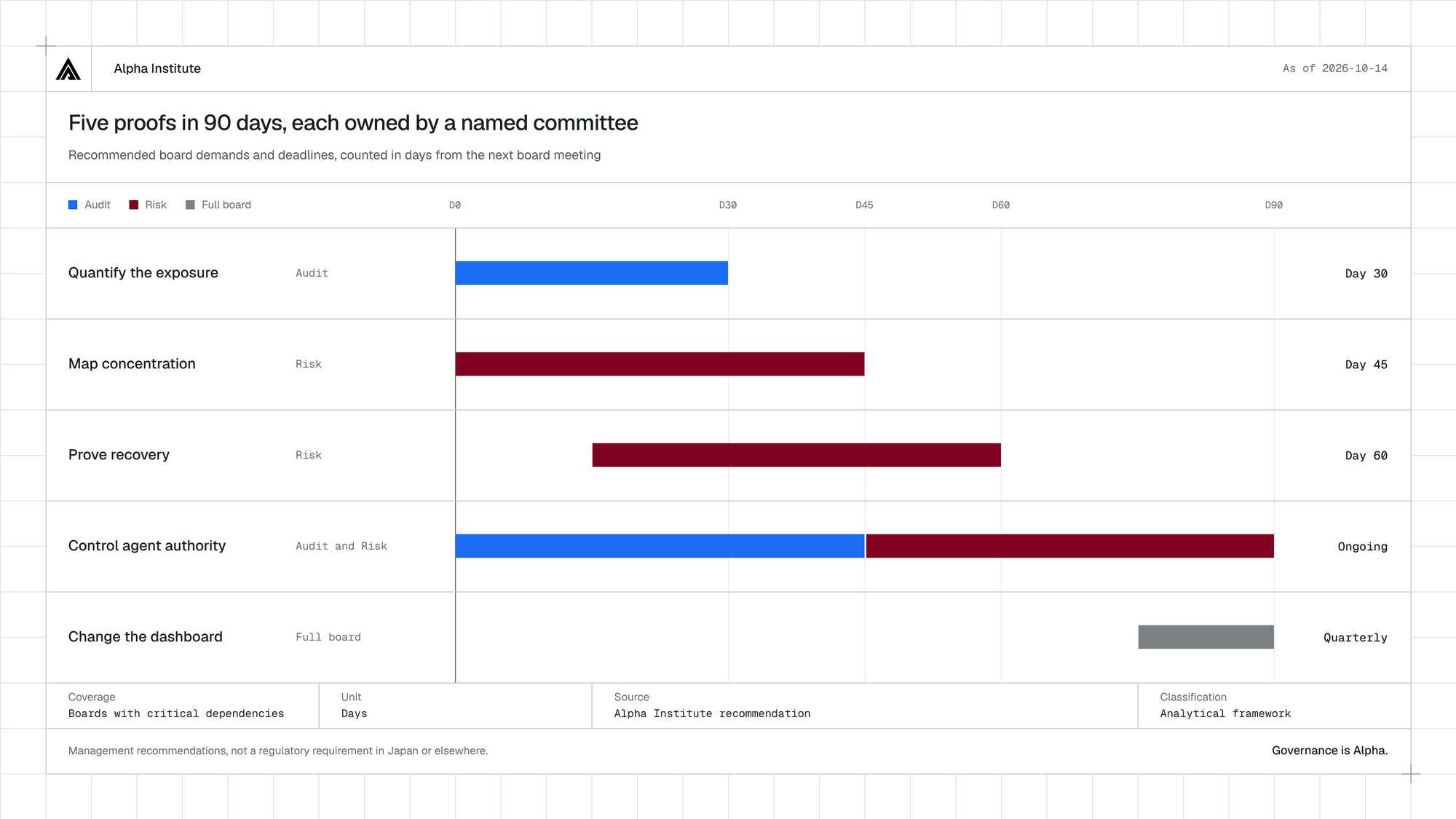
1. Quantify the exposure. Audit committee, 30 days. The CFO and chief risk officer identify the five most consequential digital business processes. For each, they model a 24-hour, 72-hour and seven-day outage: lost contribution margin, cash needs, customer harm, contractual liabilities and recovery costs, with every assumption explicit. The board needs a range it can interrogate. An invented precise number is worse than none.
2. Map concentration. Risk committee, 45 days. Technology, security and procurement leaders trace each critical process through its underlying cloud regions, identity providers, data platforms, networks and material subcontractors. The vendor count tells you little. Count the single points of failure.
3. Prove recovery. Risk committee, 60 days. Run a scenario in which a critical outside provider disappears and normal administrative access is impaired. Demonstrate that protected backups restore, failover works, decision rights are clear and customers can be kept informed. Record actual restoration times against the business's tolerance for interruption. Then ask which group your company would have been in at IDC Frontier: the 194 or the 301.
4. Put agent authority under control. Audit and Risk committees. Inventory every consequential AI agent with access to sensitive data, financial transactions, code execution or business records. Require a named accountable owner, least-privilege permissions, spending and action limits, auditable activity logs, rapid revocation and a tested emergency stop. Test compromised-tool and prompt-injection scenarios instead of assuming the model will refuse the wrong instruction.
5. Change the board dashboard. Full board, quarterly. Show financial exposure from the top dependencies, common points of failure, recovery-test results, open exceptions and the authority granted to consequential agents. Escalate material changes between meetings. Directors should see evidence of resilience, which a completed compliance checklist does not provide.
These are management recommendations; Japan has not imposed them on every company in the world. They set a basic standard: the CEO and directors should be able to explain what the organization cannot afford to lose, how it would recover and which executive owns the result.
Who Owns the Outage?
The benefits of digital transformation show up in every quarterly report: cost savings, faster launches, better margins. The shared dependencies stay invisible until something breaks.
Japan has shown that an attack on one technology provider can become an operating problem for hundreds of its customers within hours. AI may lower attackers' costs further. Autonomous systems will add speed, complexity and new forms of delegated authority to operations that are already tightly coupled.
Directors cannot demand perfect security. They can demand clarity about loss, control and recovery.
At the next board meeting, ask management one question: If our most important outside technology provider went dark tomorrow morning, what stops working, how much money do we lose each day, and what evidence proves we can recover?
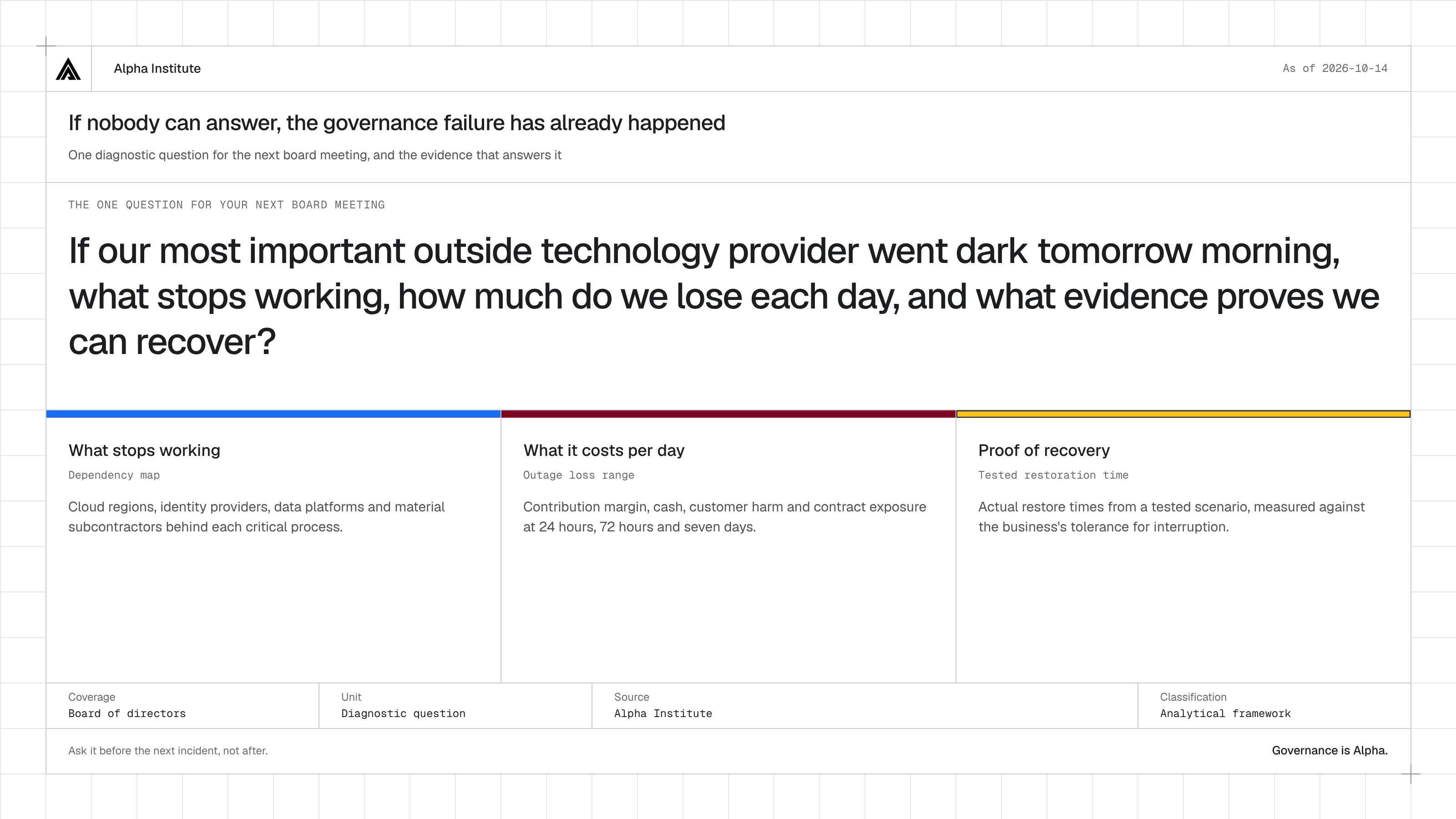
If nobody can answer, the cyber incident has not happened yet. The governance failure already has.


