

Every board will soon confront two questions: How much intelligence does this company need to purchase to remain competitive? And how will we know that spending is creating value?
As AI agents become embedded in software development, customer service, procurement, finance, and operations, the token budget begins to finance the work of the enterprise itself. For some knowledge-intensive businesses, it could eventually rival payroll or become their largest operating expense.
That possibility changes the conversation. AI spending becomes a recurring allocation of resources to productive capacity. How much intelligence a company purchases, where it deploys that intelligence, and how effectively it governs execution will increasingly influence its margins and competitive position.
Electricity offers a useful analogy. Once an industry organizes around a general-purpose capability, operating without it becomes a structural disadvantage. A business can theoretically refuse to use electricity. It will struggle to compete with businesses that have redesigned production around it.
AI may follow a similar trajectory. Competitors will establish new expectations for responsiveness, service availability, development speed, and cost. AI-native startups will design their operations around agents from the outset. Established enterprises will face growing pressure to redesign the workflows through which they compete.
This does not mean every decision should be autonomous. It means every material workflow deserves examination: where can agents perform the work, where should humans retain authority, and what combination produces the strongest economics within acceptable risk?
Essential infrastructure still requires financial discipline. A rising token bill can accompany profitable growth, inefficient execution, or both. Leadership needs evidence connecting purchased intelligence to business outcomes.
Return on inference provides that discipline.
What return on inference means
Return on inference measures the incremental economic benefit attributable to AI within a defined workflow, relative to the fully loaded cost of producing an acceptable outcome, over a stated time horizon and within approved risk limits.
Its practical purpose is to guide a continuing allocation decision: the right model, for the right task, with the right amount of reasoning, autonomy, and supervision, over the right time horizon.
An inference occurs when a trained model processes information to produce an output. Tokens are units of information processed or generated by the model and frequently serve as the meter for consumption.
An agent may require many inferences to complete one assignment. It interprets instructions, retrieves information, develops a plan, calls tools, evaluates results, and corrects mistakes. Every step can consume resources. Unsuccessful attempts consume resources too.
The enterprise pays for that activity because it expects an outcome: a resolved customer issue, a completed software change, an accurately processed invoice, or a better purchasing decision.
This distinction is central. Tokens measure consumption. Completed, acceptable outcomes establish whether that consumption was productive.
In the recent white paper from Nasdaq's Center of Board Excellence From Pilots to P&L: Where AI Value Actually Shows Up, Shannon Nash and Steven Wolfe Pereira locate AI value inside workflows - the repeatable processes through which businesses deliver results. Their argument provides the foundation for return on inference: management must identify where the work changed, what economic benefit followed, and who is accountable for sustaining it.

Why the scale matters
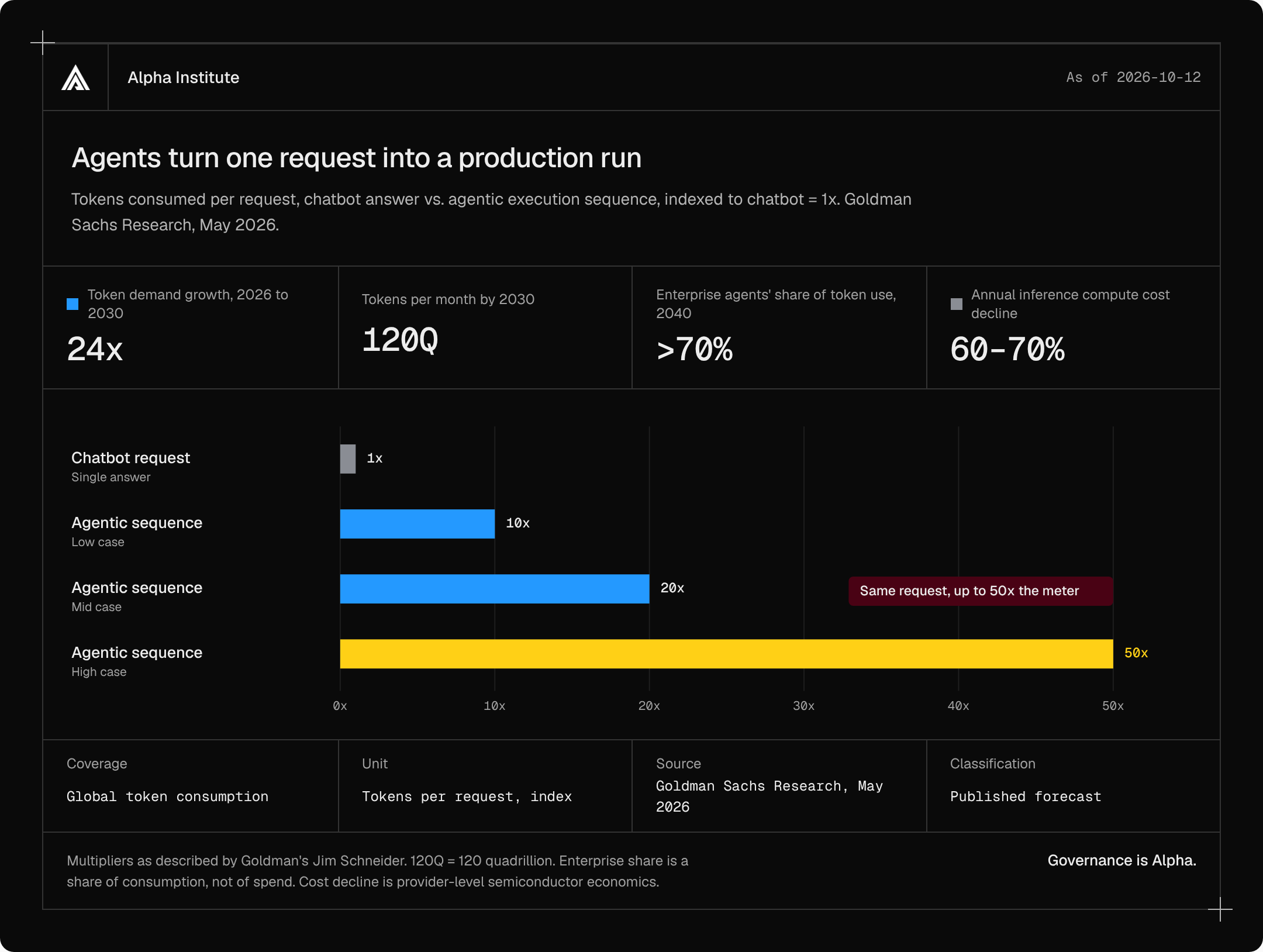
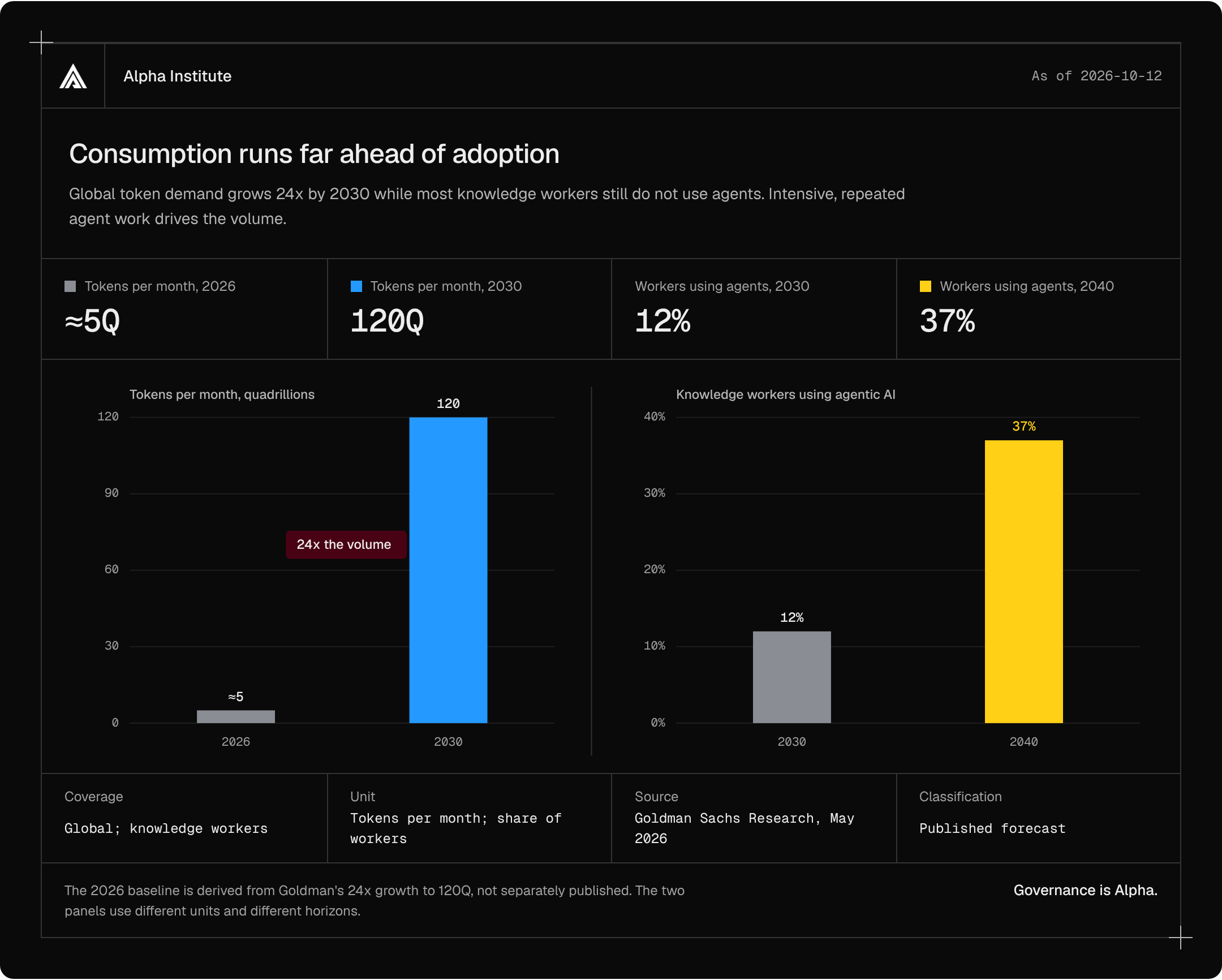
Goldman Sachs Research forecasts a 24-fold increase in monthly token consumption between 2026 and 2030, reaching 120 quadrillion tokens per month, driven by consumer and enterprise adoption of agents.
In its May 2026 public analysis, analyst Jim Schneider explains why agentic applications consume so much intelligence: a simple chatbot request can expand into a sequence requiring 10, 20, or 50 times as many tokens.
The mechanism is straightforward. A procurement agent might monitor replacement needs, review specifications, compare suppliers, check contractual restrictions, negotiate within authorized limits, validate expenditure against budget, and monitor fulfillment. Intelligence is consumed throughout the process.
Reporting on Goldman’s underlying research places enterprise agents at more than 70% of token usage by 2040. That is a reported forecast of consumption. It should not be treated as a verified forecast that enterprises will pay more than 70% of token expenditure: model prices and workload costs vary substantially.
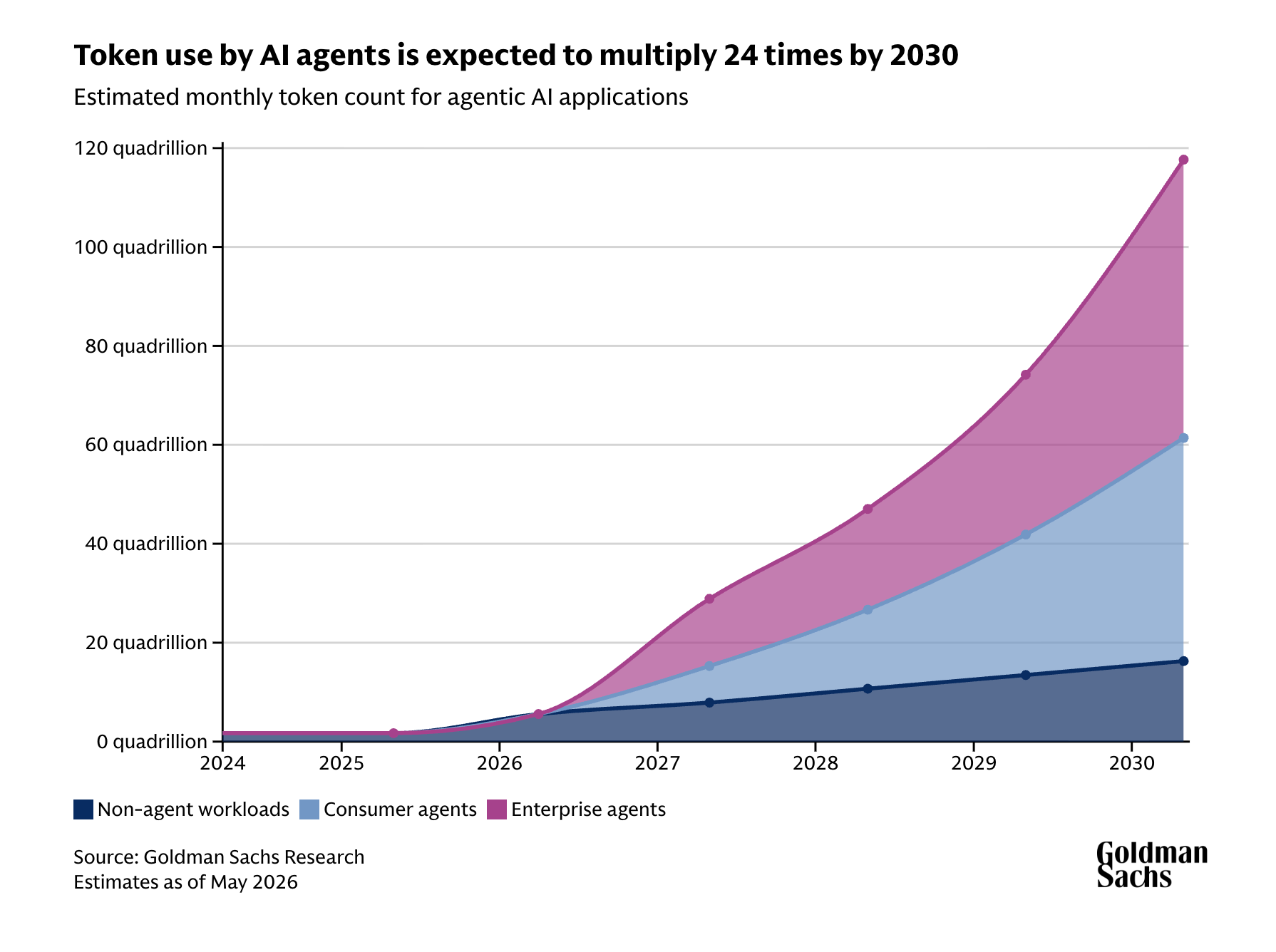
Goldman’s public interview also forecasts agentic AI use by 12% of knowledge workers in 2030 and 37% in 2040. Its demand outlook therefore incorporates a lengthy adoption process. Intensive agent activity can produce substantial consumption before adoption becomes universal.
An illustrative enterprise budget makes the scale tangible. Ten thousand workers supported by agents consuming one million tokens per working day would generate 2.5 trillion tokens annually, assuming 250 working days. At an assumed blended price of $2 per million tokens, annual inference spending would be $5 million. At ten million tokens per worker per day, it would be $50 million, before tools, integration, oversight, and other costs.
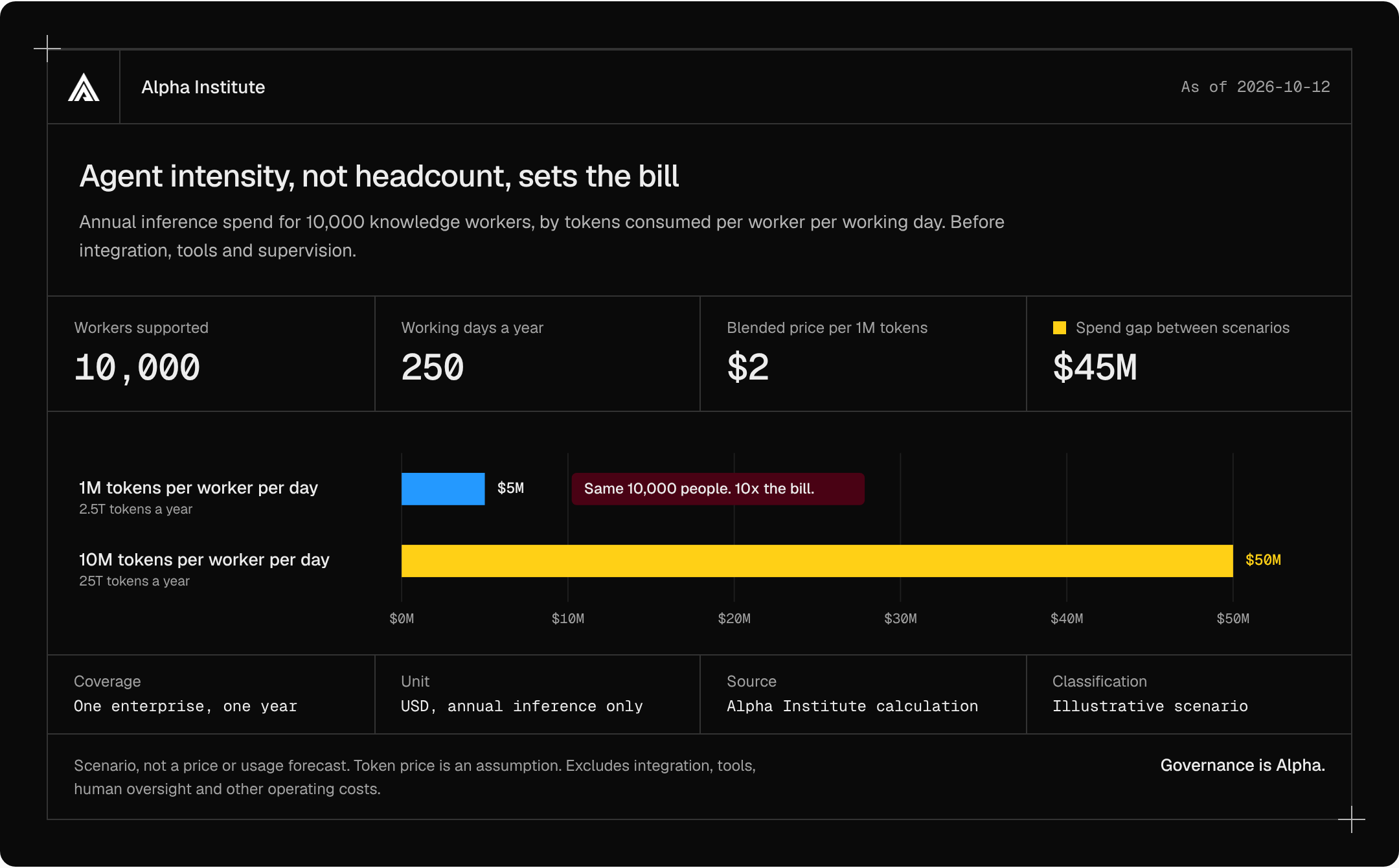
These are scenarios, not usage or price forecasts. They demonstrate why budgeting by employee count alone will become inadequate. Finance must understand how agents work: their activity, context requirements, reasoning depth, retries, and execution patterns.
Will tokens become the largest expense?
For some businesses, they could. Universal adoption of AI, however, would not establish that tokens must become every company’s largest expense.
Electricity became essential without becoming the largest cost in every industry. Manufacturers still purchase materials. Retailers still purchase inventory. Airlines still pay for aircraft and fuel.
The argument is more compelling in businesses where knowledge work constitutes most of production. As agents perform more of that work, expenditure may shift from labor, outsourcing, and conventional software toward inference and the systems supporting it. Whether inference becomes the largest expense depends on the extent of that shift, the amount of intelligence required, and its effective price.
Published income statements may also aggregate inference spending within cost of revenue or operating expenses. Internal management reporting can track it explicitly even when external statements do not display a “tokens” line.
Falling costs add another variable. Goldman reports inference-compute cost reductions of 60%-70% annually at the semiconductor level and argues that provider costs are falling faster than selling prices. Those are provider economics, rather than a promise that enterprise bills will fall at the same rate.
Total spending depends on activity, intelligence consumed per task, and effective price. Cheaper inference can reduce the cost of existing work while making additional applications economically attractive.
The defensible conclusion is consequential enough: inference is becoming a production input that deserves scrutiny comparable to labor, infrastructure, and other material operating costs. Leadership should plan for scenarios in which it becomes a dominant expense.
The right model is a financial decision
Return on inference requires an enterprise to allocate intelligence according to the economics of the task.
Extracting a purchase-order number may require a small model or conventional software. Interpreting conflicting contractual provisions may justify a stronger model, deeper reasoning, and expert review. Processing documents overnight creates different requirements from serving a customer through real-time voice.
Goldman’s analysis illustrates this variation. Its modeling found a real-time voice-agent case in which human labor was cheaper than the LLM-based alternative because of timing and latency requirements. Coding and text-based customer service had more favorable economics.
The cheapest model per token can therefore produce the most expensive completed outcome.
Consider a hypothetical workflow in which an economically consequential error that escapes existing checks creates an average loss of $200:
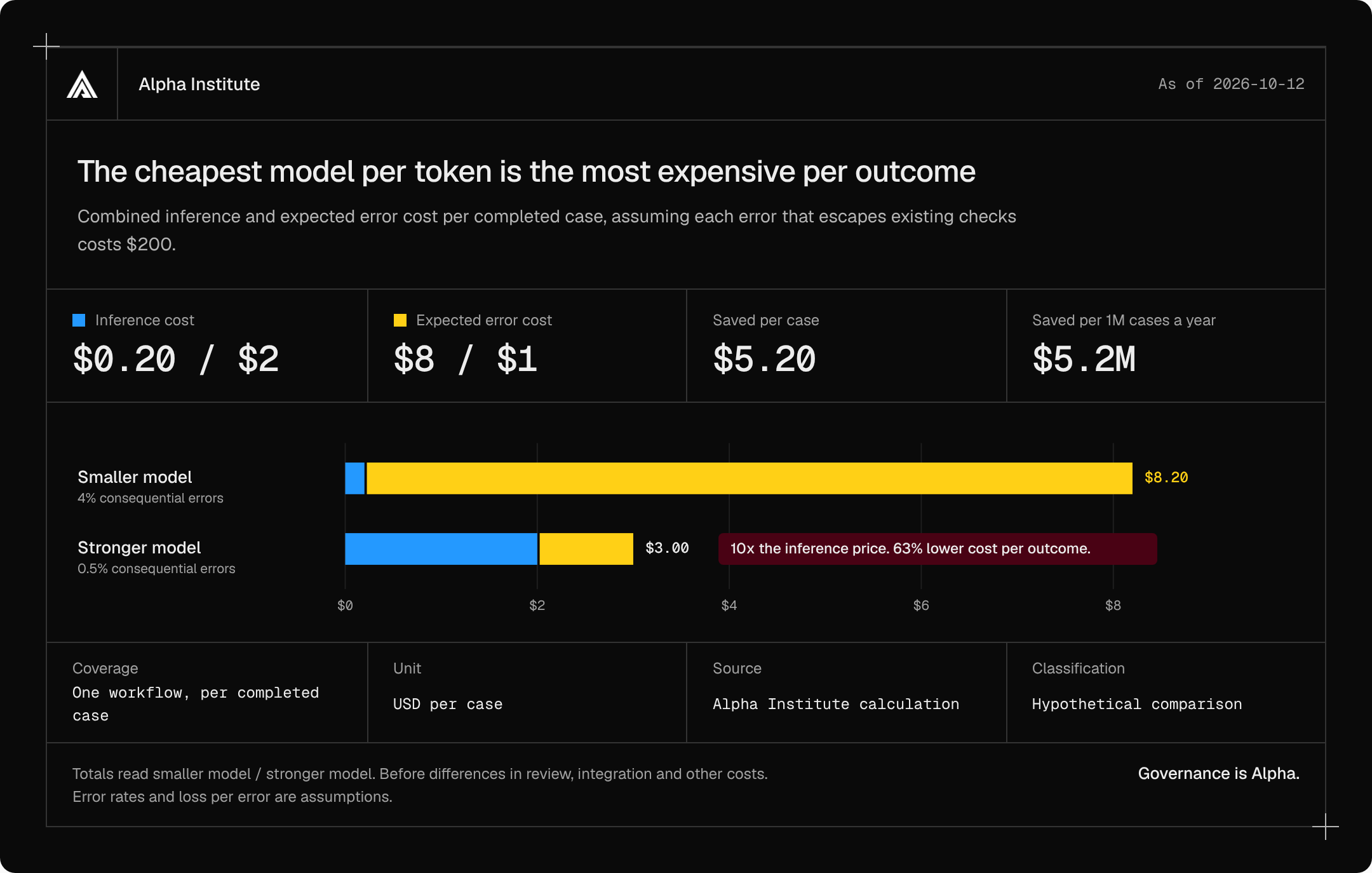
Under these assumptions, the stronger model costs ten times more for inference but improves the combined economics by $5.20 per case. Across one million cases, that represents $5.2 million in expected economic improvement, before other cost differences.
The calculation illustrates a principle. A favorable expected return still does not justify violating legal obligations or established risk limits.
Enterprises also need to allocate reasoning depth. Additional computation is warranted when its expected improvement in the outcome exceeds its additional cost, including delay. A complex decision may justify extensive analysis. A routine classification may require a brief response and a simple check.
The best configuration can change as models, prices, workloads, and business conditions change. Return on inference is consequently an operating discipline that continues throughout deployment.
What finance should measure
Three complementary measures make that discipline useful:
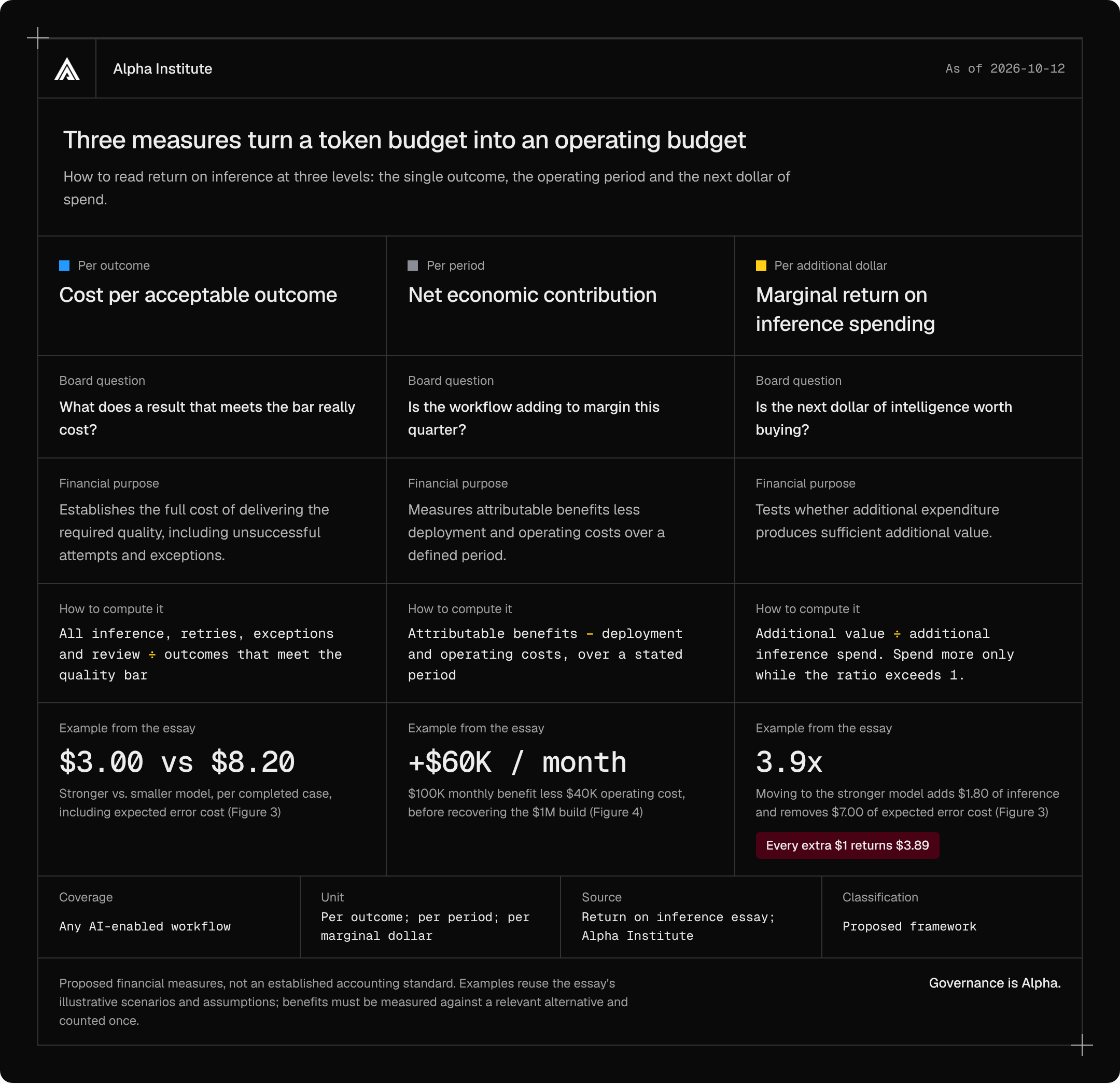
These measures complement traditional investment analysis. Payback and net present value evaluate the overall deployment. Return on inference helps management understand where value is earned or lost as the system operates.
Benefits should include attributable incremental contribution profit, realizable savings, and credible expected losses avoided. Costs should include inference, tools, infrastructure, implementation, maintenance, human review, and rework.
Measurement requires a relevant baseline and protection against double counting. Incremental revenue should be assessed through its contribution to profit. Freed employee time should be distinguished from cash savings.
Evidence supports the productivity opportunity. A 2025 study in the Quarterly Journal of Economics, examining 5,172 customer-support agents, found that AI assistance increased issues resolved per hour by approximately 15% on average, with larger benefits among less experienced workers.
Turning that improvement into financial value requires a mechanism: avoiding additional hiring as demand grows, reducing contractor expenditure, or supporting more customers with existing resources. Improved capacity has value, but management must explain how and when that value will be realized.
Average performance also deserves scrutiny. A profitable deployment can contain wasteful agents, excessive reasoning, and poorly performing workflows. The marginal question remains essential: what does the next dollar buy?
The time horizon changes the answer
Return on inference operates across three horizons.
At the transaction level, management evaluates whether another model call, verification step, or attempt is worth its cost.
At the operating level, it evaluates whether a month or quarter of agent activity improves contribution after recurring costs.
At the investment level, it evaluates whether future benefits justify implementation expenditure and can persist long enough to recover it.
Suppose a deployment requires $1 million upfront and subsequently generates $100,000 in monthly financial benefits against $40,000 in monthly operating costs. Its net benefit is $60,000 a month, producing a simple payback period of approximately 17 months.
Assuming three years of benefits, represented as annual net cash flows of $720,000 and discounted at 10%, the deployment’s net present value is approximately $790,000.
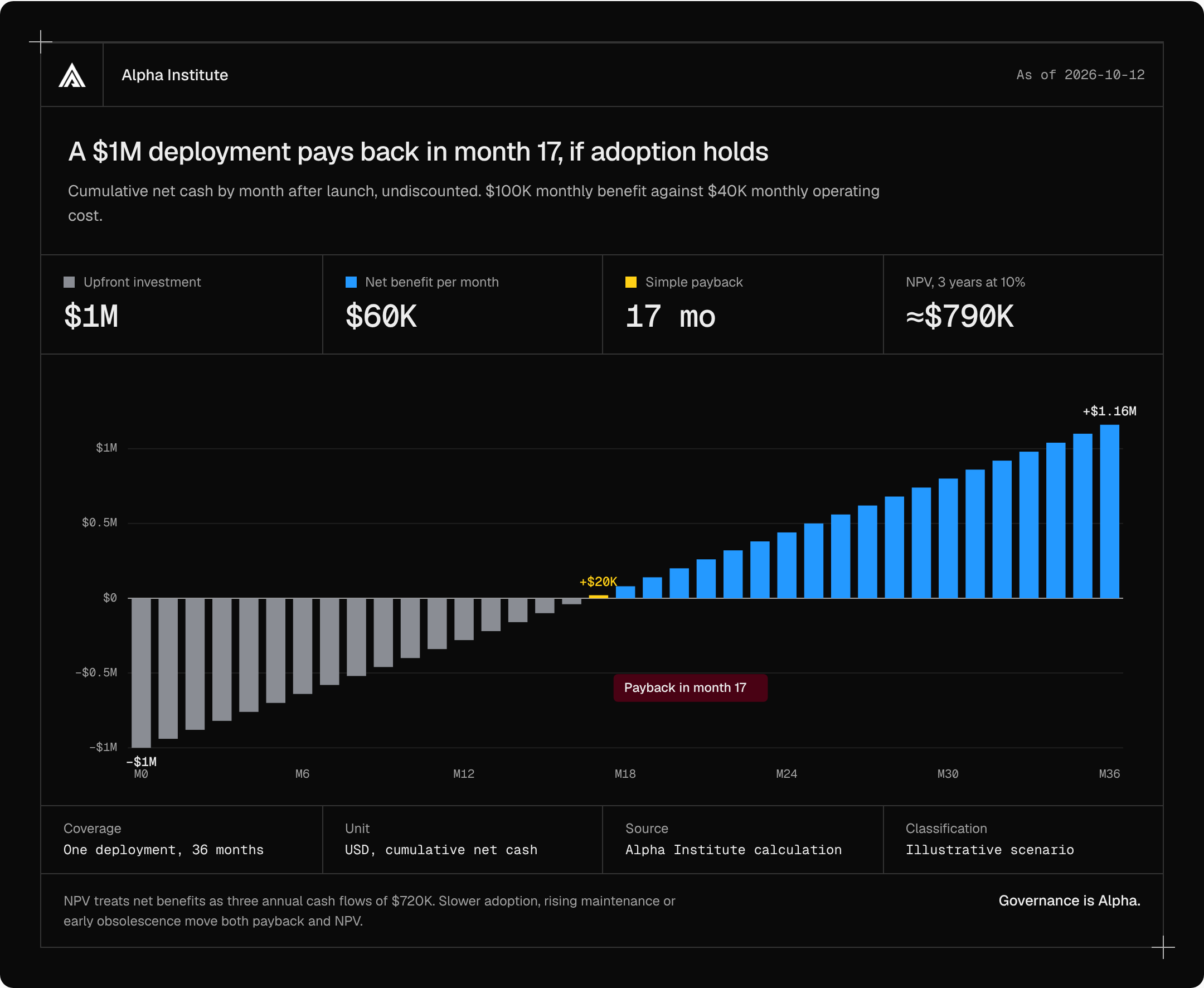
Slower adoption, rising maintenance costs, or a shorter useful life can materially change that result. Attractive transaction economics do not guarantee an attractive investment.
Management should separate benefits realized today from capacity created for future growth and strategic benefits that remain uncertain. All can inform the decision, but they require different evidence.
The competitive baseline also evolves. Preserving customers against faster, cheaper competitors can have economic value. That defensive value belongs in the analysis when its assumptions are explicit and testable.
Governance protects the return
Agents can create value continuously. They can also repeat mistakes continuously.
Financial performance therefore depends on permissions, verification, monitoring, escalation, and recovery. These controls determine how reliably the workflow produces acceptable outcomes and how quickly the organization detects a problem.
Finance should reconcile vendor expenditure with usage records. Business owners should establish whether claimed outcomes occurred. Material benefits should receive independent validation. Critical agents should have defined authority, identifiable owners, and an effective means of suspension.
Supplier dependence belongs in the assessment too. An attractive workflow may become fragile if it relies on one provider’s pricing, availability, or model behavior. Leadership needs to understand whether it can switch providers, preserve necessary records, and continue serving customers during disruption.
The board’s role is to establish expectations for strategy, risk appetite, evidence, and accountability. Management owns model selection and daily execution.
The boardroom agenda
The opening questions will become recurring boardroom questions: how much intelligence must the company purchase to compete, and what does that spending produce?
The answers will change as models improve, prices move, and agents assume more responsibility. Enterprises need a continuing discipline for allocating intelligence, evaluating outcomes, and correcting weak economics.
Whether tokens become the largest expense will vary by business. Leadership’s obligation is consistent: understand the work that expenditure finances and its contribution to competitive performance, financial results, and controlled execution.
The token budget buys the capacity to reason and act. Return on inference establishes whether that capacity is deployed productively—and where the next dollar should go.
Boardroom leaders can make that discipline concrete:
- Require baselines for material workflows. Establish cost, throughput, quality, customer outcomes, and failure rates before approving expansion.
- Assign accountable owners. Give each deployment a business executive, a finance partner, a financial hypothesis, and a method for validating benefits.
- Request a quarterly inference scorecard. Track fully loaded expenditure, cost per acceptable outcome, net contribution, exceptions, and marginal economics. Separate forecasts from realized results.
- Set boundaries before deployment. Specify permitted actions, human approval requirements, monitoring, escalation, and suspension authority.
- Define scale, redesign, and stop criteria. Expand when evidence supports the economics and controls; revise or retire deployments that fail those criteria.
- Review competitive and supplier exposure. Assess whether spending supports competitiveness and whether critical workflows can withstand outages, price increases, and model changes.


