

An AI agent could become your company’s largest sales channel, negotiate away your pricing power, and leave you with little access to the customer whose business you are fulfilling.
That possibility belongs on the board agenda.
Imagine a customer asking an assistant to book a family vacation within a $5,000 budget. The agent selects the flights, chooses the hotel, purchases the tickets and accepts the terms. The customer sees a completed itinerary. The suppliers see orders arriving through an intermediary that increasingly controls selection, comparison and checkout.
For the customer, the product is time saved. For the intermediary, the opportunity is influence over spending. For the suppliers, the strategic question is how much of the economics and customer relationship they will retain.
Consumer AI’s next phase could bring a new contest over the ownership of demand.
Olivia Moore’s seventh edition of a16z’s Top 100 Consumer AI Apps offers an early view of the economics.
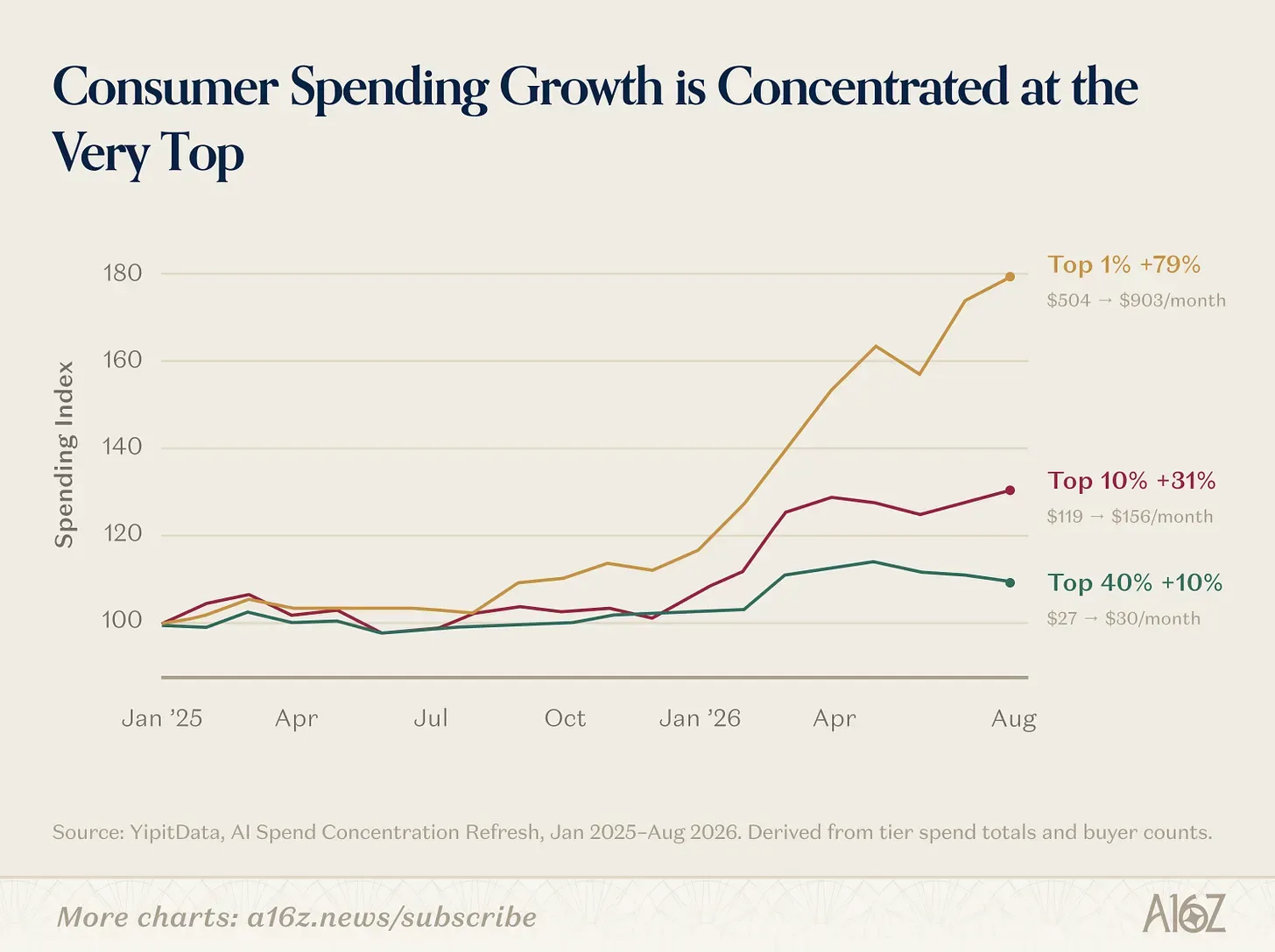
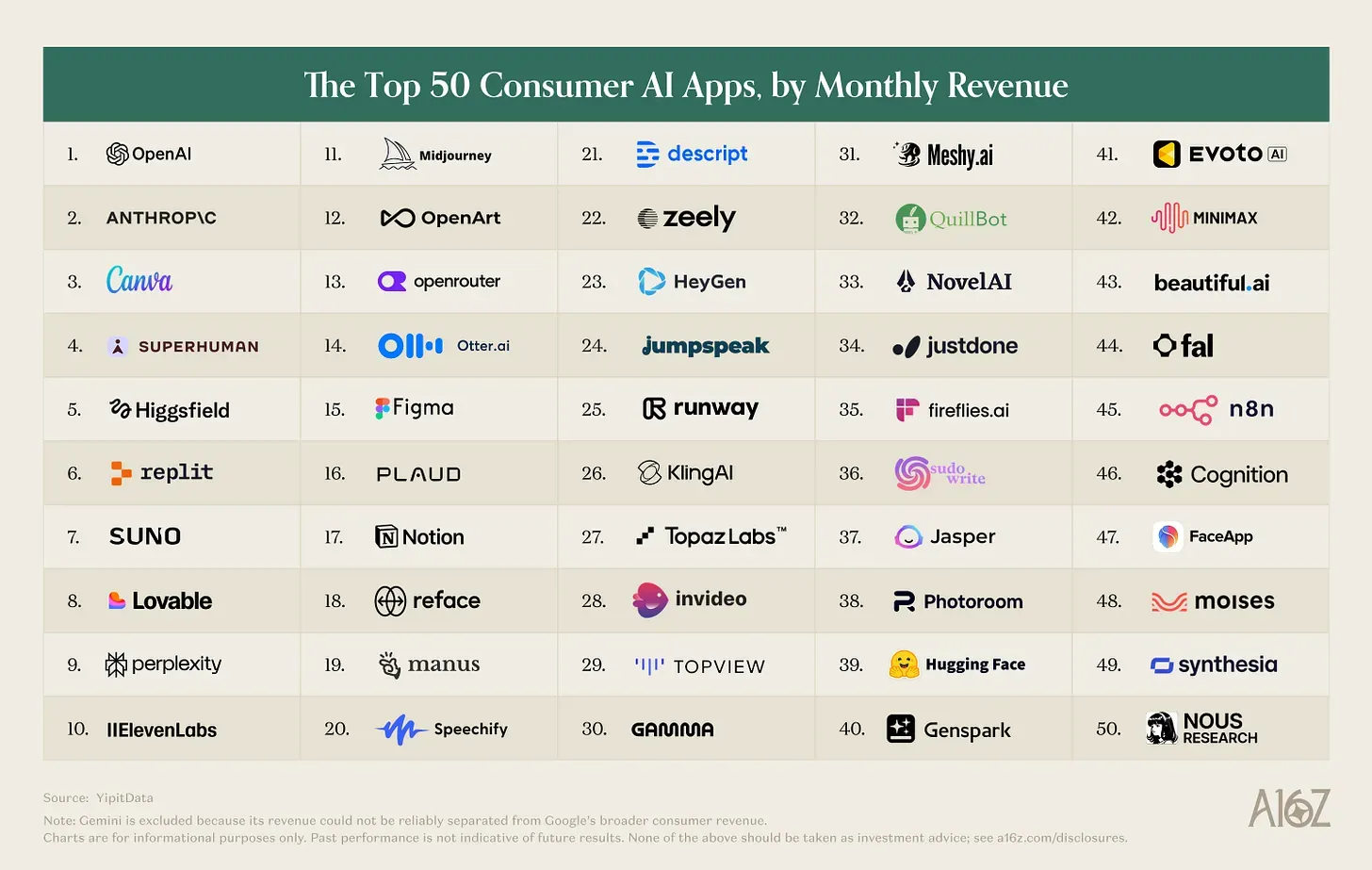
In YipitData’s U.S. e-receipt panel, 4.5% of eligible consumers held a personal subscription to ChatGPT, Gemini or Claude in August, up from 2.1% a year earlier. The top 1% of AI spenders generated 19.5% of observed spending and averaged $903 a month; the median payer spent $25. These figures describe panel observations, not total market revenue. Among 44 AI-native products in the report’s web rankings, 84% offered subscriptions and only 2% earned transaction or platform fees.
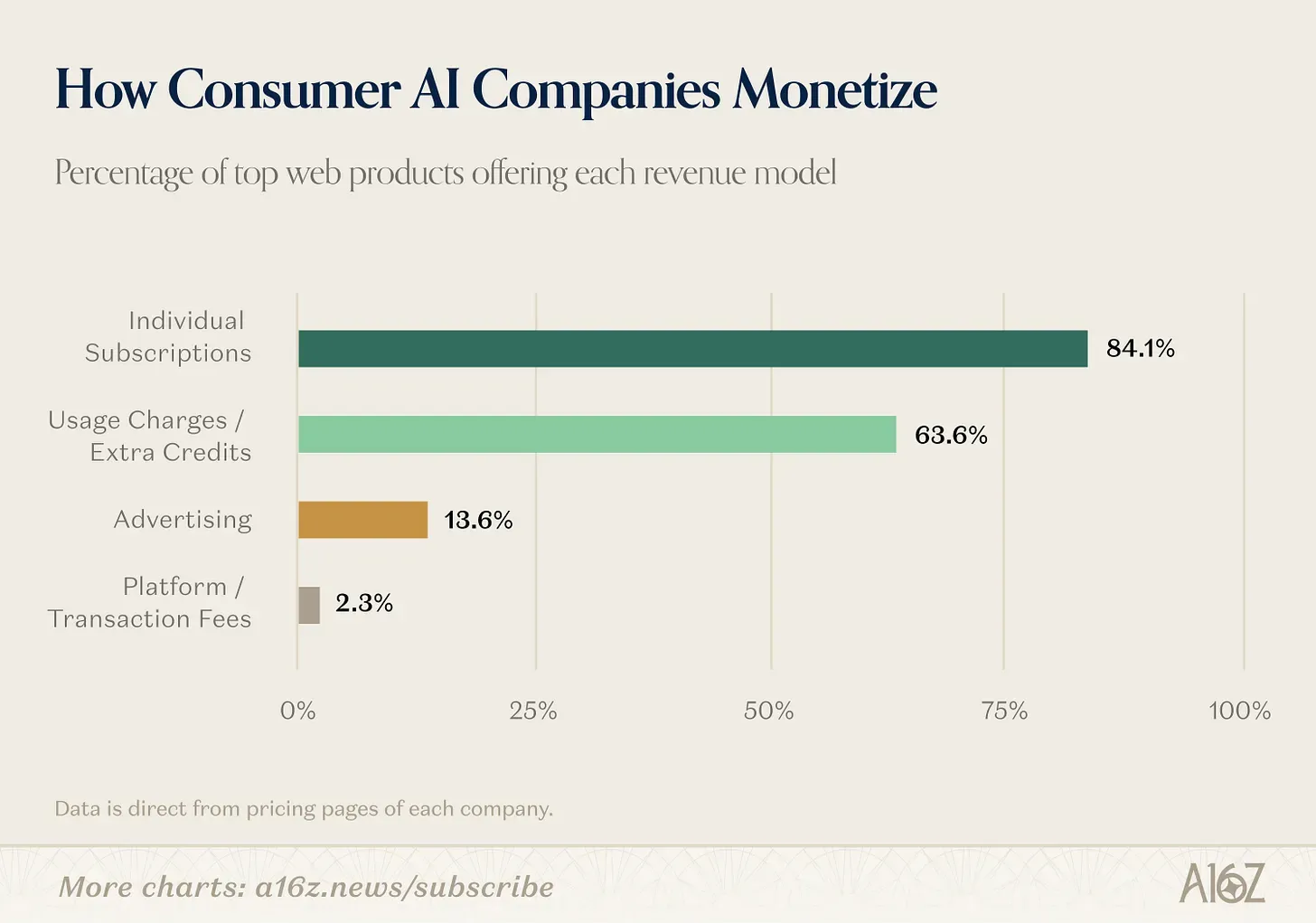
The report raises transaction-funded personal agents as a potential path to broader adoption. My investment thesis is that the consequential opportunity lies in earning repeat authority over a customer’s spending.
A subscription gives an assistant access to a software budget. Delegation can give it influence over travel, shopping, household services and other purchases. The opportunity expands when a customer trusts the assistant enough to return and let it act again.
But influence over spending is not the same as a profitable business. Investors should distinguish transaction volume, recognized revenue and contribution profit. An agent can facilitate substantial purchases while retaining a small commission, incurring expensive execution costs and absorbing costly mistakes.
Consider an illustrative $1,000 booking with a 3% commission. The agent’s operator earns $30 before paying for model inference, acquisition, support and any refunds or remediation it must fund. A single expensive exception can erase the contribution from several successful transactions. The investment case depends on those economics, repeated across retained customers.
This makes reliable execution central to value creation. An assistant that completes a task correctly, at a sustainable cost, has a different business from one that impresses in a demonstration and regularly needs a person to rescue the outcome.
Defensibility also requires scrutiny. Access to a powerful model can improve a product without protecting it from competitors using the same model. A more durable advantage could come from distinctive supply, distribution, accumulated customer preferences, trusted permissions or integrations that make execution measurably better.
Each needs evidence. Stored preferences are useful only if customers return. Integrations matter only if they improve outcomes or are difficult to replicate. Network effects require participants to make the service more valuable for one another. Calling a product a platform does not establish that relationship.
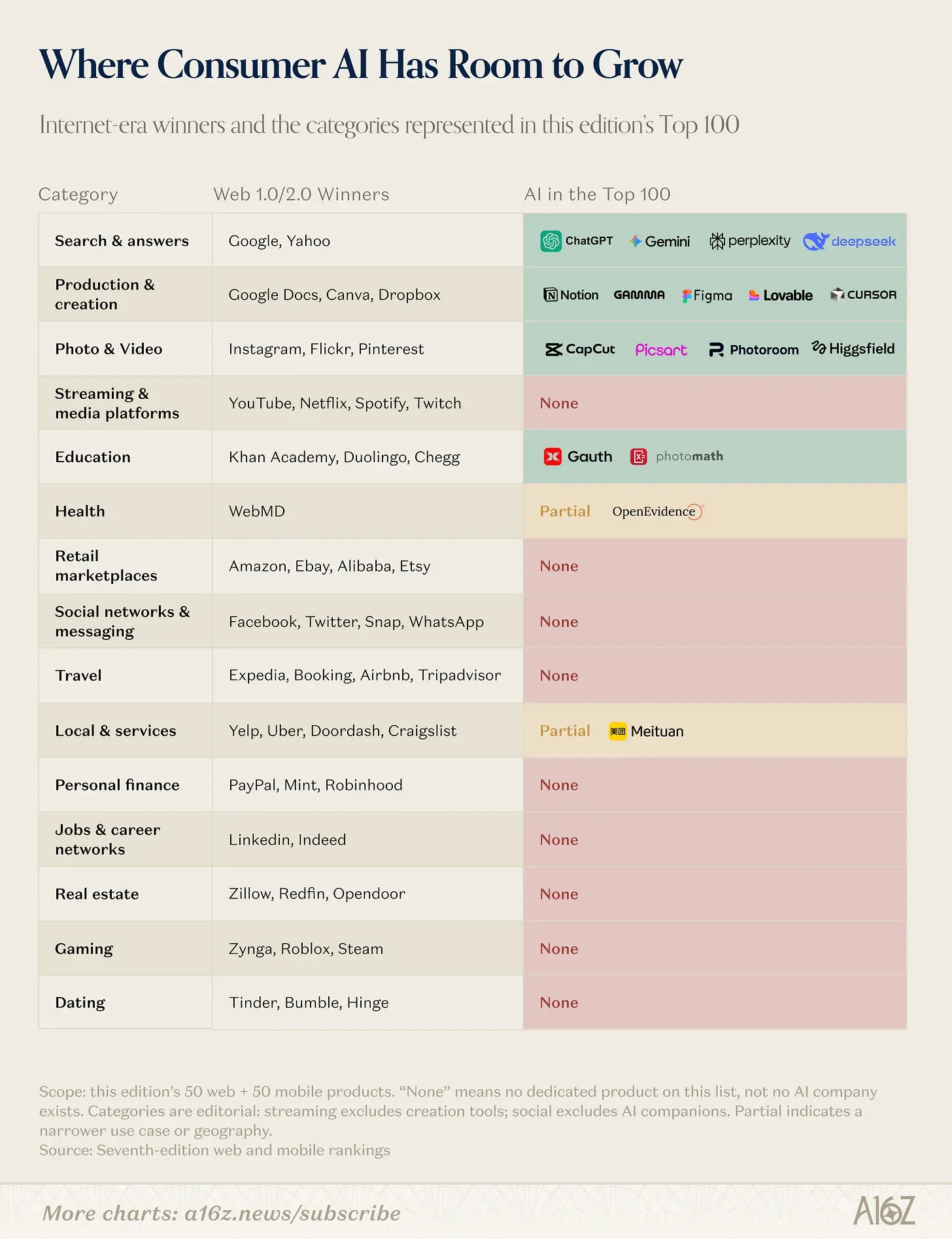
For incumbents, the corresponding risk is dependence on an intermediary that can redirect demand. If an agent makes suppliers easy to compare and switch, a business may face more competition at the moment of purchase. Strong brands, exclusive inventory, service quality and customer loyalty may still matter. Their value must survive an agent’s selection process.
This gives CEOs a practical strategic test: why would an assistant acting in the customer’s interest repeatedly choose our company?
The answer should reach beyond visibility. It might be superior availability, fewer service failures, distinctive products, clearer terms or better lifetime value for the buyer. Management must decide where to participate through agent platforms and where to invest in relationships it can sustain directly.
CFOs should examine the margin attached to that participation. Agent-mediated revenue can look attractive while introducing commissions, discounts, higher exception costs and channel concentration. Performance reporting should show contribution margin by channel, repeat purchasing, refunds and dependence on individual intermediaries.
Growth deserves closer examination when one platform controls the access, economics and rules behind it.
The same business model creates a governance challenge for the agent’s operator. If merchants fund the assistant through commissions, commercial incentives may influence which options it recommends. A customer delegating a purchase needs to understand whether the assistant is optimizing for the customer’s preferences, the operator’s revenue or an explicitly disclosed combination.
That conflict should be addressed in product design, compensation and oversight. A disclosure buried in terms does little to help a customer assess a particular recommendation.
Authority needs equally concrete boundaries. Permission to search for a hotel does not establish permission to accept a nonrefundable booking. A spending limit should remain enforceable throughout execution. Material changes should trigger approval. Access should be revocable, and failures should have an identifiable owner.
For directors, this connects strategy and control. Agent adoption can affect distribution, profitability, operational exposure and accountability at the same time. Oversight should therefore reach the business decisions through which agents gain authority: which workflows they enter, what they may commit, and how management knows they remain within their limits.
Boards should expect evidence of what agents are authorized to do, what they actually do, where people intervene and how exceptions are resolved. Reporting only how many agents were deployed says little about the quality of that delegation.
For Alpha, the opportunity is to make independent governance evidence useful across those relationships. A merchant, enterprise or other counterparty may need to verify an agent’s authority and the conditions attached to it. Alpha’s commercial test is whether its infrastructure makes those checks easier, reduces recurring verification work and produces evidence counterparties will accept. Independence must translate into a benefit customers can measure.
An assistant that saves a customer time can earn a subscription. An assistant trusted to spend can earn a place in the customer’s economic life. That position could be extraordinarily valuable, and competitors will fight to occupy it.
Every grant of authority should come with evidence that it deserves to continue. The companies that make delegation both useful and dependable will have the strongest claim on the next customer relationship.
What boardroom leaders should do in the next 90 days
- CEO and commercial leaders: map exposure to agent-mediated demand. Identify the customer journeys most likely to change, the intermediaries that could gain influence, and the reasons an agent would select your offering. Bring the board a channel strategy with explicit tradeoffs.
- CFO: establish the economics. Compare direct and agent-mediated transactions after commissions, discounts, execution costs and remediation. Stress-test profitability against higher platform fees and reduced customer access.
- Operating and technology leaders: run a bounded pilot. Choose one workflow, set spending and approval limits, name an accountable owner, and measure successful completion, human intervention and cost per completed task.
- Legal, risk and security leaders: make authority enforceable. Define permitted actions, data access, revocation, evidence retention and escalation. Test what happens when an agent exceeds its instructions or a counterparty disputes an action.
- Directors: require a quarterly assessment of value and control. Review economic benefits alongside failures, unresolved exceptions and channel concentration. Expansion should depend on demonstrated performance within agreed limits.
The board’s closing question should be precise: when an agent acts, can management show whose interests it served, what authority it held, what value it created and who can put things right?


