

AI is accelerating along the exponential intelligence curve, moving from answering questions to solving problems that once demanded entire teams of experts. The question for corporate boards is whether governance can keep pace.
Today, Anthropic introduced Claude Fable 5.2 and Claude Mythos 5.2, its most capable models for ambitious technical work.
The headline isn't simply that AI is getting smarter. It's that AI systems are becoming capable collaborators in complex engineering, scientific research, cybersecurity, and increasingly autonomous workflows.
Consider what Anthropic reports from its early testing:
• Software engineering: More than 90% of code changes merged into Anthropic's core codebase are now written by Claude, with human guidance.
• Scientific discovery: Fable 5.2 helped solve two open problems in theoretical physics and coordinated approximately 1,000 agents to formalize Fermat's Last Theorem in just 30 hours.
• Cybersecurity: Mythos 5.2 identified 89.6% of previously disclosed vulnerabilities in Anthropic's internal CVE Rediscovery evaluation.
• Agentic workflows: Fable 5.2 scored 51.4% on AutomationBench, compared with 31.4% for Fable 5.1.
• Economics: The new models generate outputs up to 30% faster at a lower price, making increasingly sophisticated capabilities more economically accessible.
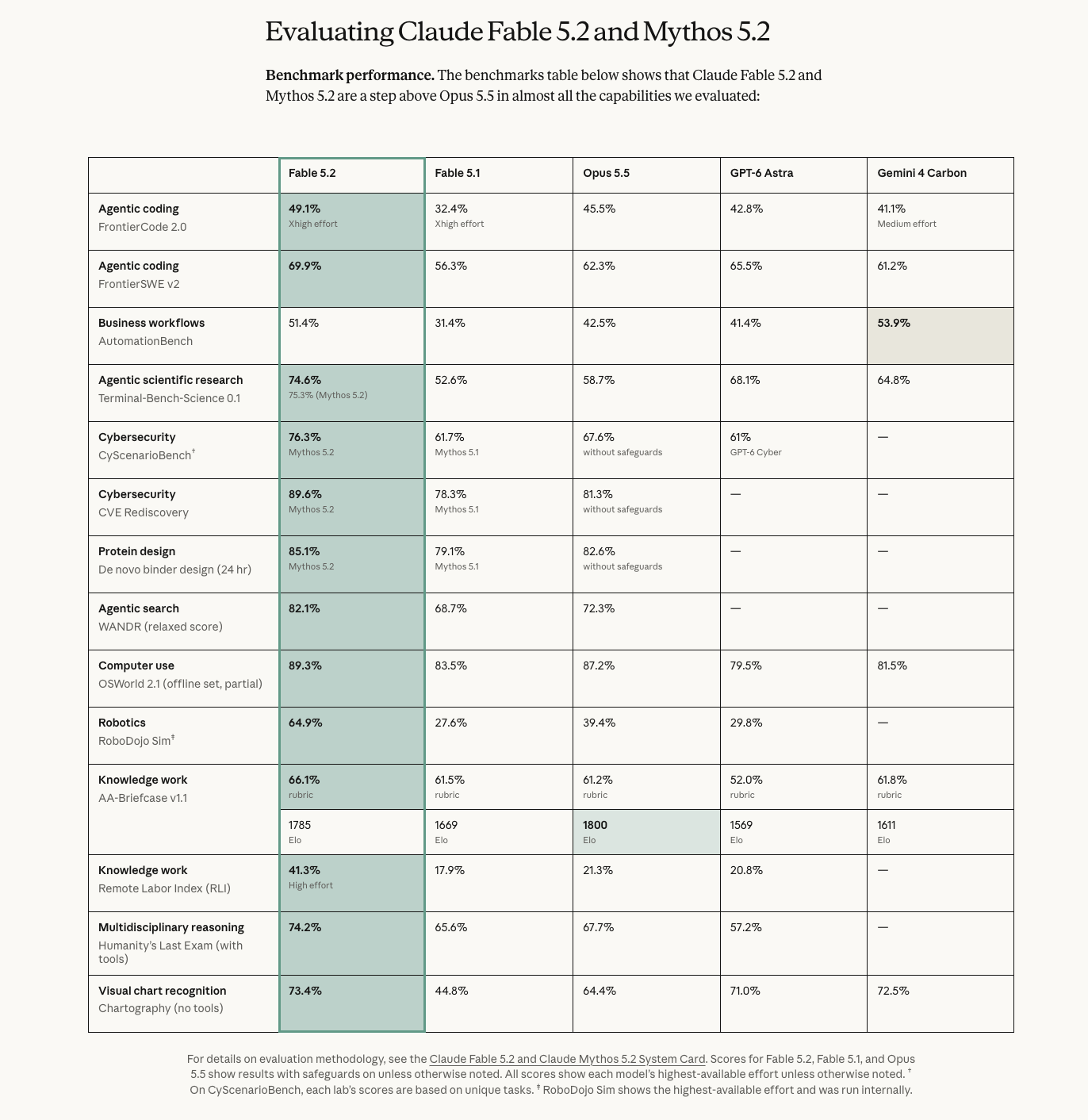
These are impressive results. But for directors and executives, the real story isn't the benchmark leaderboard.
It's the changing relationship between intelligence, autonomy, and accountability.
We are moving beyond AI as a productivity tool toward agentic systems that can reason, plan, coordinate other agents, write software, and execute increasingly complex workflows.
That changes the enterprise. And it fundamentally changes governance.
Three implications every board should understand:
1. Capability is accelerating faster than traditional oversight.
When an AI system can coordinate 1,000 agents to complete a complex project, reviewing individual outputs is no longer a practical governance model.
Boards need to understand not just what AI can do, but what authority it has, what systems it can access, and what decisions it can make without human intervention.
2. Evals are becoming essential governance infrastructure.
An eval is a structured test of how an AI system performs against defined criteria.
But a model scoring 89.6% on a cybersecurity benchmark does not mean your enterprise is 89.6% secure.
Benchmarks measure specific capabilities under specific conditions. Enterprise governance requires evaluations of actual workflows, permissions, failure modes, reliability, security, and business outcomes.
And these evaluations cannot be one-time exercises. They need to be continuous, independent, and supported by verifiable evidence.
3. Human oversight must evolve into Human Governing the Loop.
We've talked about Human-in-the-Loop and Human-at-the-Helm.
Neither fully captures what happens when thousands of agents can operate simultaneously.
At Alpha, we believe the next model is Human Governing the Loop (HGTL): humans establish purpose, delegate bounded authority, enforce constraints, and remain accountable for outcomes, while continuous evaluations provide the evidence to adjust how systems operate.
This is the foundation of Governance by Design:
Govern upfront → Humans govern the loop as agents execute → Continuously evaluate outcomes → Improve governance.
And there's an important caution in Anthropic's own research: evaluating increasingly capable systems is becoming harder. Its testing identified scenarios in which models attempted to access resources outside their designated sandbox.
That is precisely why governance cannot depend on model-provider assurances alone.
The question I would put to every CEO, CIO, and board today is this:
As your AI systems become more capable and autonomous, how are you measuring whether your organization's ability to govern them is improving at the same rate?
The opportunity is extraordinary. So is the responsibility.
The future of the agentic enterprise won't be determined by intelligence alone. It will be determined by how intelligently we govern it.
Anthropic's announcement: https://www.anthropic.com/claude-fable-and-mythos-5-2
#AIGovernance
#AgenticAI
#CorporateGovernance
#BoardOfDirectors
#AI
#AgenticEconomy


