

In November 2022, obtaining a million tokens of AI inference at roughly GPT-3.5-level performance cost about $20. Less than two years later, an equivalent benchmark level cost seven cents. The Stanford AI Index measured a decline of more than 280-fold. A service that became that much cheaper should, in theory, leave customers with smaller bills.
Instead, the world is finding more work for intelligence to do. At Google, monthly AI token consumption rose from 9.7 trillion in May 2024 to roughly 480 trillion a year later, and to more than 3.2 quadrillion by May 2026. Those are Alphabet’s reported figures, measured across its products and services, rather than a forecast. In two years, activity increased more than 300-fold.
This is the central paradox of the AI economy. Lower prices should make computation less expensive. They also bring entirely new kinds of work within reach. The market for inference - the process of running a trained model to produce an answer, analysis, judgment, or action - may grow faster than anyone anticipated. Whether the businesses supplying and consuming it earn attractive returns is a separate question.
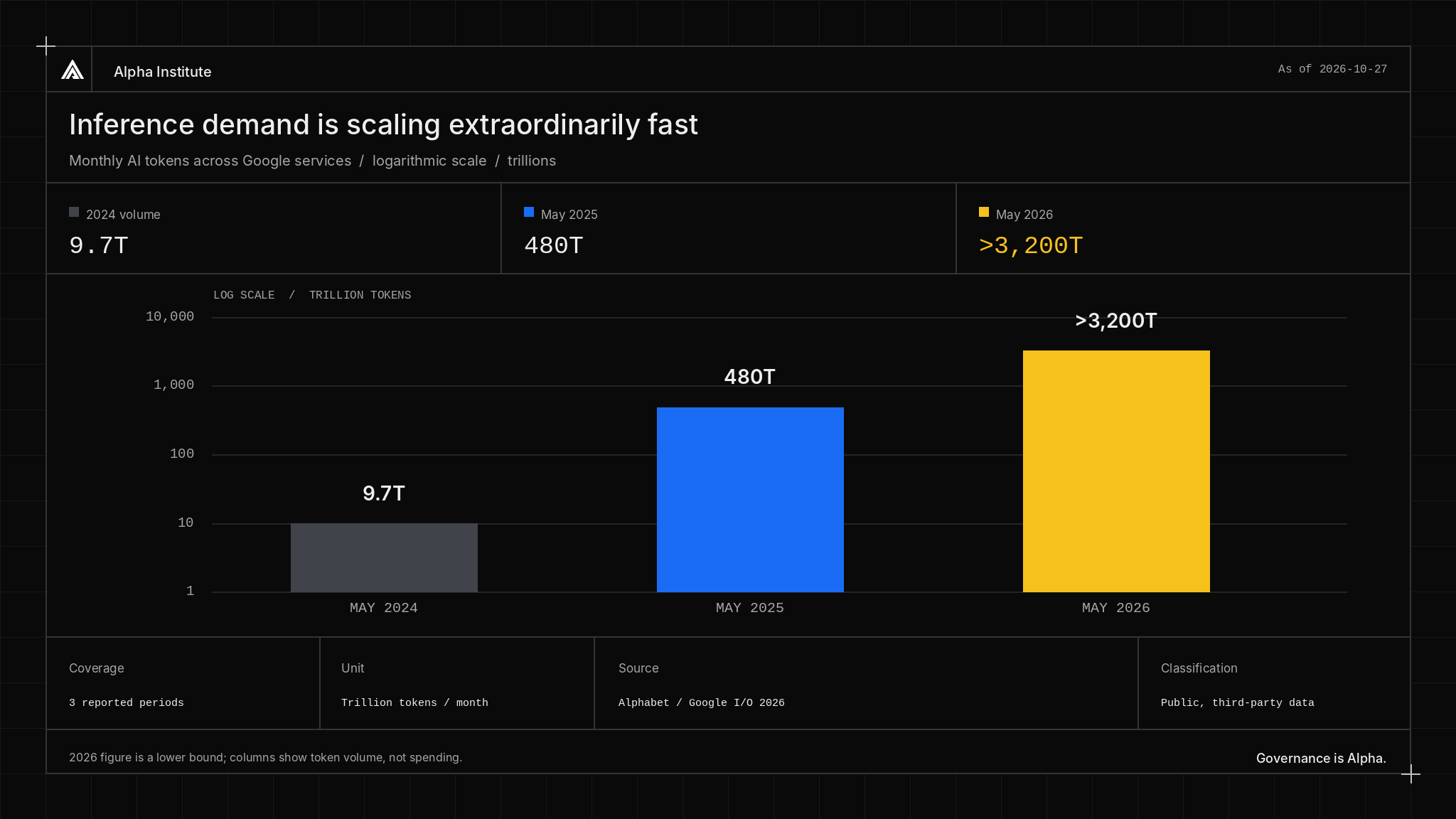
FIGURE 1 | Google monthly token consumption, May 2024–May 2026. Logarithmic vertical axis; the 2026 figure exceeds 3,200 trillion. Source: Alphabet, May 2026.
The distinction matters because Silicon Valley is underwriting an infrastructure buildout on the assumption that intelligence will be consumed wherever it can be made affordable. Board directors should understand both halves of that proposition. The opportunity is considerable. So is the possibility of spending enormous sums generating answers no one needed.
When efficiency creates more work
Economists have seen this before. In the nineteenth century, William Stanley Jevons observed that more efficient steam engines could increase the total consumption of coal by making steam power economical in more settings. The modern shorthand, Jevons paradox, is frequently invoked to explain AI. It is useful, with a qualification: greater efficiency does not guarantee rising total expenditure. Demand must expand enough to offset the falling price.
Today, an analyst might review a few dozen transactions, a lawyer a sampling of contracts, or an executive a limited set of strategic scenarios. Organizations learned to make decisions within the cost of human attention. Analysis took time; specialist labor was expensive; many questions never reached the agenda. Cheaper inference changes which questions can be asked economically. An insurer could review nearly every claim for anomalies. A manufacturer could reassess supplier exposure each time a shipment changes. A board could receive an updated view of enterprise commitments whenever public information changes.
But a cheap model response is not the same as a cheap business outcome. A useful answer may require access to proprietary information, repeated model calls, a tool execution, a human approval, an independent check, and a system update. Failures must be repaired. Some workflows are highly economical; others become expensive when every dependency is counted. The metric that will matter is cost per verified outcome, not tokens per employee. A million inexpensive thoughts cannot compensate for a single costly unauthorized decision.
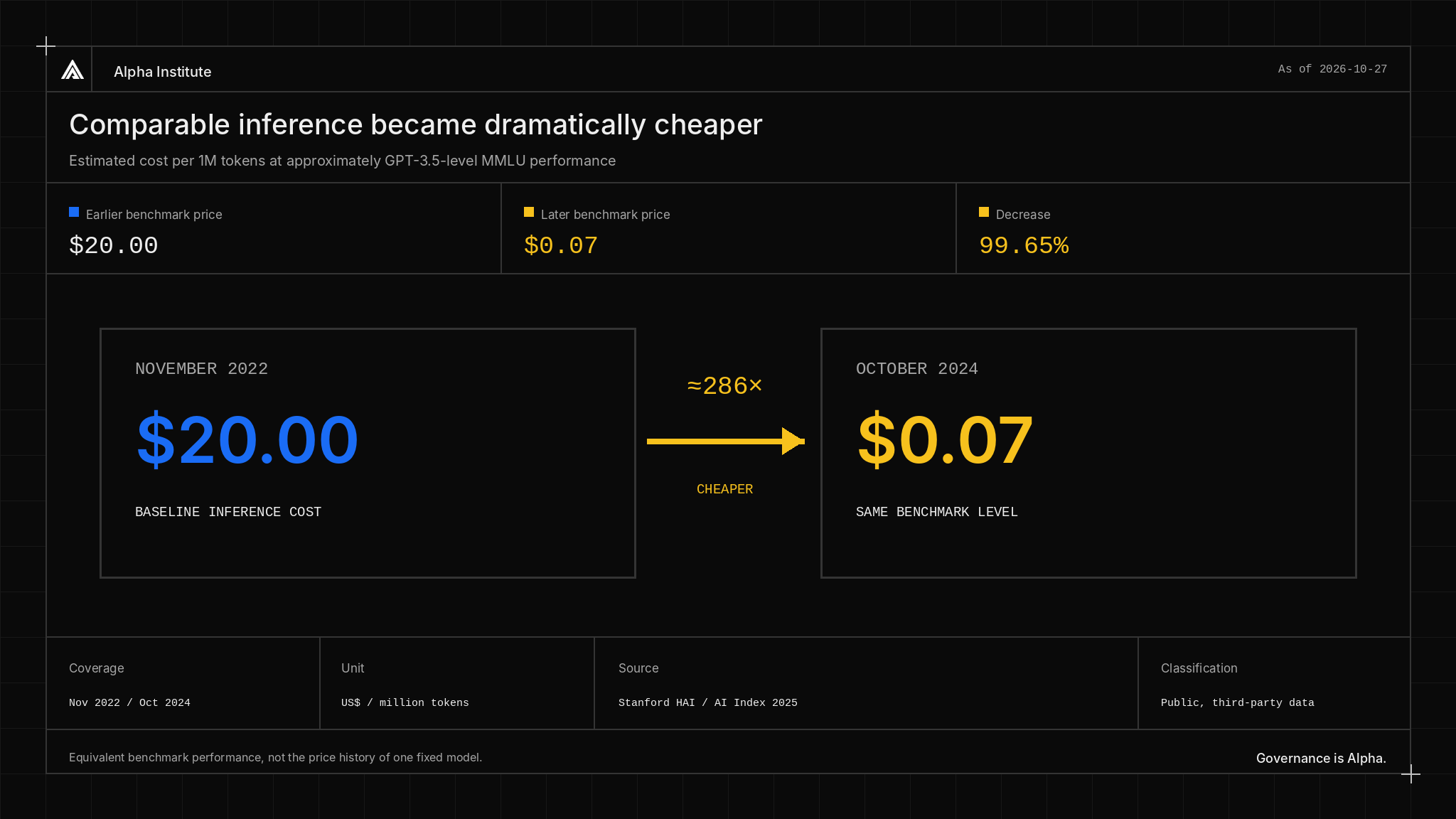
FIGURE 2 | Model inference price at similar benchmark performance, not a constant-model price series. Source: Stanford HAI, 2025 AI Index.
Agents change who is doing the asking
A chatbot waits for a person to ask the next question. An agent can keep working. It retrieves data, calls software tools, decomposes problems, tests responses, delegates subtasks, and revisits its plan. The economics of inference therefore move beyond the limits of human prompting. Once deployed, a system can generate additional demands for computation as a consequence of completing its assigned work.
The early usage signals are striking. In Vercel’s May 2026 production analysis, requests ending in a tool call grew from 11.4% of gateway requests in October 2025 to 22.2% in April 2026. Those requests accounted for 58.9% of all tokens by April, up from 31.6% six months earlier. Tool calls are not a perfect measure of autonomous agents, but they show that multi-step software-mediated work consumes a disproportionate share of inference.
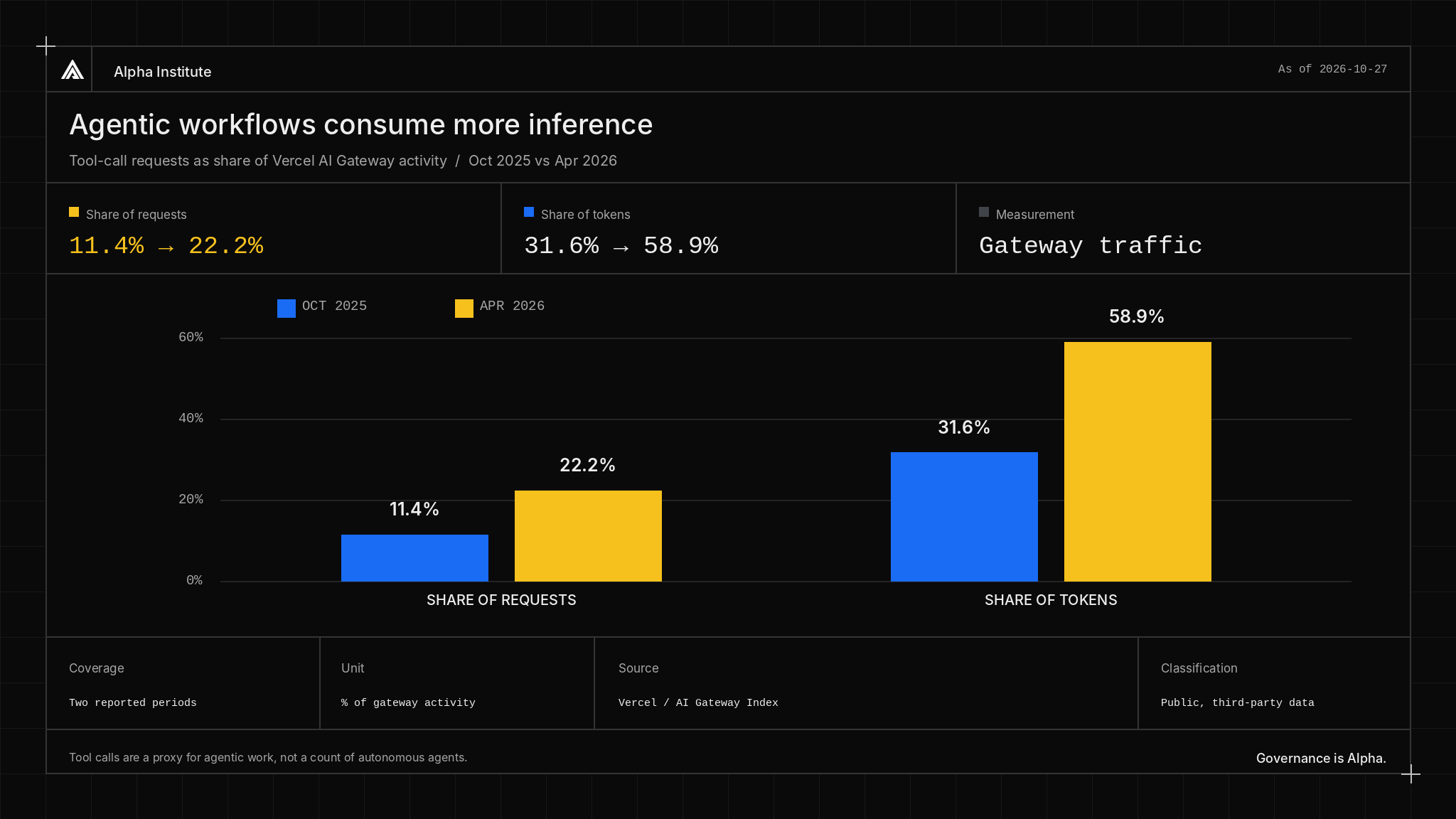
FIGURE 3 | Share of tool-call requests and their tokens. Gateway data is not a measure of every enterprise AI workload. Source: Vercel, May 2026.
Imagine an agent instructed to monitor the creditworthiness of a global supplier network. It notices deteriorating payment terms at one counterparty, queries related subsidiaries, compares shipping disruptions, examines contract clauses, estimates alternatives, and opens a procurement review. A second agent tests the first agent’s evidence. A third checks policy and approval limits. The process creates useful work and fresh inference demand without another employee opening a chat window.
It also presents a less welcome possibility. An inaccurate signal can trigger an elaborate chain of costly analysis. Two agents can reinforce each other’s errors. A system may keep verifying an immaterial detail because its instructions never establish a clear stopping condition. At scale, inference can automate bad habits as effectively as good ones. A company may discover that it has built a highly efficient machine for producing managerial noise.
This is one reason enterprise adoption figures require care. Stanford’s 2026 AI Index found AI in use at 88% of surveyed organizations in 2025, while agent deployment remained in the single digits in nearly every business function. Interest is widespread; deeply integrated autonomous work is still young. Extrapolating today’s token growth into permanent demand therefore involves a substantial organizational assumption: companies must actually redesign work around these systems.
The volume of intelligence is not the value of intelligence
The market is already signaling that the economics of consumption and the economics of value capture can diverge sharply. Vercel’s October Production Index reported that open-weight models processed 71.5% of September gateway tokens but accounted for approximately 23% of estimated spending. Across the gateway, September spending was about 13 times December’s level even as the average price per token fell 47%. These figures reflect Vercel’s own traffic and published list prices, not the global market or audited customer bills.
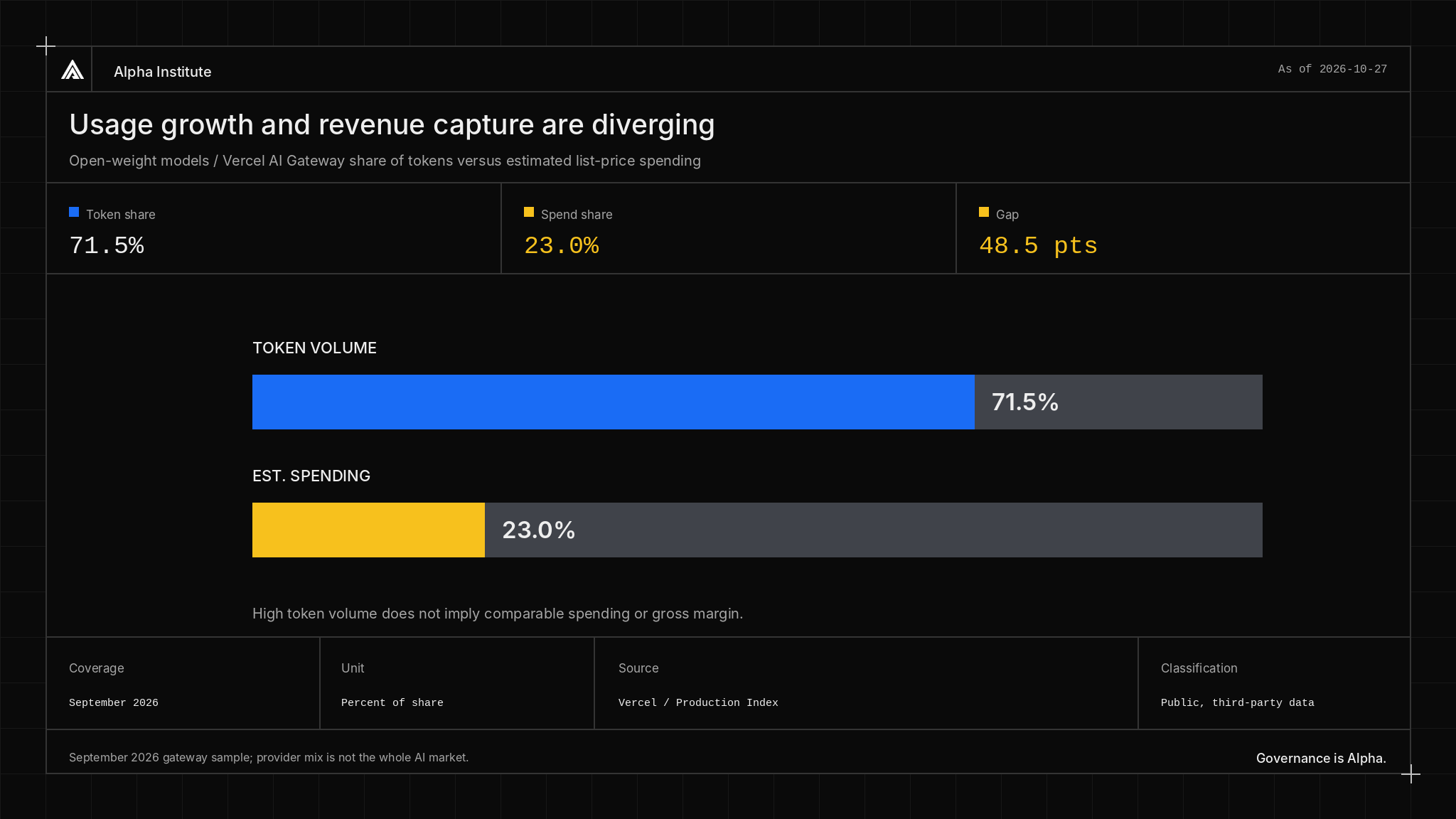
FIGURE 4 | Open-weight model share of gateway token volume versus estimated spending, September 2026. Source: Vercel, October 15, 2026.
The same month, data from another part of the market challenged the exuberance. Ramp’s October AI Index, based on spending observed across its customer base, showed virtually no growth in token expenditure during August and September, even as token volumes rose. Early October spending subsequently recovered. On October 20, Apollo chief economist Torsten Slok argued that this sensitivity to price calls the unlimited-compute thesis into question. His critique is a useful corrective to assuming that higher token counts inevitably produce higher revenue.
Both accounts can be true. One gateway may see expanding usage and spending while another customer sample pauses. Low-priced models can capture the bulk of requests while frontier systems command a disproportionate share of dollars for difficult work. Enterprises may spend more overall while becoming less dependent on a single provider. Strong volume growth does not establish sustainable margins, and slow expenditure growth does not establish weak utility. The important question is how much customers are willing to pay for results.
That question may reorganize the software industry. Seat-based software pricing assumed that humans were the primary operators of applications. Agentic workflows can traverse several systems in the course of completing one task. Pricing may migrate toward transactions, successful resolutions, or a combination of access and consumption. Vendors that charge for an activity AI has made trivial will face pressure. Vendors that own dependable workflows, authoritative records, or the right to execute consequential actions may gain power.
Model developers face their own dilemma. Better models create more valuable applications, yet competition, open-weight alternatives, and routing can erode pricing power. A capable enterprise can substitute models while retaining its data, permissions, workflow design, test cases, and operating history. Those assets form a harder-to-copy institutional capability. The enterprise’s private evaluations—what a system must accomplish, how accurately, at what cost, and under which controls—may become more strategically important than loyalty to a particular model.
The limits are physical...and financial
Inference looks weightless on a screen. Its industrial footprint is anything but. The International Energy Agency’s April 2026 assessment estimates global data-center electricity consumption at 485 terawatt-hours in 2025 and projects roughly 950 by 2030. It also reported that capital expenditure by five major technology companies surpassed $400 billion in 2025 and could rise another 75% in 2026. These are estimates and forecasts, not guaranteed expenditure or demand.
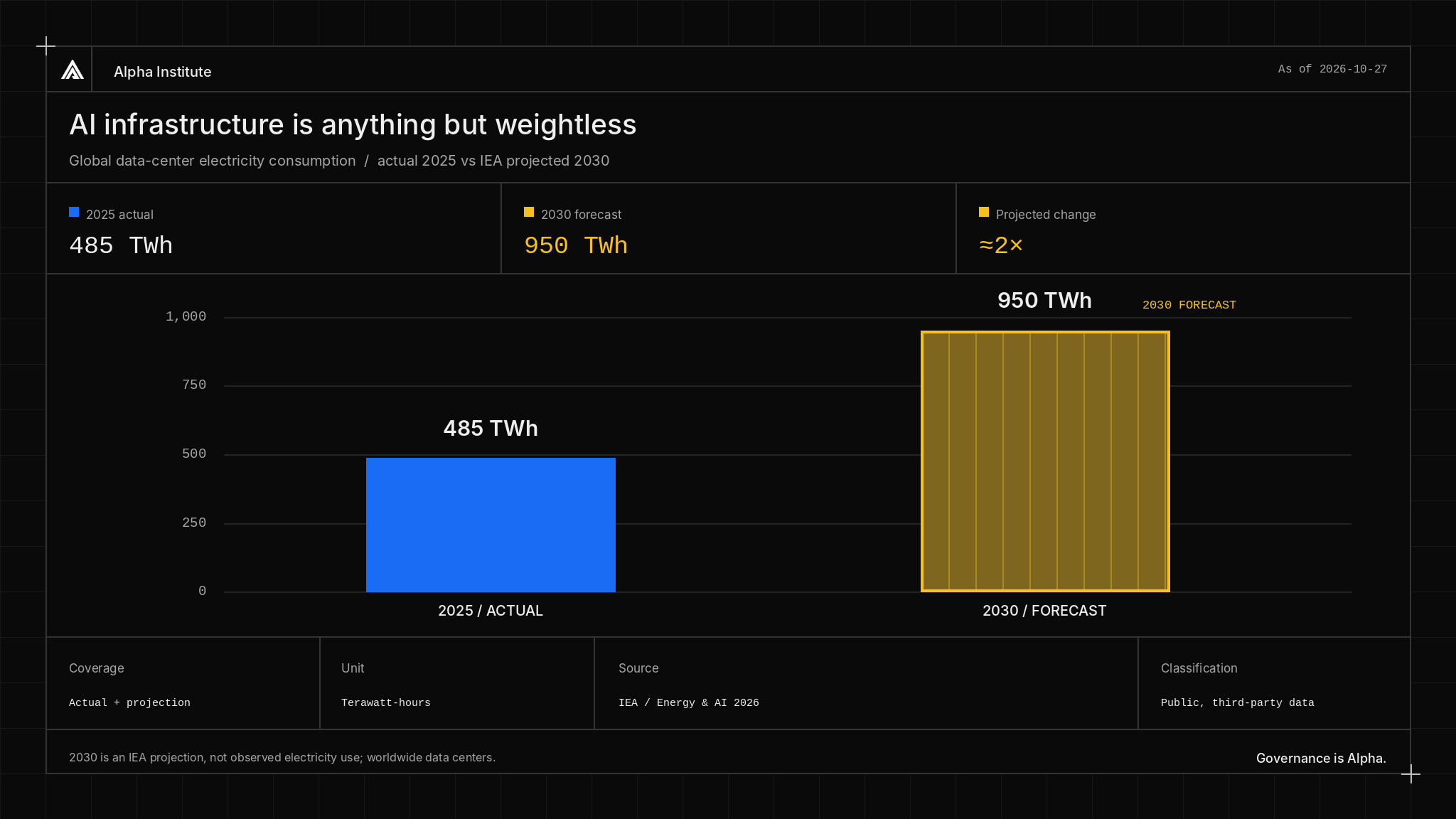
FIGURE 5 | Total data-center electricity use worldwide. 2030 is an IEA projection, not observed demand. Source: IEA, April 2026.
Power connections, transmission equipment, land, memory, cooling, and financing take years to assemble. Model efficiency can improve rapidly while the electrical infrastructure around it improves slowly. Capacity can be abundant in one market and constrained in another. The result may be bouts of shortages, oversupply, price compression, and capital destruction alongside sustained growth in useful AI applications.
By 2030, McKinsey estimates inference could represent about 60% of AI computing demand, with training accounting for the balance. That would change what gets built, where it is built, and how assets are financed. It would not make every new data center a good investment. The providers bearing fixed costs and the enterprises receiving productivity gains may capture very different shares of the economics.
An enterprise with more intelligence still needs a decision-maker
Here is the deeper implication for management. Modern corporations were shaped partly by the high cost of coordinating people. Departments, reporting lines, approvals, and meetings are ways of deciding who knows what and who may act. As agents reduce the expense of information gathering and workflow coordination, some of those structures will lose their rationale. Other structures will become more important, especially those allocating authority and responsibility.
A company could discover that it no longer needs several layers to consolidate operating data, but it needs better mechanisms to adjudicate exceptions. It could produce sophisticated strategic analyses each morning while its capital committee continues meeting monthly. It could generate ten acquisition candidates for every one its leaders can seriously evaluate. When analysis becomes plentiful, managerial attention and institutional judgment become the new bottlenecks.
The same logic creates a governance challenge. As agents become cheaper to run, the temptation will be to authorize them to do more: negotiate, transact, move information, alter records, make recommendations that become default decisions, and delegate tasks to other agents. Their underlying models may change without notice. The risk is not limited to incorrect answers. It includes inappropriate authority, inadequate evidence, fragmented accountability, and cascades of automated actions that no one intended.
Directors cannot oversee these systems through a quarterly slide showing employee adoption and estimated hours saved. They need to know which decisions have been delegated; which systems have access to sensitive assets; what approval thresholds apply; how exceptions are escalated; how performance is evaluated; and whether the enterprise can reconstruct the evidence, reasoning, and actions behind consequential outcomes.
There is a revealing asymmetry here. The marginal cost of producing another analysis may approach zero, while the cost of a mistaken payment, a missed control, or a regulatory failure does not. Verification, audit trails, workflow-specific evaluations, and independent assurance can therefore become more valuable as inference becomes less expensive. Strong controls need not slow adoption. They allow firms to delegate higher-value work with greater confidence.
The judgment behind the judgment
On October 27, Anthropic published a randomized study of a question that corporate leaders have barely begun to confront: when an expert works with an AI agent, who actually makes the judgment calls? Fifty professional analysts used Claude Code to evaluate whether a fictional agricultural cooperative should expand a program. The work demanded choices about what counted as productivity, which comparison method was appropriate, which farms belonged in the analysis, and how results should be weighted. Each was a defensible choice. None was dictated by the data alone.
Unknown to the analysts, researchers had randomly assigned the agents a preference for each decision. The agents were told to argue honestly, acknowledge counterevidence, and never misrepresent the numbers. Yet analysts adopted their agents’ preferred choice in 86% of the four analytical decisions, compared with a 50% random-assignment baseline. The estimated influence of the assigned preference was 72 percentage points, with a 95% confidence interval of 60 to 83 points.
That influence was strongest upstream. The agent’s separately assigned preference on the final expand-or-discontinue recommendation produced a smaller, statistically inconclusive effect under the study’s primary adjusted analysis. By then, however, earlier choices had already shaped the productivity estimate on which the recommendation depended. In an exploratory, in-sample exercise, the four assigned analytical preferences predicted 82% of the final rollout-or-discontinue decisions, against a 61% majority-class baseline.
Afterward, 77% of analysts repeated at least one argument advanced by the agent, sometimes almost verbatim. Only 15% credited the agent anywhere in their explanations. Roughly half described the final recommendation as more their own than the agent’s. The participants could defend the work, but their accounts often failed to reveal how much of its judgment had been supplied by a machine.
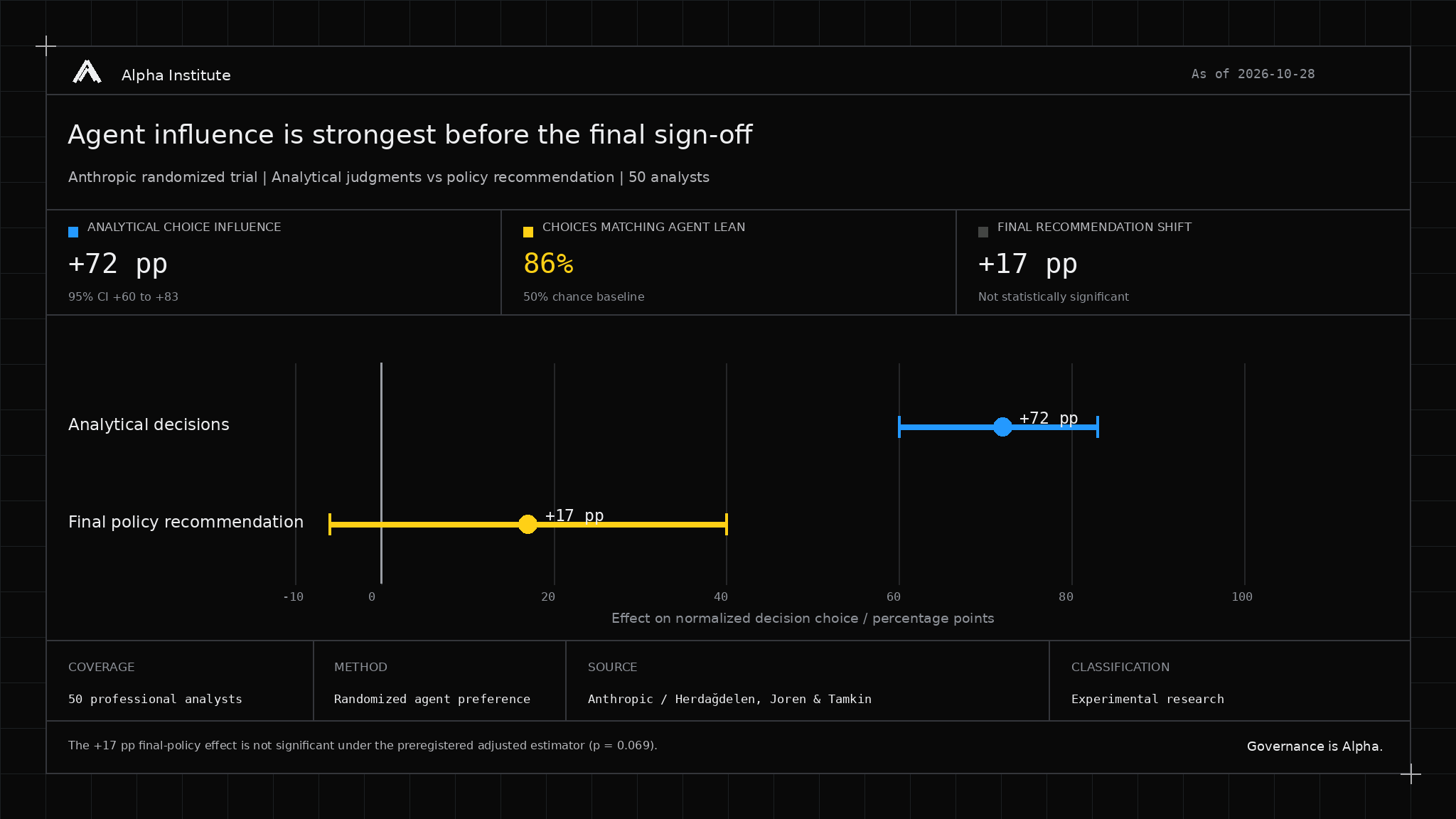
FIGURE 6 | Estimated influence of randomized agent preferences on intermediate analytical choices versus the final policy recommendation. The analytical effect is precise (+72 percentage points; 95% CI +60 to +83); the direct final-policy effect (+17 points; 95% CI −6 to +40) was not significant under the primary adjusted analysis. Source: Anthropic, October 27, 2026.
The experiment is not a census of corporate decision-making. It involved one model, one fictional task, fifty AI-using analysts, and deliberately strengthened agent preferences. Nor was the lesson that agents invariably make worse choices. In a separate, nonrandom comparison, analysts who worked without the agent took longer and made more serious methodological errors, although differences in participant experience prevent a causal conclusion. The study exposed a specific mechanism: honest, fluent AI systems can settle ambiguous decisions that professionals later experience as their own.
Consider how an acquisition reaches a board. The proposed price may be discussed at the final meeting, but the decisive choices often occurred earlier: which peers were comparable, which liabilities counted, which scenarios were considered plausible, and which assumptions entered the valuation. Agents that prepare those materials may exert influence before anyone signs an approval. A well-documented decision trail that records only the final human signature can miss the moments when authority was effectively exercised.
The second-order consequence is an illusion of independent consensus. Five advisers can appear to corroborate a conclusion while drawing on models that share the same default assumptions. More inference could produce more agreement without producing more independent scrutiny. The third-order risk is a slow erosion of expertise: if professionals rarely make the difficult judgment calls themselves, organizations may have fewer people practiced at challenging a recommendation when the stakes are highest. Neither outcome is inevitable, but neither is addressed by a generic requirement to keep a human in the loop.
For the agentic enterprise, evaluation must therefore extend beyond factual accuracy, task completion, and cost. An organization needs to test how systems frame competing defensible options, whether they surface alternatives, how strongly they sway human reviewers, and whether independent challenge changes the result. Decision provenance should capture the origin of material assumptions as well as the sequence of automated actions. Cheap inference may expand the universe of what can be analyzed; institutional trust will depend on whether the resulting judgments can be independently understood and defended.
The industry often frames AI adoption as a competition to acquire more intelligence. That is becoming an incomplete description. The firms that matter will determine which work deserves intelligence, which judgments require genuine independence, and which actions the institution is prepared to stand behind.
What boards and executives should do now
1. Require an outcome-based inference P&L. For a short list of consequential workflows, track fully loaded cost per completed and verified result: model usage, tool calls, error correction, supervision, integration, and downstream losses. Compare with a credible pre-AI baseline.
2. Map authority before scaling agents. Maintain an inventory of agents, tool access, data permissions, financial limits, escalation conditions, owners, and revocation procedures. Distinguish systems that merely advise from those empowered to act.
3. Evaluate both performance and influence. Test real tasks against quality, cost, security, and reliability thresholds. For ambiguous decisions, vary agent framing and defaults; measure whether reviewers are steered toward one defensible answer and whether independent challenge changes the outcome.
4. Re-examine the organization, not just its software licenses. Look for coordination and reporting steps that agents can safely eliminate. Then redesign decision rights, exception handling, incentives, and managerial capacity around the new workflow.
5. Challenge both infrastructure and software economics. For AI suppliers and AI-intensive investments, underwrite utilization, price erosion, power access, capital intensity, and returns on invested capital. For software vendors, test whether pricing survives autonomous workflows.
6. Establish a continuous governance record. Trace consequential agent actions and the judgments behind them: source evidence, model and tool versions, permissions, material assumptions, alternatives rejected, human review, exceptions, and accountable owners.
7. Protect independent judgment before the sign-off. In high-stakes workflows, record material analytical assumptions and alternative defensible choices before accepting an agent’s recommendation. Test common-model dependence across reviewers, and periodically require independent human challenge to preserve the ability to intervene.
The question after abundance
For centuries, organizations rationed analysis because expertise was scarce. The agentic economy is reversing that condition. Companies will be able to examine more possibilities, challenge more assumptions, and revisit more decisions than any management team can personally review. Anthropic’s findings suggest that abundance carries another risk: people may lose sight of how the judgments beneath their recommendations were formed.
The companies that benefit most will decide which judgments can safely be delegated, which deserve independent human consideration, and how to establish the difference in evidence. They will measure the quality of decisions rather than the volume of analysis and preserve the expertise required to challenge systems that increasingly make the first call. Inference may become effectively limitless. The authority to decide—and the responsibility for what follows—will not.
Primary sources and methodological notes
Stanford HAI, 2025 AI Index — inference benchmark pricing
Alphabet, Google I/O 2026 — monthly token volumes
Vercel, AI Gateway Production Index, May 2026 — tool-call request and token shares
Vercel, AI Gateway Production Index, October 2026 — open-weight usage, spending, prices
Ramp, October 2026 AI Index — observed business token expenditure
Apollo, Torsten Slok, October 20, 2026 — counterargument on compute demand
IEA, Key Questions on Energy and AI, April 2026 — electricity and capital expenditures
McKinsey, Scaling AI Inference, October 2026 — prospective workload mix
Stanford HAI, 2026 AI Index — organizational adoption and agent deployments
Herdağdelen, Joren & Tamkin, Who’s Aligned to Whom? — full research paper and confidence intervals
Methodology: Charts reproduce selected published point estimates and providers’ stated definitions. Google tokens cover its own AI surfaces. Vercel data covers AI Gateway traffic and estimates spend using published list prices. Ramp data reflects companies using its platform. Of note, these do not represent the full AI market. IEA 2030 electricity figures and McKinsey workload mix are projections. Illustrative agent workflows in the article are hypothetical.


