

OPINION
by Adam Schwartz
Co-Founder & CEO at Parable
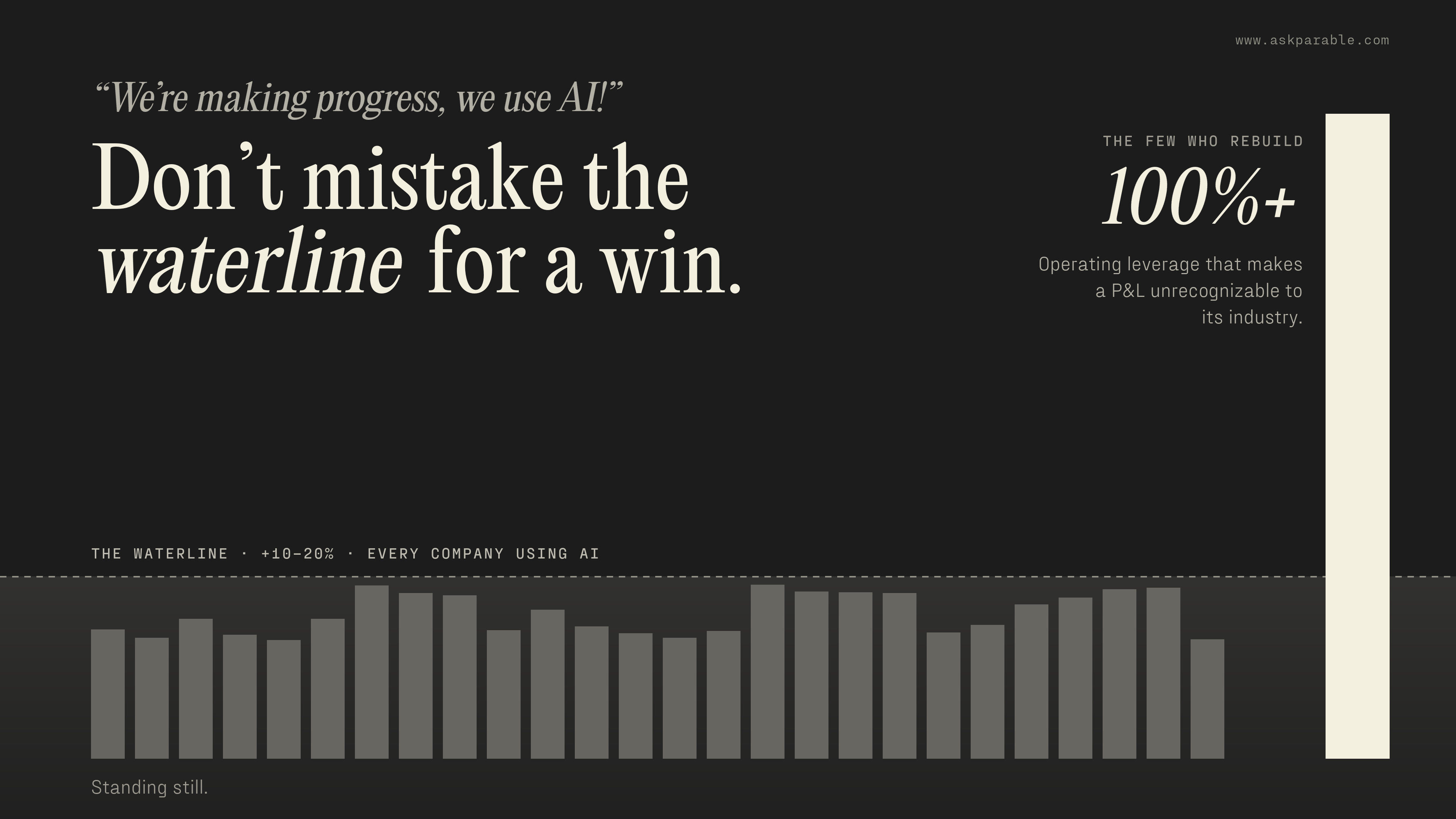
What I worry about, on behalf of executives, investors and boards is that when it comes to AI Transformation leadership will mistake the waterline for a win. Just ask any executive leadership team and they'll tell you what a great job they are doing with AI.
The nuance is that the gains they advertise might be real. But the same gains are available to every company in every industry. When everyone gets a little more operating leverage, nobody's position changes. That's the waterline: it rises for everyone, and standing on it approximates progress.
For many firms, even waterline gains might be the best case scenario. Torsten Slok, Apollo's chief economist, showed in October 2026 that revenue per worker and profit margins are rising for the seven largest tech companies and flat for the other 493 in the S&P 500. In a survey of about 9,000 executives published by the National Bureau of Economic Research the same month, firms put AI's contribution to their productivity growth at about 0.2 percent a year.
But the technology is there for the taking. My own view is that a firm in each industry will accomplish at least 100% more operating leverage, by which I mean the ability to double revenue without adding costs. The future is here, and nearly all of the S&P is crawling toward it while patting itself on the back. The ultimate winners will implement a total first principles shift in how work gets done.
At my own company Parable we've seen a 10x increase in October 2026 vs October 2025 in engineering tickets completed and in pull requests. These aren't vanity tickets. Features shipped per month that a human can actually use grew at the same rate, and over that same year my engineering team got smaller.
The labs report the same thing. Anthropic has reported publicly that by mid-2026 its engineers on average ship 8x as much code per quarter as they did between 2021-2025. OpenAI describes pull requests per engineer growing like a hockey stick, with roughly a 10x increase in load on its build and deploy systems. AI native firms are what the future of work looks like. But it's not news that AI is working in software engineering. The question is, why is it so much more impactful there than in other job functions?
On the Remote Labor Index, a set of real, non-coding freelance projects run by Scale AI and the Center for AI Safety measured how an agent performed on an end to end job. The best agent completed 2.5% of projects in October 2025, 16% in the July 2026 update, and 41% by November 2026. That's fast progress, and it shows the gap isn't intelligence. It's context, and the ability to verify the work. OpenAI's own GDPval paper notes that in real world work it often takes effort to figure out the full context of a task, and that the models struggled when they had to work that context out themselves. In software engineering, coding agents have the context. The codebase itself is a record of work, where AI can see the entire code base, not just the code native to the feature it's working on. And a coding agent can check its own work: it runs tests and loops until they pass. An agent doing a freelance design brief gets one shot and no signal. Coding gives AI both things it needs: context and verification.
So what's the equivalency of the codebase for the rest of the company? There is a record of work, it's just in a million pieces. It's in M365, CRM, meetings, decks, ERP and 50 more fragmented software tools. The fragmented record of work lives there, in unstructured data. For the rest of the organization to achieve the leverage engineering has two things have to change: the people and the data.
Part One: The People
It's well worth taking a step back and examining how companies are organized from first principles. Almost 200 years of management theory is predicated on coordination burden, communication burden and knowledge fragmentation. Alfred Chandler's account places the birth of modern management architecture in the American railroads around the 1850s. The railroads were geographically distributed and therefore could not be managed through owner oversight, so they invented hierarchical reporting, cost accounting, and the organizational chart as we know it. That technological revolution called for an entirely new way of working. So does this one.
No council, committee or single hire has the agency to rework 200 years of organizational design thinking. It starts at the top and it begs for aggression. Step one in this journey is to appoint your CEO as the Head of AI Transformation. Whatever structure sits underneath, and I'll get to a few options, the CEO owns the outcome. Without that, enterprise transformation is dead in the water.
Software engineering is already showing what the new org design looks like. Jeff Bezos famously popularized the two-pizza team: an engineering team should be small enough that it can be fed by two pizzas because every extra person adds coordination cost. It has been the gold standard of Silicon Valley organizaitonal design for over a decade. As Dan Shipper at Every has argued, AI has made this model is now obsolete. The new unit is the two-slice team: a pirate who charts the course and drives to a solution without asking permission, paired with an architect who turns pirate work into something scalable, platform compatible and secure. Their fleet of agents supply the range of skill sets required and the execution muscle. AI native firms run this way and those three actors can do more in a month than a team of eight very smart people over the same period.
The point is that AI isn't just a tooling change, it's an organizational design change.
Kmart adopted technology, too. An organizational design change means more than just technological adoption. In July 2000, Kmart's chairman and CEO, Chuck Conaway, told the market the company could "focus our resources and energies on expediting supply chain infrastructure improvements." That year Kmart committed $460 million to upgrade its information systems and $210 million to its distribution and logistics network, including new scanners in every store to speed up checkout. Eighteen months later, Kmart filed for Chapter 11.
Kmart did what a board would ask for. It bought the new technology, told the market and made the investment. Walmart used the same kind of scanner technology differently. It ran its supply chain on the data the new scanner technology produced, and it moved most of its goods through its own distribution centers. Walmart rebuilt how it operated around a new technology. Kmart bolted technology on to the way it already worked.
This is an old pattern the economist Paul David has written about. American factories took about forty years to see productivity gains from electricity, because they first bolted electric motors onto floor plans designed for steam. The gains arrived when they rebuilt the factory around the new power source. As famous as David's account has become, few companies are putting it into practice. Bolting AI on to your current operating model is easier, so that is what most companies will do. Kmart is what that looks like eighteen months later.
The Triangle of Sadness.
Unsurprisingly, the old organizational design system is preventing the new one from taking shape. What I call, 'The Triangle of Sadness' will stop most companies from effectively redesigning and ultimately from leveraging AI to its potential. Firms have done the sensible-looking thing. They hired a Chief AI Officer, Head of Transformation or gave the CIO the job, and told them to change how the company works. Then, that person runs into the org chart.
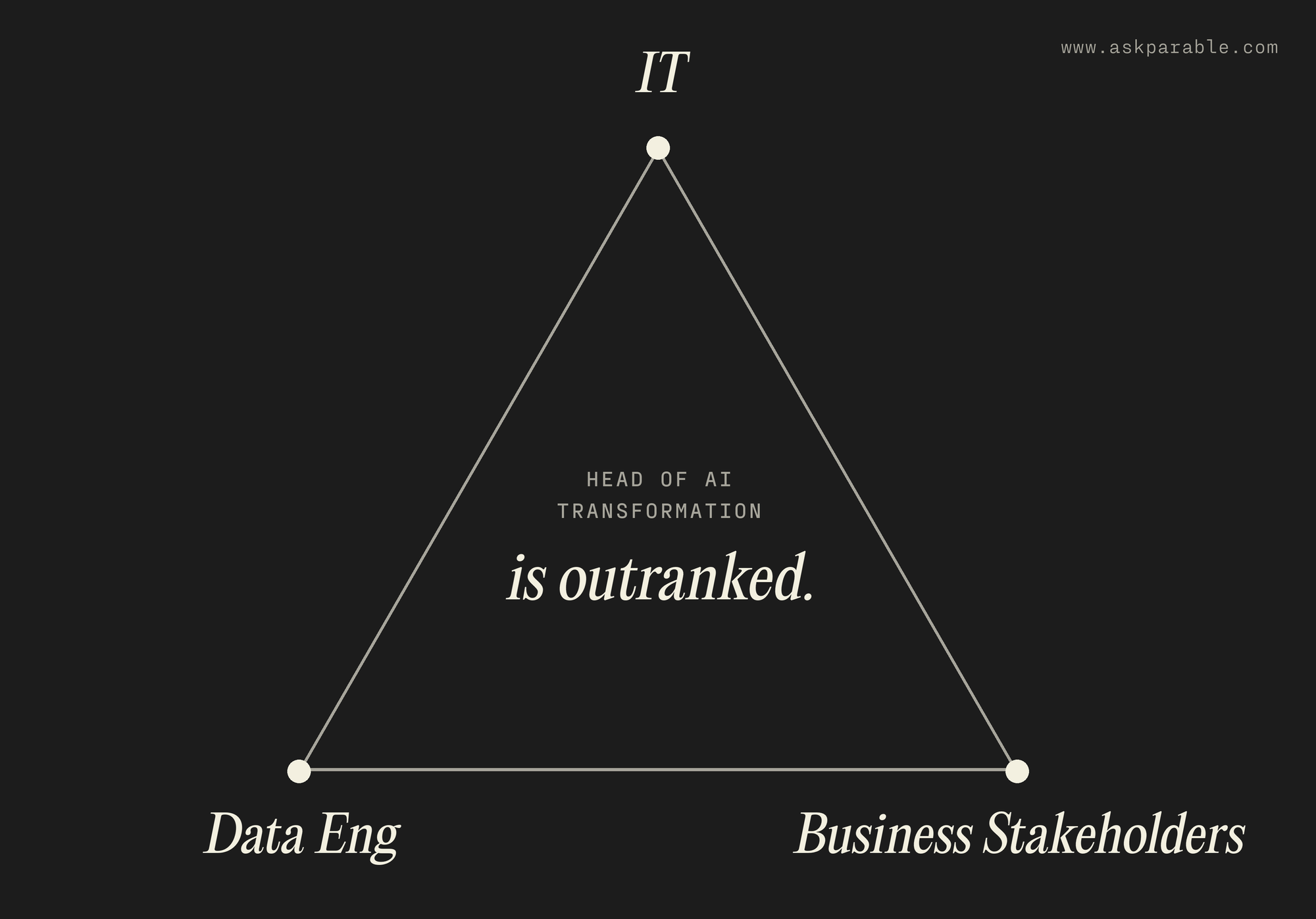
Data engineering controls how and where company data is modeled. Their literal job is to preside over and govern company data. IT decides which systems people can use and what data they can access from them. Business leaders run their functions and answer for the quarter. Everyone was busy before AI came along.
Nobody in that triangle is doing anything they aren't incentivized to do. The problem the one party incentivized to transform how the company works is outranked. Your Chief AI Officer doesn't own the data, doesn't own the systems and doesn't own the functional processes. They are more like an AI diplomat than an AI general. In the railroads, owners ceded control to local managers. Have we done the same for our AI Transformation leaders? This is why the CEO has to be in charge of transformation week to week.
When the transformation team proposes changes to how, for example, the sales team operates, the quarter comes first. The CRO can say no. Or, the CRO can use their own budget to buy an AI tool and bolt it on to their existing process, which then gets blocked by IT. Each choice makes sense in a vacuum. Added up across a company, you get a hodgepodge of AI use. You won't beat the waterline with this approach.
Nobody transforms themselves. Employees are already using AI and doing amazing things with it. But, they will add AI to the way they currently work because the systems and data they work inside leave them with no other option. They'll pave cow paths the best they can. Companies need someone thinking from first principles about how work should and could be done and that thinking needs to traverse teams and systems versus solving problems from inside silos. You can't ask one section musician to rewrite the entire symphony while they play. They know their part better than anyone, but not how the score comes together. You have to give someone a bird's eye view and a cross functional remit.
Until now, operations meant people using software tools to get work done. Moving forward, it means people and agents reacting to data, making decisions and taking action, hopefully rapidly. Your company operations will become a technology product itself, and technology products all have one thing in common: they have product managers. Product managers are trained for first principles thinking. They examine a problem, review data, triage different opportunities for ROI, design and deploy solutions to root causes, ship, measure and iterate. Most employees don't do this. They play their part. But this is the motion the rest of the enterprise will need to adopt to transform operations into a technology product. AI Transformation desperately needs ecosystem design thinking. AI works when it's directed to move vertically and horizontally through a problem space. Modern organizational design and the modern software stack are vertical. You have to break the paradigm.
Three popular models and the one I'd personally run:
- A central hub with authority. One team has authority over all cross company AI work. It delivers most of the work at first, then shares it with the business units, and finally hands delivery to them. BCG describes this model in its August 2026 guidance on AI hubs.
- Business-owned domains. Each area of the business has a business leader paired with a technology leader and together they own the value, the budget and the backlog for that area. This is the model in McKinsey's book Rewired. It puts the person who owns the number in charge of the AI outcome, which is designed to remove some of the conflict in the triangle.
- A CEO mandate with hard rules. The CEO sets company-wide rules that force the change. In April 2025, Shopify's CEO told teams to prove that AI could not do a job before asking for more headcount. This moves fast. The risks are scattered tools and measuring activity instead of value.
Each approach has flaws. In overly central teams, the hub becomes a bottleneck. It's difficult for them to meet the needs of the business and the central team rarely has enough sovereignty to influence the stakeholders in the triangle of sadness. In the business owned domain model duplicated tools, uneven progress between domains and short term thinking will rule. It's good for the quarter and bad for next year. The old world created the walls of the org chart and software tools were built to respect these walls. The goal is to destroy them and enable work to happen end to end, with less coordination burden and communication burden. Domain oriented AI Transformation will create domain specific silos progress antithetical to how AI works. The CEO mandate moves fast, but quickly stalls and fragments when the mandate makes contact with reality. It asks everyone to transform themselves.
A best of all worlds model would have a few key tenets:
- A central AI hub owned by the CEO.
- This central hub has agency and ownership of company data, systems and data access + budget. They don't coordinate with data and IT teams, they become the AI data team and the AI IT team. Existing teams keep running the systems of record and databases that help the company operate today and the hub takes the record of work, AI tooling and data access for agents. This will likely cause political distress from legacy teams. If you're not willing to experience some political distress, you will not succeed. This new team is responsible for producing a cross team, cross tool record of work that every function and every agent builds on. That record is 'the data' described in more detail in part two of this piece.
- Each business function needs a product manager but who reports into the central hub.
- The PM needs ownership and hard goals for the progress of a particular business function or team but you want reporting separation to avoid short term thinking. Ultimately these PMs report to the Chief AI Officer/Head of AI Transformation and up to the CEO, not their functional head.
- These PMs are empowered to "build product." That is, if they want to deploy an agent to automate a core workflow they have the right to do so in an experimental run, but if it breaks, they own that too. The key is that they are AI generals not AI diplomats. Any good PM will build strong relationships with their function, stakeholders and will have empathy for their user: the employees in their function.
- ROI
- Every agent should have a named owner who answers for its results and a unified framework for verification and measurement on top of a data layer for AI measurement. Too often AI ROI is what someone wrote in a deck after the fact. A record of work ensures a quantitative feedback loop.
- Compensation
- Few companies have yet to tie executive pay to any of this: in 2026, about 2 percent of US public company proxy statements included AI in executive incentives (Pearl Meyer). CEOs and their executives need to be compensated based on organizational redesign around AI specifically. Boards and especially investors would do well to enable this with their long term support.
I think in the end we'll find that building the models was the easy part. Changing how 10,000 people work is harder. Only one of those things is pure math.
In Part 2, we'll explore the data foundations enterprises need to build to empower people and AI to be successful.
Sources
- Anthropic, "When AI builds itself," The Anthropic Institute, June 2026.
- Gergely Orosz, "Inside OpenAI's agentic software factory," The Pragmatic Engineer, September 2026.
- Scale AI and Center for AI Safety, Remote Labor Index, arXiv 2510.26787, October 2025; CAIS update, July 2026; live leaderboard.
- OpenAI, GDPval, arXiv 2510.04374, October 2025.
- Alfred D. Chandler Jr., The Visible Hand, 1977.
- Dan Shipper, "The Two-slice Team," Every, February 2026.
- Torsten Slok, "No Signs of AI Payoff Outside the Tech Sector," Apollo, 24 October 2026.
- Yotzov, Barrero, Bloom et al., "Firm Data on AI," NBER Working Paper 34836, 2026.
- Kmart Corporation, Form 8-K, July 2000; Computerworld, "Kmart moves to catch up on IT," July 2000; Kmart Form 10-K, fiscal 2001.
- Paul A. David, "The Dynamo and the Computer," American Economic Review Papers and Proceedings, May 1990.
- BCG, "Why Your Organization Needs an AI Hub," August 2026. McKinsey, Rewired, 2023.
- Shopify CEO memo, April 2025, via TechCrunch.
- Pearl Meyer, "AI in Incentive Plans," Harvard Law School Forum on Corporate Governance, June 2026.