

On November 8, Nvidia’s board publicly expressed confidence in Jensen Huang. On November 11, it accepted his resignation as president, CEO, and a director, effective immediately. Nvidia announced the transition today, November 12.
A board can replace its CEO in a day. It cannot manufacture the years of independent judgment that should have preceded the decision.
The company announced that it appointed Colette Kress as interim CEO. She's been Nvidia’s CFO since 2013, and will retain both jobs while the board seeks a permanent successor. Harvey Jones, a director since 1993, was named board chair.
Nvidia’s leadership change may answer who runs the company now. However, it leaves investors entitled to a more consequential account: what directors knew, when they knew it, what evidence they demanded, and whether they had prepared the enterprise to outlast its founder.
The independent directors had named Joon H. Kim and Wachtell, Lipton, Rosen & Katz to investigate on November 10. The New York Times reported a separate relationship with an Nvidia executive on November 11. Huang has acknowledged infidelity and apologized. The espionage allegations remain contested; China has denied them.
The investigation must follow the evidence, including into the boardroom. Replacing the executive cannot substitute for examining how directors governed him.
At founder-led companies, commercial success can become a reason to defer on matters where the founder has a personal interest. Instead of asking for evidence, directors may begin defending the person they should be questioning.
Directors owe their loyalty to the corporation. The founder’s achievements do not make him an exception.
The wealth around the boardroom table
What does independence mean when the executive you oversee has led the company that accounts for billions of dollars in holdings associated with you and your family?
That question belongs near the center of Nvidia’s governance debate. Annual board fees matter, but they are small beside the financial history shared by Huang and several longtime directors. Investors are entitled to ask whether that history strengthens judgment or makes challenging him harder.
Nvidia first crossed $5 trillion in market value in October 2025. By the November 11, 2026 regular-session close, its share price was $173.73 and its market capitalization was approximately $4.20 trillion. Reuters reported that it slipped below $4 trillion on November 12. They show the scale of the institution whose oversight is at stake.
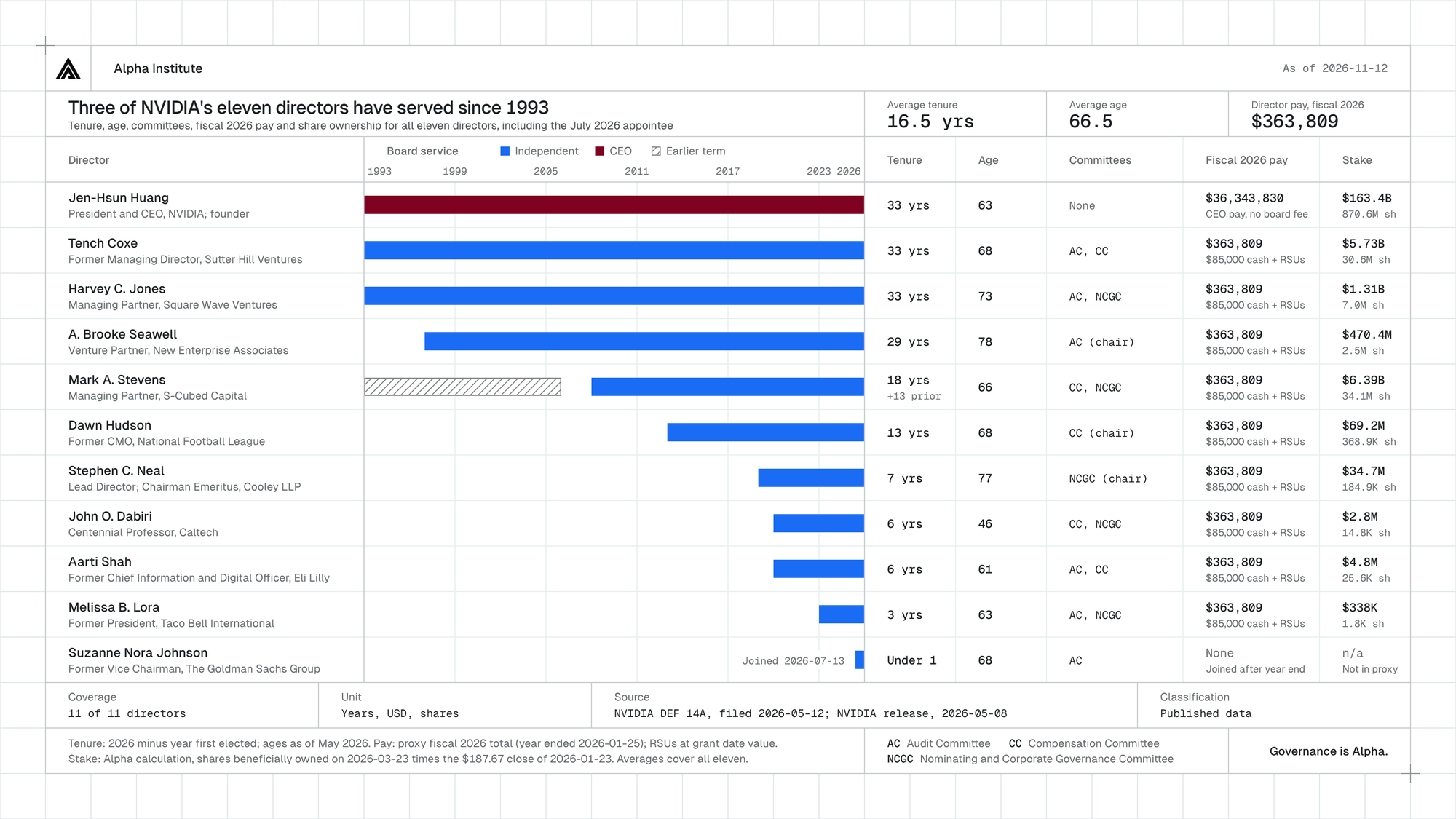
The 2026 proxy’s ownership table reports approximately 34.07 million shares beneficially owned by Mark Stevens, 30.56 million by Tench Coxe, 7.00 million by Harvey Jones, and 2.51 million by Brooke Seawell as of March 23. Applying the November 11 closing price to those disclosed holdings gives illustrative values of $5.92 billion, $5.31 billion, $1.22 billion, and $435 million, respectively. The first three total approximately $12.44 billion.
While these calculations reprice the March holdings, they do not establish what each director owned by November 2026. Beneficial ownership can include trusts, shared interests, foundation holdings, and shares issuable within 60 days. The figures are neither personal net worth nor realized gains. Stevens, for example, disclaims a financial interest in foundation shares included in his total. The proxy does not provide a complete history of acquisition costs, sales, gifts, or taxes from which lifetime gains could be calculated.
While the distinction matters, the fact is that several directors accumulated enormous equity exposure during his leadership. The question is whether that experience left them more capable of challenging him or more inclined to believe that challenging him would endanger everything they had helped build.
Thirty three years beside the founder
The May 2026 proxy lists ten director nominees. Three had served continuously since 1993: Huang along with Coxe and Jones. Seawell joined in 1997. Stevens first served from 1993 to 2006 and returned in 2008, giving him approximately 31 years of cumulative service by 2026.
The New York Times’s November 10 account supplies the history behind those dates. Stevens and Coxe joined when their firms backed Nvidia’s $2 million funding round in 1993. They stayed through early product failures and the risk that the company would not survive. Jones and Seawell came from Synopsys, an important supplier of chip-design software.
That shared history can produce informed conviction. It can also make a challenge to the founder feel like a repudiation of decisions that enriched investors and vindicated the board for decades. A director who has watched Huang repeatedly prove skeptics wrong still needs to recognize when that experience stops being relevant. Forecasting chip demand and evaluating a personal conflict require different evidence.
Nvidia’s fiscal 2026 compensation table reports $363,809 for each of the nine nonemployee directors nominated in the proxy: $85,000 in cash and $278,809 in grant-date stock-award value. Earlier director compensation programs targeted $340,000 annually in 2023, 2024, and 2025. Those annual figures should not be confused with the appreciation of investments held for decades.
A billionaire director may have little financial need to preserve a board fee. That can support independence. Large stockholdings also expose directors to the losses other shareholders suffer. Wealth does not establish dependence, and long tenure does not establish a fiduciary breach.
But financial security does not eliminate gratitude, personal allegiance, or attachment to a shared achievement. A director may fear that confronting the founder will damage the share price and the institution to which the director has devoted a career. The immediate cost of acting is visible. The longer-term cost of making another exception is easier to discount.
The relevant question is therefore not whether a wealthy director can be objective. It is whether the board has practices strong enough to test its own loyalties when objectivity becomes difficult. Who challenges the founder without losing access? Who insists on evidence that contradicts him? Who can recommend leave or replacement without first accepting his claim that the company cannot afford it?
Independent under the rules and independent in the room
Nvidia classified all nine nonemployee nominees as independent under Nasdaq standards. The proxy also makes a reasonable case for continuity: long-serving directors understand the business, while newer directors bring different expertise. Three of its nine independent nominees had joined since 2020. Annual elections, executive sessions, and individual director evaluations were part of the disclosed structure.
Nvidia’s Corporate Governance Policies make continuity a deliberate choice. The March 2025 document rejects term limits and mandatory retirement ages, relying instead on annual reviews of each director’s effectiveness. That approach can preserve valuable expertise. It also puts the burden on the review process to distinguish continuing contribution from continuing familiarity. What did those reviews establish about directors’ willingness to challenge Huang?
The responsibilities Nvidia put in writing
Nvidia’s governance statement says its board oversees management on shareholders’ behalf to serve their long-term interests. It identifies its codes, policies, and committee charters as the framework for doing so. The relevant question is whether that framework worked when enforcing it became uncomfortable.
The March 3, 2025 Nominating and Corporate Governance Committee Charter gives that inquiry a specific starting point. Section 10 assigns oversight of trade-compliance policies and risks. Section 14 covers the compliance program, investigation procedures, and management’s Compliance Committee. Section 11 assigns oversight of the processes used to provide information to directors. This committee was responsible both for overseeing important risks and for reviewing how information reached the board.
According to the May proxy, Jones and Stevens sat on that committee, chaired by lead director Stephen Neal. Did concerns about customers, exports, or executive conflicts reach it? If they did, what followed? If they did not, had directors tested whether the reporting process could escalate a concern involving the CEO?
The Audit Committee Charter adds responsibility for reviewing disclosure controls and, as appropriate, government correspondence and legal matters that could significantly affect financial results. It provides access to company records and personnel, authority to retain outside advisers, and private discussions with internal and external auditors. Those powers make the quality of the inquiry relevant: what information did directors request, and did they pursue gaps in management’s account?
Both committees also have responsibilities for reviewing code-of-conduct compliance. The governance committee’s separate authority over related-person transactions is specifically tied to SEC Item 404. A personal relationship does not automatically establish such a transaction. Directors should have counsel determine which rules apply while independently assessing the underlying conflict.
All three committee charters require meeting minutes to be kept and distributed to board members. The investigation can compare those records with briefing materials, information requests, and follow-up. Investors need an account of how the system operated, not another description of its design.
These documents do not establish that directors received a particular warning, disregarded it, or breached a fiduciary duty. They define responsibilities against which the evidence can be assessed. Oversight is distinct from preparing disclosures, conducting audits, or running the business. But when a board gives committees authority to obtain information and review risks, the inquiry must examine whether they exercised it effectively.
Jones’s appointment as chair brings deep institutional knowledge to the transition. It also means that any review of his earlier decisions must be overseen independently of him. A board cannot credibly examine its own conduct if the directors whose decisions are being reviewed control the scope or conclusions.
Huang did not have Zuckerberg-style supervoting shares. His disclosed March ownership was 3.58%. Nvidia illustrates how a founder can become difficult to challenge without controlling a majority of the vote. Expertise, relationships, financial history, and perceived indispensability can exert their own pressure.
Did Nvidia’s board act too slowly?
Three days elapsed between the board’s public expression of confidence and its acceptance of Huang’s resignation. That interval alone cannot establish whether directors acted responsibly. The oversight clock starts when a material concern reaches the board, or when a functioning reporting system should have brought it there.
An independent review should reconstruct the first relevant warning, its escalation through legal or compliance, the notice given to directors, and each decision to act or wait. It should distinguish information available at the time from facts learned later. The public record does not yet establish that chronology.
The November 8 confidence statement deserves close examination. What had directors verified? What remained unknown? Nvidia’s board said it had no reason to believe national security or company secrets were compromised. Was that assurance grounded in a defined review, or in the absence of information that the investigation had only begun to seek?
These are different evidentiary positions. Investors should not have to guess which one supported a board’s statement.
A prompt investigation followed by a change of judgment can be responsible governance. Previously ignored warnings would tell a different story. Neither the resignation nor the appointment of respected counsel resolves that distinction.
National security makes the information question harder to dismiss
Reuters relayed The Information’s allegation that the relationship aided at least $7.5 billion in Nvidia chip shipments to China. It also relayed reporting that Secretary of State Marco Rubio had briefed President Trump about intelligence concerning the relationship. The White House disputed that account; Reuters could not independently verify the underlying reports. These are serious allegations, not established findings that the affair caused unlawful sales or that Nvidia’s directors knew of wrongdoing.
In their November 11 records-preservation letter, Senators Elizabeth Warren and Chris Coons sought documents concerning chip exports and the reported intelligence operation. The letter establishes congressional scrutiny. It does not establish that the board received the intelligence reportedly available to government officials.
The board inquiry must connect those separate information trails. Did anyone communicate a government warning to Nvidia? Who received it? Did export-control concerns involving Megaspeed reach independent directors? Did the CEO participate in decisions affecting a customer associated with someone with whom he had a personal relationship, and was that conflict disclosed and managed?
Government approval of a shipment would not, by itself, resolve questions about a personal conflict, the destination of other shipments, or the accuracy of corporate assurances. Directors need evidence about the transactions and the review process. They cannot infer that all is well because another institution had some responsibility.
The proposed shareholder lawsuit raises the related disclosure issue: did public statements about Megaspeed reflect what the company actually knew? The appropriate test is the evidence available when each statement was made. A complaint is an allegation, and a subsequent share-price decline is not proof of deception.
What fiduciary duty demands when the founder is the risk
Management runs the business. Directors choose and oversee the CEO, challenge strategy, scrutinize major uses of capital, and ensure material risks receive attention. Their responsibility includes replacing leadership when the company’s interests require it.
Duty of care requires sufficiently informed judgment. Directors need to obtain relevant information, question material assumptions, consider alternatives, and follow up. Duty of loyalty requires them to act for the corporation and its stockholders rather than a conflicting personal interest. These are foundational Delaware principles; their application and remedies depend on the governing law and facts.
Long service, gratitude, and admiration do not automatically establish a legal conflict. They can nevertheless make the exercise of independent judgment harder. A director can sincerely believe in a founder and still owe the company a decision the founder will dislike.
A bad outcome does not establish a fiduciary breach. The business judgment rule generally protects informed, good-faith decisions by directors without disqualifying conflicts. But avoiding legal liability is a poor ambition for a board entrusted with the future of a consequential company.
Delaware’s oversight doctrine sets a particularly demanding liability threshold. Under Stone v. Ritter, the relevant failures include an utter failure to establish reporting or control systems, or a conscious failure to monitor them, with the required showing of bad faith. Poor oversight and legally actionable misconduct are not interchangeable. Shareholders can demand better governance without claiming that a court has already found a breach.
An investigation involving an employee relationship also requires immediate attention to authority. A CEO can influence witnesses’ careers, pay, and access to information. Directors should document their decision about leave, reporting lines, evidence preservation, and restrictions on contact or decision-making. Continued service requires effective safeguards, not simply confidence in the executive’s importance.
Facts, policies, and investigation needs differ. Intel accepted Brian Krzanich’s resignation in 2018 after an investigation confirmed a policy violation, and McDonald’s terminated Steve Easterbrook in 2019 after finding an employee relationship violated company policy. Technology itself is no exemption. The harder problem is a board that believes it cannot afford to enforce its standards against one person.
Succession planning is the board’s responsibility
The Times reported that former Nvidia executives had discussed succession planning over the years, but Huang resisted. Rene Haas, who worked at Nvidia from 2006 to 2013 and later became Arm’s CEO, said in a 2024 interview that Huang believed such planning could create competition among executives and become divisive.
That account does not prove that no confidential succession plan existed in November 2026. It makes the question more specific: what did directors do when the founder reportedly opposed preparing for his replacement? Did they require a process, assess candidates independently, and revisit progress? The board’s records should answer those questions.
Kress’s appointment demonstrates emergency continuity. Investors still need confidence in the work behind it: the authority transferred, the responsibilities redistributed, and the leadership bench available for the permanent appointment.
Nvidia’s Corporate Governance Policies expressly require the board to receive and review periodic updates on senior management development. The Compensation Committee Charter also assigns oversight of human-capital strategies, including development and retention. Neither provision establishes that a tested CEO succession plan existed. Together, they give investigators a basis for asking what leadership-development work directors actually reviewed.
A credible process covers three tasks. Emergency succession identifies who takes charge immediately. Leadership development prepares candidates over time. Long-term succession defines the capabilities the next CEO will need to execute the strategy. Completing the first does not establish readiness on the other two.
The questions for directors are concrete. When did they last assess candidates without Huang present? Which operating decisions and external relationships depended on him personally? Had other executives been given enough responsibility to demonstrate readiness? How will the CFO’s work be covered while Kress holds both offices?
The Times also reported that Huang had more than 60 direct reports and that many senior executives led particular products or technologies rather than broad operating businesses. Such a structure can speed decisions and keep a technically gifted founder close to the work. It can also leave fewer executives with experience running the enterprise as a whole.
Directors should ask whether they accepted a structure that concentrated decisions around Huang while limiting opportunities for others to develop. If so, the difficulty of replacing him would partly reflect organizational choices the board had allowed to persist. Succession planning includes giving potential leaders the responsibility to become credible candidates.
The compensation charter already recognizes a basic limit on founder authority: the CEO cannot attend deliberations or voting on his own compensation. It also gives the committee responsibility for compensation-risk reviews and recovery policies. The board should apply comparable independence of judgment to leadership development and conflicts, while assessing any compensation recovery under the actual policy and applicable law. A resignation alone does not establish grounds for a clawback.
The Times further reported substantial roles for Huang’s children and son-in-law, and an impression among some employees that his children might eventually succeed him. That impression is not evidence of a designated family successor or improper hiring. It is a reason for independent directors to insist on documented qualifications, appropriate conflict review, and a succession process that compares family members and other candidates against the same requirements.
Three former employees also told the Times that Huang viewed the board principally as a governance requirement. Their account is not a finding about how every director behaved. But it poses a direct question: had the board established authority the founder respected when their judgments diverged?
A company’s dependence on its founder is not simply an argument for keeping him. It is a risk directors are responsible for reducing. The more power and knowledge accumulate around one executive, the more deliberate the board must be about developing leadership beyond him.
Meta: when the founder controls the vote
Mark Zuckerberg’s position illustrates a different source of founder power. Meta’s November 2026 information statement reports him with 60.6% of voting power, measured as of October 1. Class B shares carry ten votes each; Class A shares carry one.
Zuckerberg’s voting position limits outside shareholders’ ability to change the board through an ordinary contested vote. Directors therefore carry a responsibility that minority shareholders cannot readily enforce at the ballot box. Nomination by a controller does not make a director the controller’s personal representative.
That structure also affects how investors should assess accommodations for the founder. Meta’s 2026 proxy describes permission for Zuckerberg to pledge shares for personal borrowing, with limits of 20% of his holdings pledged and borrowing of no more than 5% of their fair market value at the time. It disclosed 12 million Class B shares pledged as of April 1.
The disclosed arrangement concerns personal borrowing secured by shares. It does not establish that Meta made Zuckerberg a real estate loan. The board cited his assets and repayment capacity among its safeguards. The governance question is whether those safeguards are independently tested, and whether directors can reject an expansion or withdraw permission when circumstances change.
A more recent capital-structure decision brings the tension into sharper focus. Meta’s November 2 filing describes approved nonvoting Class C shares scheduled to become effective January 19, 2027. Its rationale includes financing flexibility and retaining Zuckerberg at California headquarters amid potential wealth-tax exposure.
Nonvoting shares can provide liquidity while preserving voting control. Directors must weigh the corporate benefit against the consequences for other shareholders and examine credible alternatives. Retaining a founder may have substantial value. Treating every accommodation necessary to retain him as self-justifying would leave the board with little judgment to exercise.
Tesla: who negotiates for the company?
Shareholders approved Musk’s 2025 performance award with more than 75% support. The potential headline value approached $1 trillion over a decade, subject to demanding milestones. Tesla described a maximum market-capitalization target of $8.5 trillion alongside operational requirements. The award is neither an immediate payment nor guaranteed compensation.
The shareholder vote deserves respect. Many investors knowingly support extraordinary terms for Musk. Directors still owe them a defensible negotiation: what alternatives were assessed, what incentive was needed given his existing ownership, and what commitments Tesla secured on attention and competing interests.
The litigation over the earlier award shows why process deserves its own scrutiny. In 2024, Delaware’s Court of Chancery rescinded Musk’s 2018 compensation package after findings concerning control, process, and fairness. In December 2025, the Delaware Supreme Court reversed the rescission on remedy grounds without resolving the contested liability questions. The award was restored. That was not a blanket endorsement of the original negotiations.
The lesson is not that a large award is necessarily improper. It is that ambition in the performance targets cannot compensate for weakness in the bargaining. If the board begins with the assumption that the founder must be retained at almost any cost, it has surrendered its strongest negotiating position.
What would show that a board had stopped giving the founder a pass?
These companies have different ownership structures and face different allegations. They should not be treated as a single legal case. Each board, however, must demonstrate that the founder’s commercial importance has not displaced independent judgment.
For Nvidia, that means supporting Kress and conducting a credible search for a permanent CEO. The investigation must also be able to examine the board’s own decisions, with directors recusing themselves where appropriate. If the evidence reveals deficient controls or inaccurate disclosures, the board must correct them and explain the material findings shareholders need to assess its response.
Confidentiality and legal privilege will constrain what can be published. They should not become a blanket explanation for why investors must simply trust the institution whose oversight is under examination.
The growing use of autonomous systems makes this discipline more consequential. Boards will increasingly oversee decisions executed through delegated authority at speed. They need reliable information, enforceable limits, and people empowered to intervene. A board that hesitates to question its most powerful human decision-maker has an accountability problem to resolve before delegating authority further.
Founders deserve credit for building extraordinary companies. Directors are responsible for ensuring those companies can withstand a founder’s mistakes, departure, or resistance to scrutiny. That responsibility becomes tangible in the information directors demand, the decisions they make, and the standards they enforce.
Every board should compare its own governance commitments with the evidence of what it does. The next meeting should move beyond whether a policy exists to who exercised the authority, what information they obtained, and what changed as a result. These six actions make that examination concrete.
Actions for the next board meeting
- Reconstruct the knowledge timeline. Have independent counsel identify material warnings, recipients, decisions, and follow-up. Compare government communications and compliance findings with committee minutes, briefing materials, and requests for further information. Separate evidence available at the time from hindsight.
- Test succession beyond the interim appointment. Require an emergency authority map, evidence of leadership development, and a permanent CEO specification tied to strategy. Review each without the incumbent controlling the discussion.
- Ask for the evidence behind public assurances. Select a public statement about compliance or security. Determine what reviewers actually examined, what remained unknown, whether conflicts affected the work, and who approved the wording.
- Subject the board to independent scrutiny. Compare the board’s actual work with its policies and committee charters. Identify who can investigate directors’ conduct independently, when recusals are required, and what findings and corrective actions can appropriately be disclosed.
- Review founder exceptions and director ties. Examine long tenure, financial exposure, and personal relationships in the context of actual decisions. For special compensation, pledging permissions, or other accommodations, record the corporate benefit, alternatives, conditions, review date, and authority to withdraw approval.
- Test whether bad news can bypass the CEO. Ask internal audit to verify that sensitive concerns reach independent directors safely and promptly. Assign remedial work to named owners and require evidence of completion.
The more indispensable a founder appears, the more independent the board must be. Directors owe their loyalty to the company, including when protecting it requires confronting the person who built it.


